The Troubles
The Troubles was a thirty-year conflict in Northern Ireland between republican paramilitaries seeking a united Ireland, chiefly the Provisional IRA, loyalist paramilitaries determined to keep the province in the United Kingdom, and the British Army and Royal Ulster Constabulary. It grew out of civil rights protests and street violence in 1968-69, brought the British Army onto the streets in Operation Banner, and combined bombings, shootings and assassinations in Northern Ireland, the Republic of Ireland, England and mainland Europe. Roughly 3,500 people were killed, more than half of them civilians, before the ceasefires of the 1990s and the Good Friday Agreement of 10 April 1998.
Also known as Northern Ireland conflict, Northern Ireland Troubles, Na Trioblóidí, Operation Banner, The Long War, Northern Irish conflict, The Conflict in Northern Ireland, Irish Troubles
Background
Ireland was partitioned in 1921 and Northern Ireland, with a Protestant and unionist majority, stayed in the United Kingdom. Its Catholic and nationalist minority faced discrimination in housing, jobs and voting. In 1968 the Northern Ireland Civil Rights Association began marching for reform. A march in Derry on 5 October 1968 was broken up by the Royal Ulster Constabulary, and months of marches and rioting followed. In August 1969 fighting in Derry's Bogside spread to Belfast, where streets were burned out and people were shot. On 14 August the British government sent troops onto the streets in Operation Banner. The IRA, almost dormant until then, split in 1969-70, and the Provisional IRA emerged as the larger, more militant wing intent on forcing a British withdrawal.
The War
Internment without trial, introduced on 9 August 1971, was aimed almost entirely at the nationalist community and drove recruits to the Provisionals. On 30 January 1972, Bloody Sunday, soldiers of the Parachute Regiment shot dead thirteen unarmed civil rights marchers in Derry. That year was the worst of the conflict, with nearly 500 dead: the IRA bombed commercial targets across the province and on Bloody Friday set off about twenty bombs in Belfast in one afternoon. The campaign extended to England from 1973, with pub bombings in Guildford and Birmingham in 1974 and later attacks on Brighton, London, Warrington and Manchester. Loyalist groups, chiefly the UVF and UDA, answered with sectarian killings of Catholics and with the Dublin and Monaghan bombs of May 1974, which killed 33 people.
From 1976 the government pursued Ulsterization, putting the RUC and the Ulster Defence Regiment in front with the regular army in support. The British SAS was publicly committed to South Armagh in the same year. The IRA reorganized into small cells for a long war; in the 1981 hunger strikes Bobby Sands and nine others died, and republicans won large electoral support. In 1985-86 Libya shipped the IRA around 120 tons of arms, including AKM rifles and Semtex explosive; a fifth and larger cargo aboard the Eksund was seized in 1987. The SAS killed eight IRA members at Loughgall in May 1987 and three more in Gibraltar in March 1988. The IRA declared ceasefires in August 1994 and, after a break, in July 1997; loyalists followed. The Good Friday Agreement of 10 April 1998 set up a power-sharing government and a process for decommissioning weapons.
Weapons
The British Army began with the L1A1 SLR, its version of the FN FAL, and replaced it with the L85A1 from the mid-1980s. Patrols also carried the Sterling Submachine Gun, the Browning Hi-Power pistol and the L7 general purpose machine gun. Rubber and later plastic baton rounds killed seventeen people. The RUC carried Ruger revolvers and Sterlings. The IRA began with old Thompson submachine guns and M1 carbines, then obtained the Armalite AR-18 and AR-15 rifles from the United States in 1970-71. The RPG-7 appeared in 1972, and M60s stolen from a US National Guard armory in 1976 were fired at helicopters and patrols. The AKM, a modernized AK-47, became the standard republican rifle after the Libyan shipments, and Semtex replaced home-made explosive in bombs, mortars and booby traps. The IRA built its own mortars and made the car bomb a routine weapon. Loyalist groups were armed mostly with pistols and shotguns until 1987, when a shipment of Czech vz. 58 rifles, pistols and grenades was divided among the UDA, UVF and Ulster Resistance.
Aftermath
About 3,500 people died: roughly half civilians, a third members of the security forces, and the rest paramilitaries. Dissident republicans continued on a small scale, and the Real IRA's Omagh bomb of August 1998 killed 29 people. The IRA declared its campaign over in 2005 and decommissioned its arsenal, and Operation Banner ended on 31 July 2007. Northern Ireland remains divided but has been governed under the 1998 settlement.
Weapons used
-
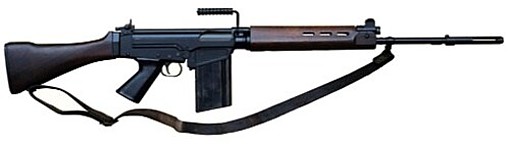
FN FAL
As the L1A1 SLR, the British Army's rifle for the first half of the conflict, carried on street patrols and rural operations until the… Continued…
-
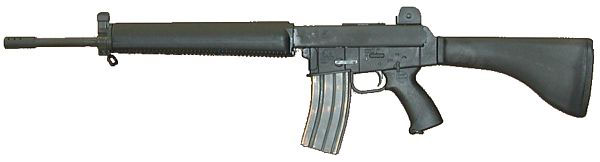
Armalite AR-18
Obtained by the Provisional IRA from the United States in 1970-71 and so closely tied to the campaign that 'Armalite' became a byword for… Continued…
-
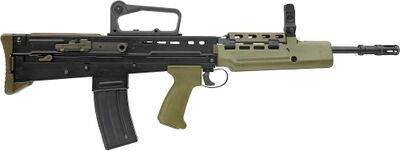
L85A1
Replaced the SLR in British Army units in Northern Ireland from the mid-1980s and served through the ceasefires and beyond. Continued…
-
AK-47
AKM rifles shipped from Libya in 1985-86 became the standard republican rifle for the last decade of the conflict. Continued…
-
Sterling Submachine Gun
Carried by British soldiers in vehicles and on urban patrols and by RUC officers; some were also stolen or captured by paramilitaries. Continued…
-
Browning Hi-Power
The British Army's service pistol, carried by officers and plain-clothes personnel; Brownings also reached loyalist groups in the 1987… Continued…
-
FN MAG
As the L7 general purpose machine gun, mounted on vehicles and at rural bases and checkpoints in South Armagh and Fermanagh. Continued…
-
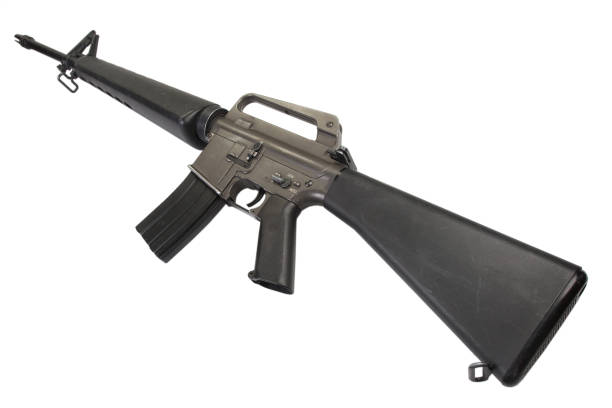
M16 RifleFor sale
AR-15 and M16 rifles were smuggled from the United States alongside the AR-18 and used by the IRA in sniping and ambushes. Continued…
-
Thompson Submachine Gun
Old IRA stocks of Thompsons were the Provisionals' main automatic weapon in 1969-71 before American rifles arrived. Continued…
-
M1 Carbine
Another early IRA weapon drawn from pre-1969 stocks and Irish-American supply, used in the first years of the campaign. Continued…
-
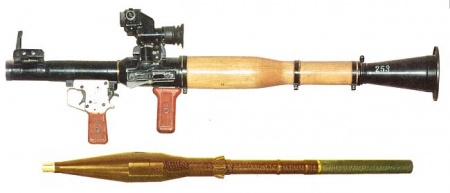
RPG-7
First used by the IRA in 1972 and supplied again from Libya, fired at armored vehicles, police stations and army posts. Continued…
-
M60 Machine Gun
Seven M60s stolen from a US National Guard armory in 1976 reached the IRA and were used in attacks on patrols and helicopters. Continued…
Sources
David McKittrick and David McVea. Making Sense of the Troubles. Penguin, 2012.
Richard English. Armed Struggle: The History of the IRA. Macmillan, 2003.
Ed Moloney. A Secret History of the IRA. Penguin, 2002.
Toby Harnden. Bandit Country: The IRA and South Armagh. Hodder & Stoughton, 1999.
Suggest an edit · account required · reviewed before publishing · how it works