RPG-7
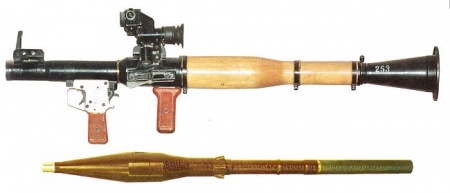
The RPG-7 is a Soviet shoulder-fired, reusable anti-tank grenade launcher adopted in 1961 and the most widely used weapon of its kind in the world. A simple steel tube fires a rocket-assisted grenade, usually the 85mm PG-7V shaped-charge warhead, which can pierce the armor of many tanks. Cheap, rugged and easy to use, it has been built by the millions in the Soviet Union and many other countries, and it has fought in nearly every war since Vietnam — from Afghanistan and Mogadishu to Iraq and Chechnya.
Also known as RPG-7, RPG-7V, Ruchnoy Protivotankovy Granatomyot, B41, Type 69, PG-7V
Origins
The German Panzerfaust of the Second World War showed that a single infantryman could destroy a tank with a disposable shaped-charge launcher, and the Soviet Union followed it with the reusable RPG-2 in 1949. Its successor, developed by the GSKB-47 bureau (later Bazalt) and adopted in 1961, was the RPG-7 — Ruchnoy Protivotankovy Granatomyot, "hand-held anti-tank grenade launcher." It was designed to give each Soviet infantry squad its own anti-tank weapon (see Soviet Union Arms & Weapons).
Design & Construction
The launcher is a steel tube about 40mm in diameter and 37 inches long, with a pistol grip, a trigger mechanism, a heat shield, and a flared venturi at the rear to vent the back-blast. It weighs about 15 pounds unloaded and is fired from the shoulder, with a 2.7x PGO-7 optical sight or iron sights. The grenade's warhead is larger than the tube and sits in front of the muzzle. A small charge throws it out of the tube, and after about ten meters a rocket motor ignites to carry it to the target, while fins unfold to stabilize it. The standard PG-7V warhead is an 85mm shaped charge able to penetrate about 260mm of steel armor, and later tandem warheads were designed to defeat reactive armor. Fragmentation and thermobaric warheads were added for use against infantry and buildings. The effective range against a moving vehicle is about 200 meters. Crosswinds push the rocket off course, and aiming requires practice, but the basic weapon is cheap and nearly indestructible.
Combat Use
The RPG-7 was supplied to Soviet allies and liberation movements around the world. In the Vietnam War the North Vietnamese Army and Viet Cong used it, often under the designation B41, against American armored vehicles, bunkers and patrol boats on the rivers, alongside the American M79 Grenade Launcher on the other side. It was the weapon of the Arab armies in the wars of 1967 and 1973, of the mujahideen against Soviet armor in Afghanistan in the 1980s, and of the Chechens against Russian tanks in Grozny in 1994-95. In Mogadishu in 1993, Somali militiamen with RPGs brought down two American Black Hawk helicopters, the event recounted in Black Hawk Down. It was used against American and allied forces throughout the Global War on Terror era in Iraq and Afghanistan, often alongside the AK-47.
Legacy
More than nine million RPG-7s are estimated to have been made, including copies built in China as the Type 69 and in many other countries, and it is in service with dozens of armies and countless irregular forces. Like the AK-47, it has become a symbol of the guerrilla and insurgent wars of the late twentieth century. Armies have spent decades developing cage armor, reactive armor and active protection systems to defeat it.
Sources
Rottman, Gordon L. The Rocket Propelled Grenade. Osprey Publishing, 2010.
Jane's Infantry Weapons. Jane's Information Group, annual editions.
Bowden, Mark. Black Hawk Down: A Story of Modern War. Atlantic Monthly Press, 1999.
Suggest an edit · account required · reviewed before publishing · how it works