Historical Context
UN Intervention in Somalia
The international military intervention in Somalia during the civil war and famine that followed the fall of Siad Barre. It ran through three missions: the small UN observer force UNOSOM I, the US-led Unified Task Force (UNITAF, Operation Restore Hope) and the larger UN mission UNOSOM II. The Battle of Mogadishu in October 1993 led to the withdrawal of American and then all UN forces.
1992 – 1995
Overview
The government of Somalia collapsed in January 1991 when rebel movements drove out President Siad Barre, who had ruled since 1969. The victors then fought each other. In Mogadishu the forces of Ali Mahdi Muhammad and Mohamed Farrah Aidid, rival leaders of the same movement, divided the capital. Fighting and drought produced a famine in the south that killed perhaps 300,000 people, though estimates vary.
The United Nations set up a first mission, UNOSOM I, in April 1992. Its few hundred Pakistani troops, who arrived later in the year, could not protect food convoys from armed gangs. In December 1992 the Security Council authorized a much stronger force led by the United States. This Unified Task Force, or UNITAF, began landing at Mogadishu on 9 December in what the Americans called Operation Restore Hope. At its height it had about 37,000 troops from more than twenty countries, roughly 25,000 of them American. It secured the ports, airfields and roads, and the famine eased.
On 4 May 1993 UNITAF handed over to a new UN mission, UNOSOM II, which had fewer troops and a far more ambitious task: to disarm the factions and help restore a national government. Aidid saw this as aimed at him. On 5 June his militia attacked Pakistani peacekeepers in Mogadishu and killed 24 of them. The Security Council called for the arrest of those responsible, and the mission became a hunt for Aidid. In August the United States sent a special operations force, Task Force Ranger, on a mission codenamed Operation Gothic Serpent. Its seventh raid, on 3 October 1993, became the Battle of Mogadishu.
President Clinton then ordered American forces out, and the last left in March 1994. The remaining UN troops withdrew by early March 1995, covered by an international naval force. Somalia was left without a central government.
Arms of the Intervention
The intervention set well-equipped regular forces against clan militias armed from the stockpiles of the old Somali army, which had been supplied first by the Soviet Union and later by the West. The militias' main weapons were the AK-47 and the RPG-7, along with machine guns, mortars and recoilless guns. Their best-known weapon was the "technical", a pickup truck or four-wheel-drive car with a heavy machine gun or other weapon mounted in the back.
American infantry carried the M16 Rifle, the M249 Squad Automatic Weapon and the M60 Machine Gun, with the Beretta M9 as the standard sidearm and the M67 Grenade as the standard hand grenade. They wore the Kevlar PASGT Helmet and body armor. Helicopters gave the UN forces their mobility and much of their firepower, and their vulnerability to rocket-propelled grenades over a crowded city was the hard lesson of October 1993.
Why It Mattered
The intervention showed both what armed humanitarian relief could do and where it could lead. UNITAF's limited mission saved many lives. The wider mission that followed drew the UN into a war with one faction that it had neither the forces nor the political backing to win.
The losses in Mogadishu changed American policy. In May 1994 the Clinton administration issued new, much stricter conditions for taking part in UN peace operations, and Washington's reluctance to become involved in Rwanda that spring is often linked to the experience of Somalia. For Somalia itself the withdrawal was followed by many more years of conflict.
Battles & Operations
Weapons
-
AK-47
The AK-47 is the most produced firearm in human history: Mikhail Kalashnikov's gas-operated assault rifle in 7.62x39mm, built around loose… Continued…
-
Beretta M9
The Beretta M9 is the 9 mm semi-automatic pistol adopted by the United States armed forces in 1985 to replace the .45 caliber M1911A1. It… Continued…
-
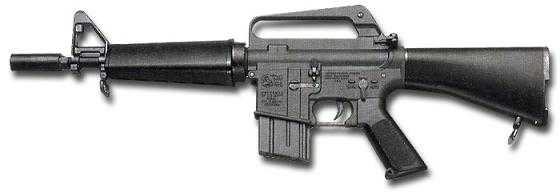
CAR-15
CAR-15 was Colt's name, from the mid-1960s, for a family of weapons built on the AR-15 and M16 rifle, and soldiers came to use it for the… Continued…
-
M14 Rifle
The M14 was the United States' last wooden-stocked battle rifle: a select-fire development of the M1 Garand chambered for the new 7.62mm… Continued…
-
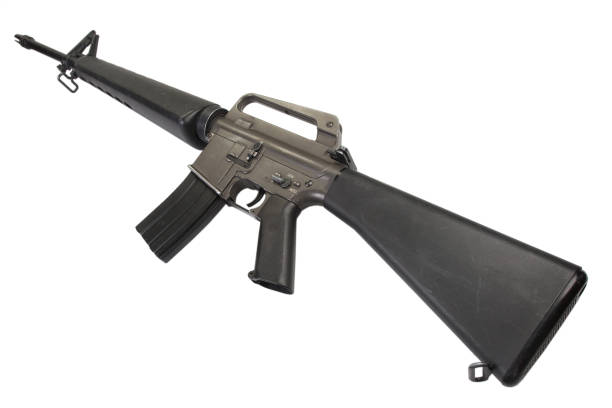
M16 Rifle
The M16 brought the assault rifle to the West: Eugene Stoner's AR-15 design in 5.56mm, built of aluminum forgings and polymer around a… Continued…
-
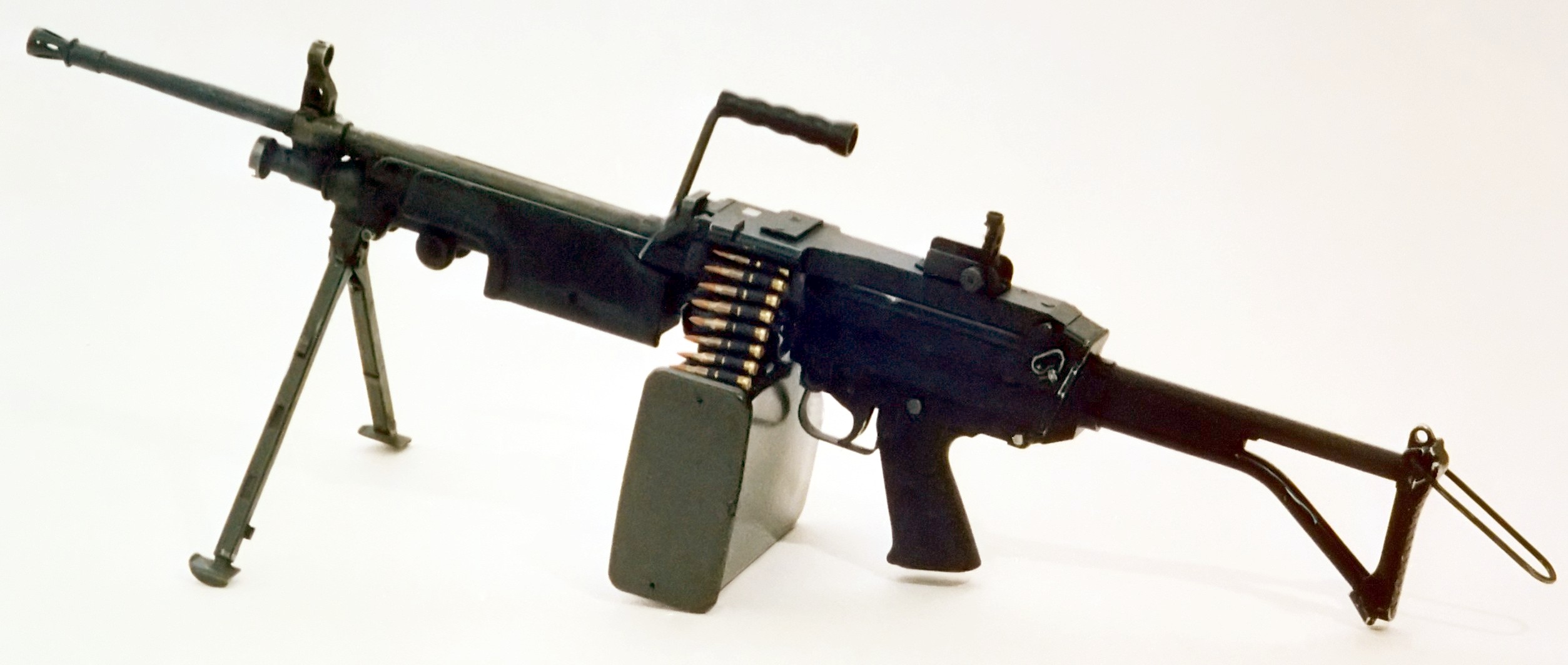
M249 Squad Automatic Weapon
The M249 Squad Automatic Weapon is the American version of the Belgian FN Minimi: a gas-operated, belt-fed 5.56mm light machine gun light… Continued…
-
M67 Grenade
The M67 is the standard fragmentation hand grenade of the United States armed forces. Adopted in the late 1960s, it is a smooth steel… Continued…
-
PASGT Helmet
The PASGT helmet was the standard combat helmet of the United States armed forces from the early 1980s until the mid-2000s. Its name stands… Continued…
-
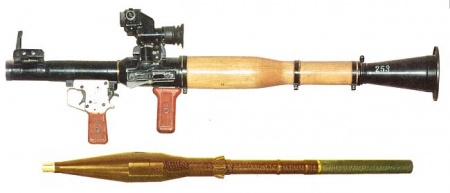
RPG-7
The RPG-7 is a Soviet shoulder-fired, reusable anti-tank grenade launcher adopted in 1961 and the most widely used weapon of its kind in… Continued…