M249 Squad Automatic Weapon
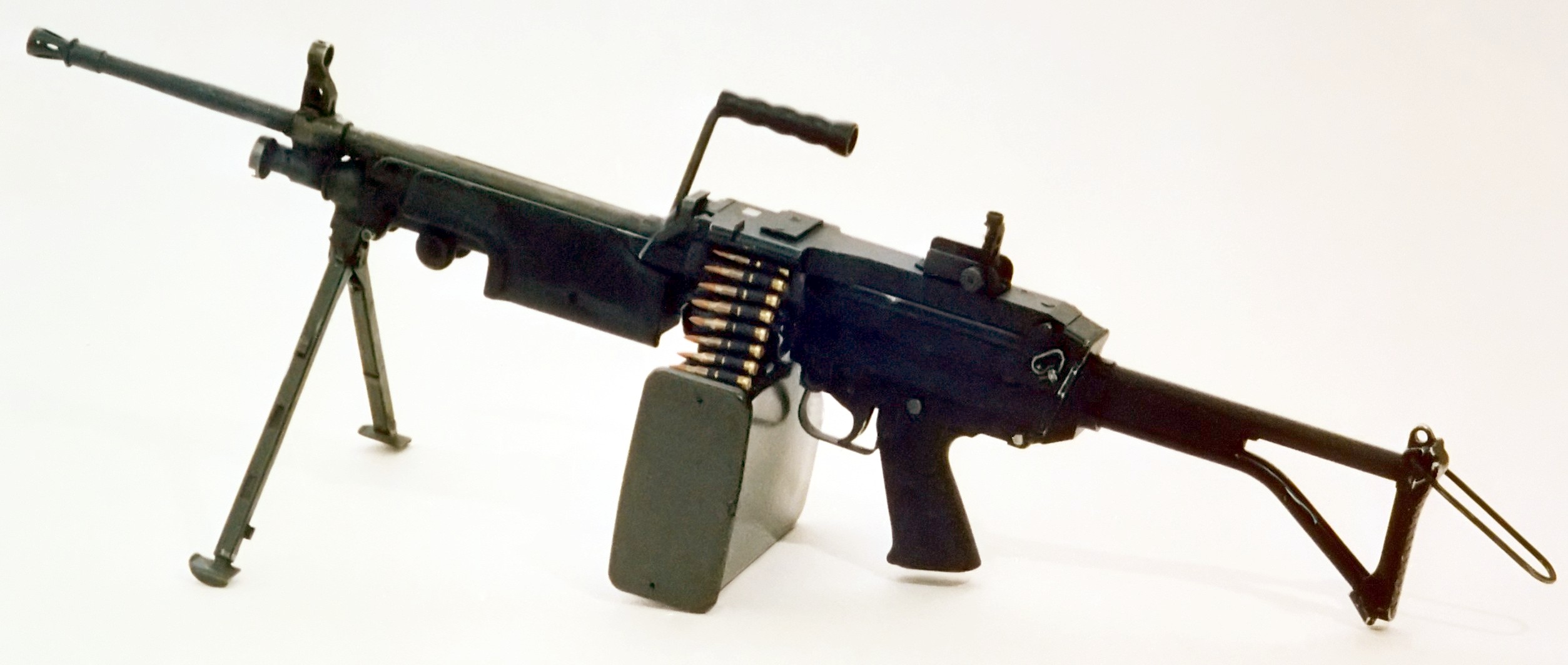
The M249 Squad Automatic Weapon is the American version of the Belgian FN Minimi: a gas-operated, belt-fed 5.56mm light machine gun light enough to move with a rifle squad and firing the same ammunition as its rifles. Adopted in 1984 after a decade of trials, it gave each fire team a base of automatic fire the M16 could not provide, and it fought in Panama, the Gulf, Somalia, Iraq and Afghanistan. It can feed from a 200-round belt box or, in an emergency, from a standard rifle magazine, and the shortened Para and Mk 46 versions serve special operations forces.
Also known as SAW, M249 SAW, M249 Light Machine Gun, FN Minimi, M249 Para, Mk 46 Mod 0
Origins
When the M16 Rifle replaced the M14 Rifle the American squad lost its automatic rifle: the M16 with a bipod was no substitute for the BAR, and the 7.62mm M60 Machine Gun was too heavy to go with a fire team. In 1972 the Army wrote a requirement for a squad automatic weapon in the rifle's caliber, and trials through the late 1970s pitted candidates from Ford Aerospace, Maremont, Heckler & Koch and FN Herstal against each other. FN's Minimi, designed by Maurice Bourlet and Ernest Vervier, the team behind the FN MAG, won in 1980; it was type-classified as the M249 in 1982 and issued from 1984, initially made in Belgium and then by FN's plant in Columbia, South Carolina.
Design & Construction
The M249 is a conventional gas-operated, open-bolt machine gun with a rotating bolt and a quick-change barrel, firing 5.56mm NATO at 700 to 850 rounds per minute. Its distinguishing feature is dual feed: the belt runs through a top-cover feed tray, and a magazine well on the left side accepts a standard 30-round M16 magazine when belts run out, though magazine feed is unreliable and doctrinally a last resort. The 200-round belt is carried in a plastic box that clips beneath the receiver. At 17 pounds empty it is lighter than any 7.62mm gun but heavy for its caliber, and the "Para" version with a 13.7-inch barrel and collapsing stock, and the further lightened Mk 46 for the US Navy SEALs and other special operations forces, trade sustained-fire capacity for portability. Later Product Improvement Program guns added a hydraulic buffer, rails and a heat shield.
Combat Use
The SAW's first action was Panama in 1989, then the Gulf War, Somalia — where Rangers of the US Army Rangers fought with it in Mogadishu — and the long wars in Iraq and Afghanistan, in which it was the automatic weapon of every Army and US Marine Corps fire team. Its light, fast-firing round suppresses well at the ranges of urban combat, and its ammunition commonality is a genuine advantage. Its faults are those of a belt-fed gun in a rifleman's hands: sensitivity to dirt and worn parts, a belt that snags in vegetation, and a barrel that heats quickly under the fire it invites.
Legacy
The Marine Corps replaced most of its SAWs with the M27 Infantry Automatic Rifle — a heavy-barreled HK416 — from 2011, judging accuracy and mobility worth more than belt-fed volume, and the Army's Next Generation Squad Weapon program produced the 6.8mm XM250 to succeed the M249 from the 2020s. The Minimi itself remains in service with more than forty armies and is still in production at Herstal.
Sources
Rottman, Gordon L. The M249 Light Machine Gun. Osprey Weapon 56, 2017.
US Army Field Manual FM 3-22.68, Crew-Served Machine Guns 5.56-mm and 7.62-mm.
FN Herstal. Minimi technical documentation.
Jane's Infantry Weapons, 2008-2009.
Suggest an edit · account required · reviewed before publishing · how it works