CAR-15
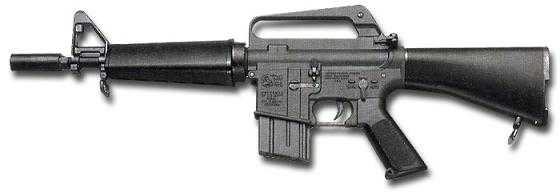
CAR-15 was Colt's name, from the mid-1960s, for a family of weapons built on the AR-15 and M16 rifle, and soldiers came to use it for the short carbines that grew out of it. The best known are the XM177 series of the Vietnam War, with a barrel of 10 or 11.5 inches, a sliding stock and a long flash suppressor. They were issued first to special forces such as the Green Berets, MACV-SOG and Navy SEALs. Later Colt Commando carbines carried the name into the 1990s, and the line led directly to the M4 Carbine.
Also known as XM177, Colt Commando, Colt Automatic Rifle-15, CAR-15 Submachine Gun, Colt Model 607, XM177E1, XM177E2, GAU-5/A, Colt Model 723, Commando
Origins
When the M16 Rifle entered American service in the early 1960s, Colt saw a chance to sell a whole family of weapons built on the same design. Around 1965 it offered the "CAR-15", for Colt Automatic Rifle, in several forms: a standard rifle, a heavy-barrel automatic rifle, a carbine, a short submachine gun and a survival rifle for aircrew. Few of these were bought, but the short CAR-15 Submachine Gun, the Colt Model 607, went to Vietnam in small numbers in 1966 for special operations units. It had a 10-inch barrel and a sliding stock. Its success led the US Air Force to order a version as the GAU-5/A, and the Army to test the XM177 and XM177E1. Troops called all of them "CAR-15s", and the name outlived Colt's catalogue.
Design & Construction
The CAR-15 carbines kept the M16's direct-impingement gas system and rotating bolt, and fired the same 5.56mm cartridge from the same magazines. To make them handier, Colt cut the barrel to 10 inches, added a two-position sliding stock and rounder, shorter handguards. The short barrel gave a loud report and a large muzzle flash, so Colt fitted a 4.5-inch moderator that reduced the flash and some of the noise. It was not a true silencer, although it was often mistaken for one. The short barrel also cut velocity and range and made the gas system less reliable. The improved XM177E2 of 1967 had an 11.5-inch barrel, which improved reliability and let it launch the 40mm grenade of the XM148 launcher. All versions were select-fire weapons, capable of automatic fire, and weighed roughly 6 pounds empty.
Combat Use
In the Vietnam War the CAR-15 and XM177 series were issued to the Green Berets, the cross-border reconnaissance teams of MACV-SOG, US Navy SEALs, long-range patrol units, radio operators and officers, and to Air Force security police. Small teams valued their short length in thick jungle, in helicopters and in ambushes, although some complained of loud reports and reduced range. After the war Colt developed the Commando carbines from the same pattern. In the Battle of Mogadishu in 1993, Colt Model 723 carbines, still called CAR-15s, were carried by Delta Force operators and by some US Army Rangers. Short carbines of the same line, among them the Navy's Mk 18 with a 10.3-inch barrel, remained in special operations use in the Global War on Terror.
Legacy
The CAR-15 proved that a short, light version of the M16 was worth having, and it set the pattern for a generation of American carbines. Colt's longer 14.5-inch carbines of the 1980s led directly to the M4 Carbine, adopted in 1994, which became the standard American infantry arm. Genuine XM177 and GAU-5 carbines are rare and highly regarded by collectors. Because they are automatic weapons, surviving examples in private hands in the United States are regulated under the National Firearms Act, and semi-automatic replicas are popular with collectors and re-enactors.
Sources
Ezell, Edward Clinton. The Great Rifle Controversy: Search for the Ultimate Infantry Weapon from World War II through Vietnam and Beyond. Stackpole Books, 1984.
Stevens, R. Blake, and Edward C. Ezell. The Black Rifle: M16 Retrospective. Collector Grade Publications, 1987.
Rottman, Gordon L. The M16. Osprey Publishing (Weapon series), 2011.
Bowden, Mark. Black Hawk Down: A Story of Modern War. Atlantic Monthly Press, 1999.
Suggest an edit · account required · reviewed before publishing · how it works