M4 Carbine
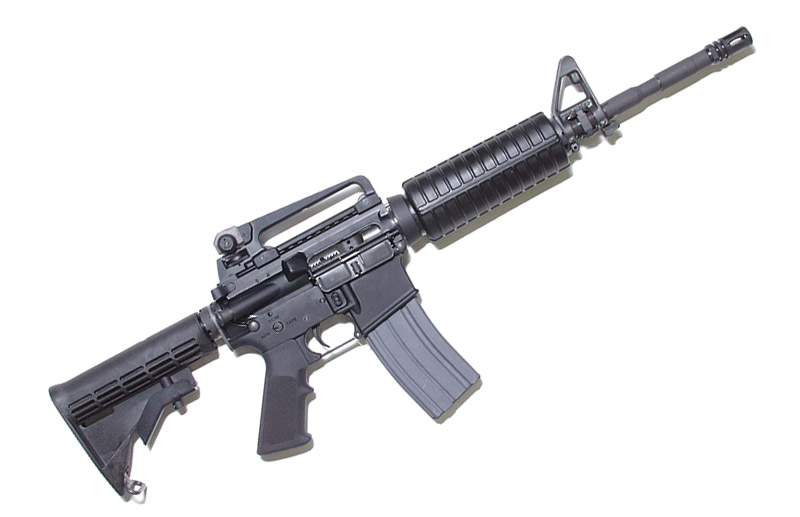
The M4 carbine is a shortened, lighter version of the M16 rifle, made by Colt and adopted by the US Army in 1994. It has a 14.5-inch barrel, a sliding stock and a flat-top receiver with a rail for sights. The fully automatic M4A1 was first taken up by special operations forces and later by the whole Army. Fitted with optics, lights and lasers, it became the standard American weapon of the wars in Afghanistan and Iraq, and the Marine Corps also adopted it. In 2022 the Army chose the SIG Sauer XM7 to replace it in close-combat units.
Also known as M4, M4A1, Carbine 5.56mm M4, Colt M4, Colt Model 920, M4 SOPMOD
Origins
Short carbine versions of the M16 Rifle were used from the Vietnam War onward, starting with the CAR-15 family and the XM177 of American special units. They were handy, but their very short barrels were loud and lost much of the 5.56mm bullet's power. In the 1980s the M16A2 introduced heavier ammunition and other improvements, and Colt developed a carbine to go with it. After testing, the Army adopted it as the M4 in 1994. It was first meant for soldiers who did not need a full-length rifle, such as vehicle crews, officers and support troops, in the same role the M1 Carbine had filled in the Second World War. Special operations units took it up quickly, and it was soon much more than a support weapon.
Design & Construction
The M4 works the same way as the M16. Gas from the barrel is piped straight back into the bolt carrier, which unlocks and cycles a rotating bolt. It has a 14.5-inch barrel, a stock that slides to several lengths, and a flat-top upper receiver with a rail, so the carrying handle can be removed and a telescopic or red-dot sight mounted instead. The barrel has a step cut into it for mounting the M203 grenade launcher, the successor of the M79 Grenade Launcher. The standard M4 fired single shots or three-round bursts, while the M4A1 fired fully automatic. In the 1990s the Special Operations Peculiar Modification (SOPMOD) kit gave special forces a rail handguard and a set of accessories: optical sights, lasers, lights, a suppressor and a short grenade launcher. The same ideas soon spread to ordinary units.
Combat Use
The M4A1 became the main weapon of the US Army Rangers, the Green Berets, Delta Force and the US Navy SEALs. After 2001 it went to war in Afghanistan and Iraq, where much fighting happened in vehicles, buildings and narrow streets, and during these wars the Army made it the standard weapon of its infantry, including divisions like the 101st Airborne. With night sights and lasers it gave American troops a strong advantage at night. It also drew criticism. In a 2007 Army dust test, the M4 had many more stoppages than the XM8, the HK416 and the FN SCAR, and some soldiers complained of jams in heavy fighting. The Army improved its magazines and parts and from the mid-2010s converted its carbines to the M4A1 standard, with a heavier barrel and full-automatic fire. In 2015 the US Marine Corps made the M4 the standard weapon of its infantry in place of the M16A4, before later issuing the M27 version of the HK416 to its riflemen. M4 fire teams usually worked alongside the M249 Squad Automatic Weapon.
Legacy
In April 2022, under the Next Generation Squad Weapon program, the Army selected SIG Sauer's XM7 rifle, a version of the MCX Spear from the SIG MCX family, in the more powerful 6.8mm cartridge, together with the XM250 automatic rifle. The XM7 is meant to replace the M4 in close-combat units such as infantry and scouts, with fielding beginning in 2024, while the M4 is expected to stay in service with other troops for years. The M4 has also been adopted by many other armies. For most of the twenty-first century so far it has been the typical American soldier's weapon, and it is the direct descendant of Eugene Stoner's original design.
Sources
Rottman, Gordon L. The M16. Osprey Publishing, 2011.
Ezell, Edward Clinton. The Great Rifle Controversy: Search for the Ultimate Infantry Weapon from World War II Through Vietnam and Beyond. Stackpole Books, 1984.
Chivers, C. J. The Gun. Simon & Schuster, 2010.
Department of the Army. TC 3-22.9, Rifle and Carbine. 2016.
Suggest an edit · account required · reviewed before publishing · how it works