M79 Grenade Launcher
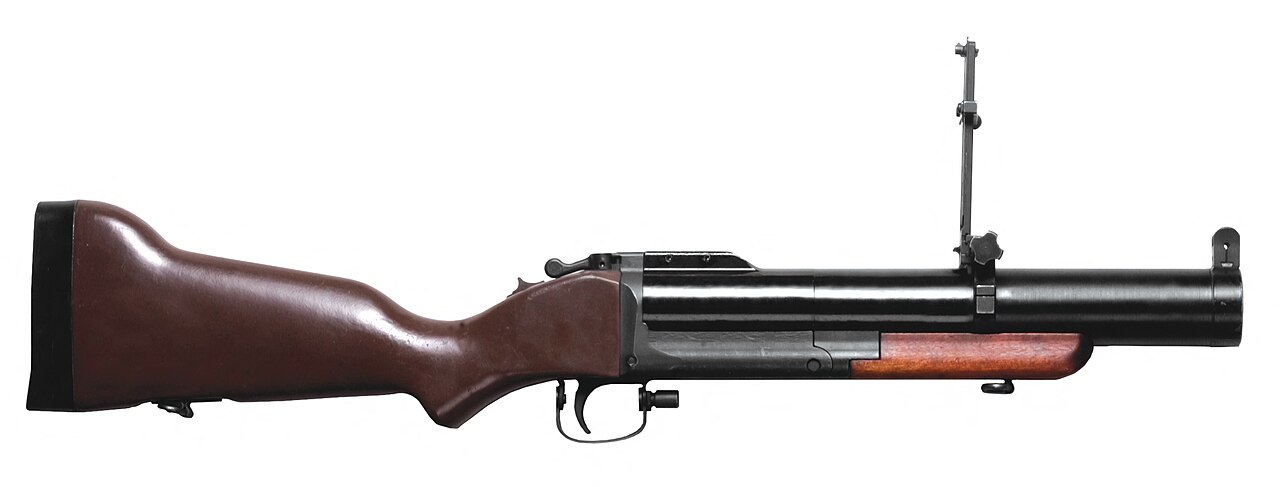
The M79 is a single-shot, break-open, shoulder-fired grenade launcher that fires a 40x46mm low-velocity grenade to about 400 meters, adopted by the United States Army in 1960 to fill the gap between the hand grenade and the mortar. Shaped like a stubby, thick-barreled shotgun, it gave every Vietnam rifle squad its own artillery: high-explosive, buckshot, flechette, smoke, illumination and tear-gas rounds delivered with a hollow "bloop." Replaced by the rifle-mounted M203 from 1969, it never disappeared, and special operations units and allied armies still carry it.
Also known as Thumper, Blooper, Bloop-Gun, M79, Bloop Gun, Elephant Gun, Wombat Gun
Origins
The rifle grenade of the Second World War was inaccurate, slow to prepare and hard on the rifle, and Springfield Armory's Project NIBLICK of the early 1950s set out to replace it with a family of spin-stabilized 40mm grenades fired from a dedicated launcher. The cartridge used the "high-low" pressure system devised in Germany in 1944: propellant burns at high pressure in a small chamber inside the case and bleeds through vents into the barrel at low pressure, so a shoulder weapon can throw a 230-gram grenade at 250 feet per second without breaking the gunner's collarbone. The launcher, the M79, was standardized in December 1960 and reached the Army in 1961.
Design & Construction
The M79 is as simple as a firearm can be: a 14-inch rifled aluminum barrel that pivots down to load, a walnut stock with a thick rubber recoil pad, a hammer-fired trigger with a cross-bolt safety, and a leaf sight graduated to 375 meters that folds against a blade sight for close work. It weighs six pounds empty and is under 29 inches long. The 40x46mm M406 high-explosive grenade arms after about 14 meters of flight and has a five-meter casualty radius; other rounds include the M576 buckshot and flechette loads for close defense, white and colored smoke, parachute illumination, CS gas and practice rounds. A trained grenadier could put a round through a window at 150 meters and lob one onto a position at 350, firing four to six rounds a minute.
Combat Use
The M79 was issued one per rifle squad in Vietnam War, and the grenadier — who carried a pistol as his only other weapon — was an essential man in every firefight, dropping high-explosive on machine-gun nests and bunkers that riflemen could not reach and sweeping trails with buckshot. "Thumper" and "blooper" were the sounds it made. The US Marine Corps, the 101st Airborne and the US Navy SEALs, who favored a cut-down pistol-grip version for riverine work, all used it, and it went to Australian, South Vietnamese and South Korean forces. Its weakness was that the grenadier had no rifle, which drove the development of the M203 under-barrel launcher for the M16 Rifle from 1969.
Legacy
The M79 was never formally withdrawn. Its longer sight radius and barrel make it more accurate than the M203 at range, and units in Iraq and Afghanistan quietly kept it for that reason; Navy riverine and special warfare units and the armies of Thailand, South Korea, Turkey and others still field it, and copies were produced abroad. It is the direct ancestor of the M203, the M320 and every 40mm low-velocity launcher in the world, and the grenadier's shotgun-like stance with the Thumper is one of the abiding images of the Vietnam infantryman.
Sources
Rottman, Gordon L. US Grenade Launchers: M79, M203, and M320. Osprey Weapon 57, 2017.
US Army Field Manual FM 23-31, 40-mm Grenade Launcher M79.
Springfield Armory Historical Site, Massachusetts — M79 development records.
Ezell, Edward C. Small Arms of the World, 12th ed. Stackpole, 1983.
Suggest an edit · account required · reviewed before publishing · how it works