HK MP7
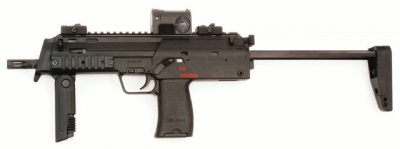
The Heckler & Koch MP7 is a personal defense weapon: a machine pistol the size of a large handgun that fires a small, very fast 4.6x30mm cartridge able to defeat the soft body armor that stops every conventional submachine-gun round. Introduced in 2001, it uses a scaled-down version of the gas-piston rotating-bolt action of the G36 rifle, weighs about four pounds, and can be fired one-handed or shouldered from its extending stock. It serves German forces, the SEALs and special units in more than twenty countries, and was carried on the raid that killed Osama bin Laden.
Also known as MP7, MP7A1, MP7A2, Personal Defence Weapon, PDW
Origins
In 1989 NATO issued a requirement for a personal defense weapon: something to arm the vehicle crews, artillerymen, signalers and staff who make up most of a modern army and who cannot carry a rifle, but who face an enemy in body armor against which the pistol and the 9mm submachine gun are useless. FN answered with the FN P90 and its 5.7x28mm cartridge. Heckler & Koch answered a decade later with the MP7 and a round of its own, the 4.6x30mm, developed with the ammunition maker Dynamit Nobel (later RUAG): a pointed, hardened-steel-cored bullet of about 2 grams leaving a seven-inch barrel at roughly 2,400 feet per second. The MP7 entered production in 2001 and was adopted by the Bundeswehr the same year.
Design & Construction
Mechanically the MP7 is a miniature assault rifle rather than an enlarged pistol. It uses a short-stroke gas piston driving a rotating bolt, the same layout as HK's G36 Rifle, which lets it fire from a closed bolt with a locked breech — impossible for the simple blowback submachine guns that preceded it. The receiver is polymer, the magazine feeds through the pistol grip like the Uzi and HK MP5K, and a folding foregrip and a telescoping stock let the weapon be fired one-handed, two-handed or from the shoulder. Empty it weighs 4.2 pounds and is just over sixteen inches long with the stock retracted; magazines hold 20, 30 or 40 rounds. The MP7A1 of 2003 added a longer stock and ambidextrous controls; the A2 of 2014 replaced the folding foregrip with a rail.
Combat Use
The armor-defeating cartridge, the low recoil and the tiny package made the MP7 attractive well beyond the rear-echelon troops it was designed for. German KSK special forces and the Bundeswehr's police-type units took it up first; the British SAS, Norwegian, Korean and Japanese special forces followed, and the US Navy SEALs adopted it for close-quarters work, often with a suppressor, for which the small cartridge is well suited. It was one of the weapons carried into the Abbottabad compound on 2 May 2011 during Operation Neptune Spear. Critics note that the 4.6mm bullet, for all its penetration, delivers less energy than a rifle round and rather less than a 9mm at close range; supporters answer that it hits what the operator aims at and goes through what he needs it to.
Legacy
The MP7 and the P90 between them created the PDW category, and the MP7 has been the more widely adopted of the two. It has not replaced the rifle, and the short 5.56mm carbine remains the general answer for troops who need compact firepower; but as a special-operations and protective-detail weapon the MP7 holds a niche no other design fills as neatly. Civilian ownership is limited — HK has never offered a semi-automatic version — which keeps the weapon rare outside military and police hands.
Sources
Heckler & Koch GmbH. MP7A1 technical data.
Thompson, Leroy. The MP5 Submachine Gun. Osprey Weapon 35, 2014 (MP7 in context).
Owen, Mark, with Kevin Maurer. No Easy Day. Dutton, 2012.
Jane's Infantry Weapons, 2010-2011.
Suggest an edit · account required · reviewed before publishing · how it works