Uzi
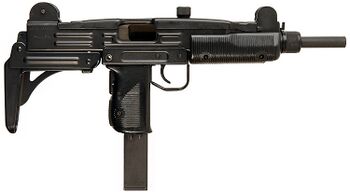
The Uzi is a submachine gun designed in Israel by Major Uziel Gal around 1950 and made by Israel Military Industries. By placing the magazine in the pistol grip and wrapping the bolt around the barrel, Gal made a gun that was short, well balanced and easy to reload in the dark. Rugged, simple and reliable in sand and mud, the Uzi served the Israel Defense Forces from the 1950s through the Six-Day War and beyond. It was built under license in Belgium and Germany, sold to dozens of countries, and became one of the most recognized firearms in the world.
Also known as Uzi submachine gun, IMI Uzi, Mini Uzi, Micro Uzi, MP2
Origins
Israel fought its War of Independence in 1948 with a mix of weapons bought or captured from many countries, including the British Sten Gun and the German MP40. The new state wanted a submachine gun it could build itself. Uziel Gal, an officer in the Israel Defense Forces (IDF), completed his design around 1950, and it was adopted in the early 1950s. Production by Israel Military Industries (IMI) began soon after, and the first guns reached the army in 1954. Gal asked that the weapon not be named after him, but the request was turned down, and the gun has been called the Uzi ever since.
Design & Construction
Gal borrowed the key idea of the Czechoslovak vz. 23 series of submachine guns: a bolt that wraps around the rear of the barrel. This made the gun much shorter without shortening the barrel. The magazine went into the pistol grip, directly under the bolt, which put the weight over the firer's hand and made the gun easy to hold with one hand. It also meant that "hand finds hand": a soldier could find the magazine well by feel and change magazines in the dark. The receiver was made from stamped sheet steel, with deep grooves pressed into it to collect sand and dirt away from the moving parts. A grip safety at the back of the pistol grip stopped the gun from firing if it was dropped. Early Uzis had a detachable wooden stock; later guns had a metal stock that folded under the receiver. The Uzi fires from an open bolt at a moderate rate of about 600 rounds a minute, which makes it easy to control, and it uses 25- or 32-round box magazines.
Service
The Uzi first saw combat in the Sinai campaign of the 1956 Suez Crisis, and in the Six-Day War of 1967 it was carried by Israeli paratroopers, tank crews and infantry. It was issued widely until the 1980s, when the IDF began to replace it in front-line units with assault rifles; it was finally withdrawn from Israeli service in the early 2000s. Abroad it was a great success. FN Herstal of Belgium, the maker of the FN FAL, built it under license, and West Germany adopted it for the Bundeswehr as the MP2. It was bought by the armed forces and police of dozens of countries during the Cold War. The US Secret Service carried Uzis for many years; agents drew them in the moments after the attempted assassination of President Ronald Reagan in 1981.
Legacy
IMI developed smaller versions for close protection and special forces: the Mini Uzi of 1980 and the Micro Uzi of 1986, which is little larger than a pistol. Semi-automatic carbine and pistol versions were also sold to civilians. The Uzi's layout, with the magazine in the grip and a telescoping bolt, was copied by later designs such as the American MAC-10. Its compact shape made it a staple of films and television, and for many people it is the image of a submachine gun. It stands beside the HK MP5 as one of the two defining submachine guns of the second half of the twentieth century.
Sources
McNab, Chris. The Uzi Submachine Gun. Osprey Publishing (Weapon series), 2011.
Hogg, Ian V., and John Weeks. Military Small Arms of the 20th Century. Arms and Armour Press, 1973 and later editions.
Ezell, Edward Clinton. Small Arms of the World. 12th edition, Stackpole Books, 1983.
Suggest an edit · account required · reviewed before publishing · how it works