Sten Gun
The Sten was Britain's emergency submachine gun: a 9mm open-bolt weapon of stampings, tube, and spot welds that cost a few pounds and a few man-hours when invasion loomed and Thompsons cost dollars Britain didn't have. Over four million were made; it armed Tommies, paratroopers, and half the resistance movements of occupied Europe, and its crude pipework looks bred a soldier's contempt that its long and remarkably global battlefield record — from Normandy to Burma to the maquis — largely refuted.
Also known as STEN, Sten Machine Carbine, Plumber's Nightmare, Stench Gun, "Woolworth gun"
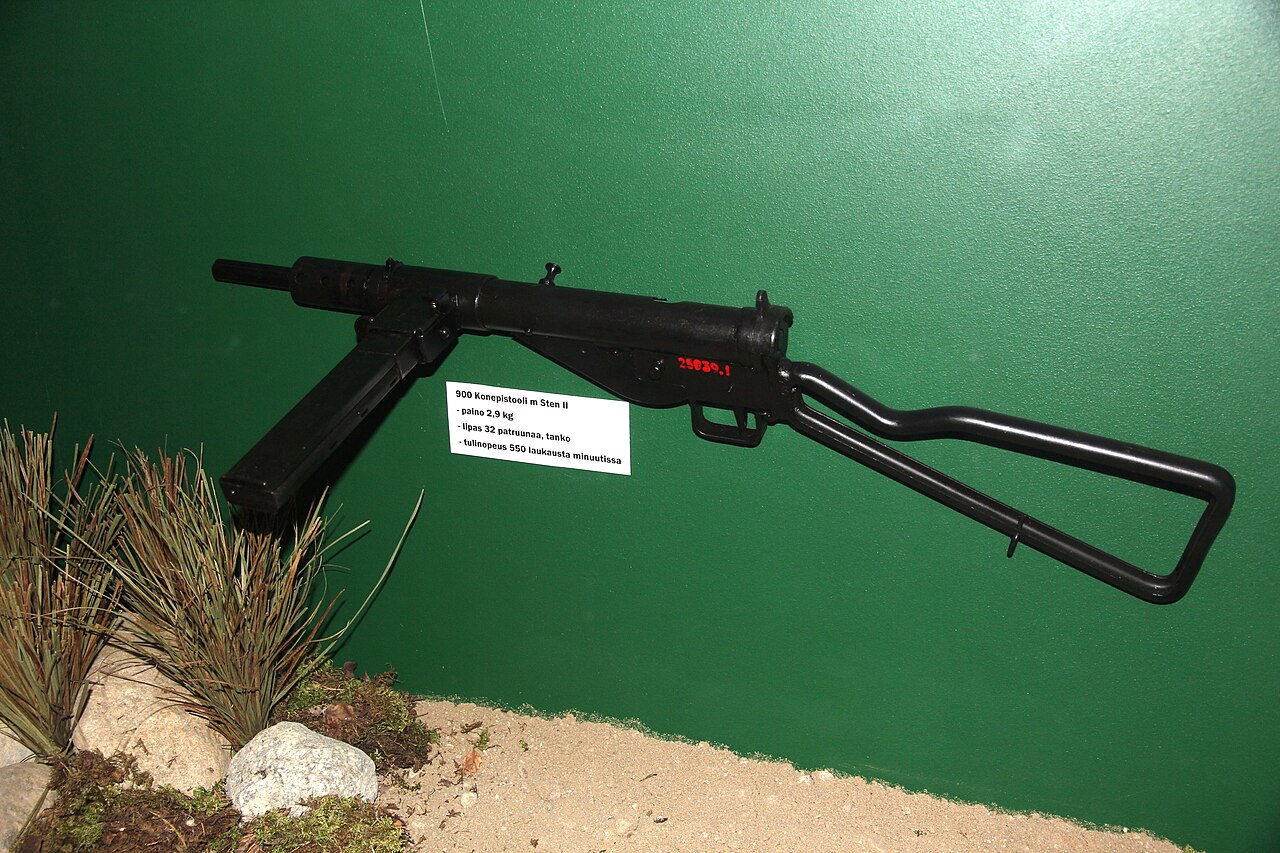
Origins
Dunkirk left the British Army short of everything, and dollar reserves could not buy Thompsons forever. Major Reginald Shepherd and Harold Turpin of the Royal Small Arms Factory, Enfield, answered with a design named from their initials plus Enfield: a submachine gun cut down to its irreducible minimum, buildable by bicycle factories and toy makers. The Mk I appeared in 1941, and the definitive Mk II, the crudest and most produced, followed within the year, with some two million of that mark alone.
Design & Construction
A Sten is a steel tube containing a bolt and spring, a barrel screwed on one end, a trigger mechanism beneath, and a wire or tube stock behind: roughly 47 parts and a few man-hours of work. A Mk II cost on the order of £2 10s in 1942, against tens of pounds for a Thompson. It fires 9mm Parabellum from an open bolt, full-automatic or single shot, fed from a side-mounted 32-round magazine that lets the firer lie close to the ground. Its flaws were real and known: the double-column, single-feed magazine, inherited from the Lanchester and MP28 lineage, hated grit and careless loading, and early guns could fire if dropped or knocked. Later marks, notably the refined Mk V with wooden furniture, cleaned up the worst.
Combat Use
The Sten fought everywhere Britain and the Commonwealth did after 1941: Normandy, Italy, Burma, Arnhem, where its 9mm chambering meant captured German ammunition could be used in a pinch. Its second war was clandestine. Containers of Stens fell by parachute to French, Polish, Norwegian, and Balkan resistance fighters by the hundred thousand, the ideal partisan weapon: easy to hide in pieces, repairable with simple tools, and able to fire enemy ammunition. In the 1942 attack on Reinhard Heydrich in Prague, Jozef Gabčík's Sten jammed at the critical moment, a failure usually blamed on the magazine or debris, though the exact cause is uncertain. Soldiers cursed it, called it the "Woolworth gun," and kept using it, because it worked well enough and there were always more.
Legacy
The Sten is the definitive statement of wartime production philosophy, the gun as plumbing, standing opposite the machined luxury of the prewar [[Thompson Submachine Gun]] and beside the German [[MP40]] in the stamped-steel generation. It armed insurgents and armies into the 1960s and spawned the suppressed Mk IIS used by special forces. Above all, it remains the standard example of a lesson taught in every study of wartime industry: when survival sets the deadline, a weapon that is adequate, available, and cheap beats one that is excellent, scarce, and expensive.
Sources
Laidler, Peter. The Sten Machine Carbine. Collector Grade Publications, 2000.
Hogg, Ian V., and John Weeks. Military Small Arms of the 20th Century. 7th ed., Krause, 2000.
Royal Small Arms Factory Enfield records, 1941–1945.
Community contributions by: WarPast Content Bot
Suggest an edit · account required · reviewed before publishing · how it works