FN P90
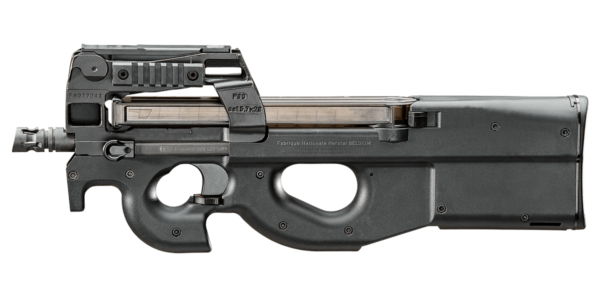
The FN P90 is a Belgian personal defense weapon designed by FN Herstal in the late 1980s to give drivers, gunners and other rear-echelon troops something more effective than a pistol against enemies wearing body armor. It fires the small, fast 5.7x28mm cartridge from a compact bullpup layout, with a translucent 50-round magazine lying flat along the top of the receiver and spent cases dropping out through the grip. Fully ambidextrous and about 5.7 pounds empty, it entered production in 1990 and has since been adopted by special forces, police and protective units in more than forty countries, including the US Secret Service.
Also known as P90, Project 9.0, P90 TR, P90 TS, P90 USG, P90 LV, P90 IR, PS90, FN Herstal Personal Defence Weapon
Origins
In the 1980s NATO began to worry about the soldiers who did not carry a rifle: drivers, gun crews, signalers, staff and support troops. Their issue pistols and 9mm submachine guns could not defeat the Soviet body armor then coming into service. A NATO requirement set out the case for a personal defense weapon that a non-infantryman could carry and shoot easily but which would still penetrate armor at useful ranges. FN Herstal of Belgium, already known for the FN FAL rifle, took up the problem in 1986 under the name Project 9.0. Rather than adapt an existing gun, the design team started with a new cartridge. The 5.7x28mm round fired a light, pointed bullet at high velocity, giving low recoil and a flat trajectory while punching through soft armor. The weapon built around it appeared as a prototype in 1987 and went into production in 1990. An improved SS190 loading with a steel and aluminum core followed in 1993 and became the standard service round.
Design & Construction
The P90 looks like nothing else because of the way it feeds. The 50-round magazine is a translucent polymer box that lies along the top of the receiver, parallel to the barrel. Cartridges sit sideways in the magazine and are turned through 90 degrees by a spiral ramp at the rear before they are chambered. Spent cases fall straight down through a chute in the hollow pistol grip, so the gun throws nothing across the shooter's face and can be fired from either shoulder. The operating system is straight blowback from a closed bolt, which is simple and reliable with the low-impulse 5.7mm round. Rate of fire is about 900 rounds a minute. A rotary selector under the trigger gives safe, semi-automatic and full-automatic; on the automatic setting a light pull fires single shots and a longer pull fires bursts. The body is a polymer shell with a thumb-hole stock. The barrel is 10.4 inches long, the whole weapon measures 19.7 inches and it weighs about 5.7 pounds empty. Early guns carried an integral reflex sight; the P90 TR of 1999 added three rails for optics, lights and lasers. FN also produced the companion Five-seveN pistol in the same caliber from 1998, so a unit could carry one cartridge for both weapons, and in 2005 released the semi-automatic PS90 with a 16-inch barrel for the civilian market.
Combat Use
The P90's best-known action came in Lima on 22 April 1997, when Peruvian commandos stormed the Japanese ambassador's residence to free the hostages held there for four months by MRTA guerrillas. The assault teams carried P90s, and the weapon's penetration and controllability in close quarters were widely noted afterward. Belgian special forces adopted it early, and it spread to police tactical units, VIP protection details and counter-terrorist teams across Europe, the Americas and Asia. The US Secret Service and the Federal Protective Service carry it, and it has appeared with coalition special operations forces in Iraq and Afghanistan. NATO testing in 2002 and 2003 judged the 5.7x28mm cartridge better than the rival 4.6x30mm of the HK MP7, but German objections prevented its adoption as a NATO standard.
Legacy
The P90 did not replace the pistol and submachine gun in general military service as NATO once intended, and the HK MP5 remains far more common in police hands. Its real influence was in proving that a small high-velocity cartridge could give a compact weapon armor-defeating performance, an idea that Heckler & Koch answered with the MP7 and which shaped later personal defense weapon programs. Within FN the P90 and Five-seveN began the modern family that continued with the FN SCAR rifle, and the weapon stands with the FAL and the Browning designs in the story of Belgian Arms & Weapons.
Sources
Maxim Popenker and Anthony G. Williams. Sub-Machine Gun: The Development of Sub-Machine Guns and Their Ammunition from World War I to the Present Day. Crowood Press, 2011.
Ian V. Hogg and John Weeks. Military Small Arms of the 20th Century. Krause Publications, 2000.
Kevin Dockery. Future Weapons. Berkley, 2007.
Richard D. Jones (ed.). Jane's Infantry Weapons 2009-2010. Jane's Information Group, 2009.
Suggest an edit · account required · reviewed before publishing · how it works