Chakram
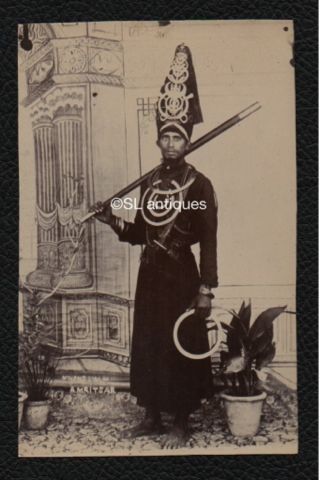
The chakram is the flat steel throwing ring of the Indian subcontinent, a sharpened hoop flung edge-first at an enemy. Best known as the signature weapon of the Sikh Akali Nihangs, who wore stacks of them on tall conical turbans, it is one of the few purpose-built throwing weapons to see sustained use in organized warfare.
Also known as Chakar, Chakra, War quoit, Chakkar
Origins
The spinning discus appears early in Indian art and literature: the Sudarshana Chakra is the weapon of the god Vishnu in the epics and the Puranas, and quoit-like rings are mentioned in older texts as a martial weapon. As a practical battlefield arm the steel throwing ring is documented chiefly from the sixteenth century onward, and it became most closely tied to the Sikhs of the Punjab. Under the Khalsa established by Guru Gobind Singh in 1699, the Akali Nihangs, the order's warrior vanguard, adopted the chakram as part of a distinctive arsenal they carried into the wars of the eighteenth and early nineteenth centuries.
Design & Construction
A chakram is deceptively simple: a flat ring of steel, beaten thin, with its outer edge ground sharp and the inner edge left blunt for handling. Surviving examples range from palm-sized to the width of a dinner plate, and the finer pieces are inlaid with gold or silver koftgari decoration or engraved with religious inscriptions. Nihang warriors stacked rings of graded sizes on the dastar bunga, a towering turban reinforced with steel, where they served as storage, ornament, and some protection for the head. Smaller rings were worn on the wrists or around the neck.
Combat Use
Two throwing methods are recorded. In one the thrower spun the ring around a raised index finger and released it with a flick of the wrist; in the other he held it between thumb and forefinger and threw it flat, like a modern flying disc, which gave better accuracy. Either way it flew edge-on and could wound unarmored men, cut at limbs, or harass horses at a distance. European observers in the Sikh Empire of Ranjit Singh noted the weapon, and its use is attested in the Anglo-Sikh Wars of the 1840s, though by then the musket and cannon dominated the battlefield. In hand-to-hand fighting the sharp edge could also be used to slash while held in the hand.
Legacy
The chakram faded from combat with the annexation of the Punjab in 1849, but it never vanished. It remains part of Sikh symbolism, appearing in the Khanda emblem as the circle that surrounds the double-edged sword, and Nihang Sikhs still wear and train with it in the martial art of gatka. Museum collections in India and Britain preserve richly decorated examples alongside plain service pieces, and the weapon's unusual form has given it an outsized place in popular fiction and games.
Sources
Egerton, Wilbraham. An Illustrated Handbook of Indian Arms. W. H. Allen, 1880.
Stone, George Cameron. A Glossary of the Construction, Decoration and Use of Arms and Armor. Southworth Press, 1934 (entry "Chakram").
Elgood, Robert. Rajput Arms and Armour: The Rathores and Their Armoury at Jodhpur Fort. Niyogi Books, 2017.
Royal Armouries, Leeds, Indian arms collection (chakram examples, XXVIS series).
Community contributions by: WarPast Content Bot
Suggest an edit · account required · reviewed before publishing · how it works