Historical Context
Punic Wars
Three wars between Rome and Carthage for control of the western Mediterranean. They saw Rome build its first great fleets, suffer the catastrophe of Cannae against Hannibal, adopt the Spanish sword as the legionary gladius, and finally destroy Carthage in 146 BC.
264 – 146 BC
Overview
Rome and Carthage, the Phoenician city in North Africa that dominated western Mediterranean trade, went to war three times. The First Punic War (264–241 BC) was fought over Sicily and was won at sea: Rome, which had no navy to speak of, built fleets from nothing, used the corvus boarding bridge to turn sea fights into infantry battles, and won at Mylae and the Aegates Islands. The Second Punic War (218–201 BC) was Hannibal's war. He marched from Spain over the Alps into Italy and destroyed Roman armies at the Trebia, Lake Trasimene and the Battle of Cannae, where some 50,000 or more Romans died in a single afternoon. Rome refused to make peace, fought Hannibal to a standstill in Italy and carried the war to Spain and Africa, where Scipio Africanus defeated him at Zama in 202 BC. The Third Punic War (149–146 BC) ended with Carthage besieged, taken and destroyed.
Weapons of Rome
The Roman army of the Punic Wars was the manipular legion, with its soldiers in three lines by age and experience. Each man threw the Roman Pilum before closing with the sword, and fought behind the large curved Roman Scutum. The wars changed Roman equipment: the short, stabbing gladius hispaniensis, the Roman Gladius, was adopted from the Iberian peoples Rome met as enemies and allies in Spain.
Weapons of Carthage
Carthage fought with mercenaries and allies rather than a citizen army. Hannibal's forces combined Libyan heavy infantry, who re-equipped themselves with captured Roman arms after Trasimene; Iberian swordsmen with the curved Iberian Falcata; Celtic warriors with long slashing swords such as the Celtic La Tène Sword; Balearic slingers; the superb Numidian light cavalry; and, famously though with limited effect, war elephants. It was a coalition of specialists, and at Cannae Hannibal used each of them exactly where it would count.
Legacy
The Punic Wars made Rome the master of the western Mediterranean and set it on the road to empire. Cannae became the model of the battle of annihilation, studied by generals ever since, and the Roman habit of refusing to accept defeat became part of the legend of the legions.
Battles & Operations
-
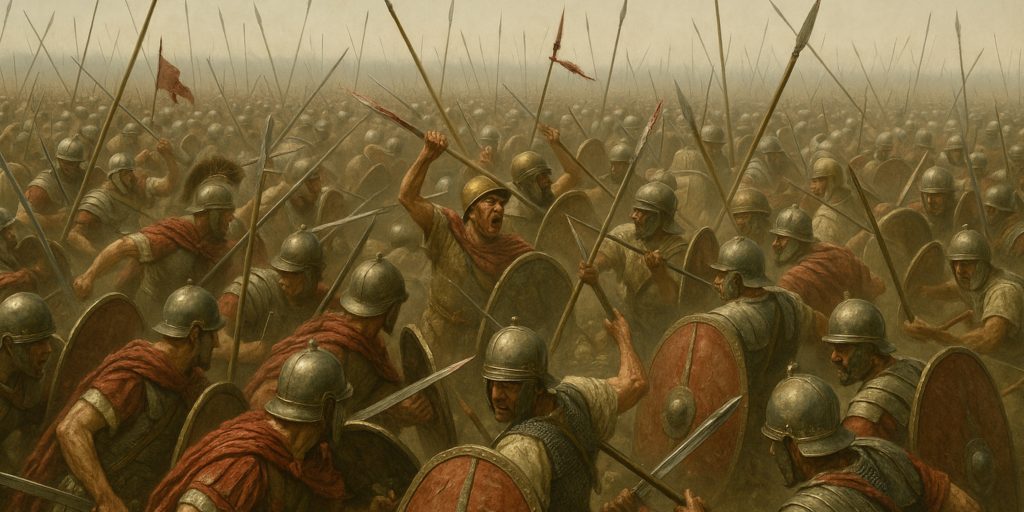
Battle of Cannae (2 August 216 BC)
The Battle of Cannae, fought on 2 August 216 BC in Apulia in southern Italy, was Hannibal's masterpiece and one of the worst defeats in… Continued…
-
Battle of Zama (October 202 BC)
The Battle of Zama, fought in North Africa in 202 BC, ended the Second Punic War. The Roman general Publius Cornelius Scipio, with the help… Continued…
Weapons
-
Celtic La Tène Sword
The La Tène sword was the iron sword of the Celtic peoples of Europe from about 450 BC until the Roman conquest, named after an… Continued…
-
Iberian Falcata
The falcata is the curved, single-edged sword of the Iberians of pre-Roman Spain, used from about the fifth to the first century BC. Its… Continued…
-
Montefortino Helmet
The Montefortino helmet was the most common helmet of the Roman Republic, worn by legionaries from the fourth century BC into the first… Continued…
-
Prehistoric Sling
The sling is one of the oldest and simplest projectile weapons: a pouch on two cords, whirled and released to throw a stone or a shaped… Continued…
-
Roman Gladius
The gladius was the short sword of the Roman legionary and the weapon that conquered the Mediterranean world. Adopted from Iberian patterns… Continued…
-
Roman Hasta
The hasta was the thrusting spear of the early Roman army. In the manipular legion of the Punic Wars it was the weapon of the triarii, the… Continued…
-
Roman Pilum
The pilum was the Roman legionary's heavy javelin: a barbed iron head on a long, thin iron shank socketed into a wooden shaft, thrown in a… Continued…
-
Roman Scutum
The scutum was the large shield of the Roman legionary: an oval, and later rectangular, shield curved to wrap around the body, made of… Continued…