Origin
Confederate States
The Confederate States of America relied heavily on imported British Enfield rifles and domestically produced copies due to limited industrial capacity. Edged weapons including the Bowie knife were common, and the war drove improvisation in weapons from swords to early ironclad warships.
Overview
The Confederate States of America (1861–1865) faced the fundamental challenge of fighting an industrialized war with a largely agrarian economy. The Confederacy imported weapons from Britain and Europe, manufactured arms in Richmond and other centers, captured enormous quantities of Union weapons, and improvised when none of the above were sufficient.
Small Arms
Rifles and Muskets
- Enfield Pattern 1853 rifle musket — The most important Confederate long arm; .577 caliber; imported in large numbers from Britain through the blockade; highly regarded for its accuracy and reliability
- Springfield Model 1861 (captured) — Identical in caliber (.58) to the Enfield; Confederate forces captured and reissued thousands
- Richmond Rifle Musket — A Confederate-manufactured copy of the US Model 1855/61; produced at Richmond Armory using machinery captured from Harpers Ferry
- Fayetteville Rifle — Confederate-made rifle using captured Harpers Ferry machinery
- Cook & Brother rifles and muskets — Georgia and later North Carolina manufacturer; produced both rifle muskets and shorter artillery carbines
- Austrian Lorenz rifle — Imported in large numbers; some chambered in different calibers caused supply complications
Edged Weapons
The Bowie knife became emblematic of Confederate soldiers, with many arriving carrying large sheath knives. Officers carried swords — often straight cavalry sabers or naval cutlasses. Confederate sword manufacturing was limited; many carried imported British or pre-war American swords.
Cavalry Arms
Confederate cavalry was often better mounted than Union counterparts in the early war. Standard arms included:
- Cavalry sabers (though many Confederate troopers preferred pistols and carbines to swords)
- Colt revolvers (pre-war stock and captured examples)
- Sharps and other carbines (mostly captured)
- LeMat revolver — A distinctive Confederate-favored weapon with a 9-round cylinder above a single-shot 20-gauge shotgun barrel
Artillery
The Confederacy cast bronze and iron cannon at Tredegar Iron Works in Richmond and other facilities. Confederate artillery was qualitatively comparable to Union guns but increasingly outmatched in quantity. Captured Union artillery was routinely pressed into Confederate service.
This article is a stub. Contributions covering specific weapons, battles, and Confederate manufacturing are welcome.
Battles & Operations
-
Battle of Gettysburg (1-3 July 1863)
The Battle of Gettysburg was fought on 1-3 July 1863 around the town of Gettysburg, Pennsylvania, between the Union Army of the Potomac… Continued…
-
Second Battle of Fort Wagner (18 July 1863)
The Second Battle of Fort Wagner, fought on 18 July 1863 on Morris Island outside Charleston, South Carolina, was a failed Union night… Continued…
Weapons
-
Colt 1851 Navy Revolver
The Colt 1851 Navy is the revolver that made Samuel Colt's fortune and the revolver of the American frontier and Civil War: a .36-caliber… Continued…
-
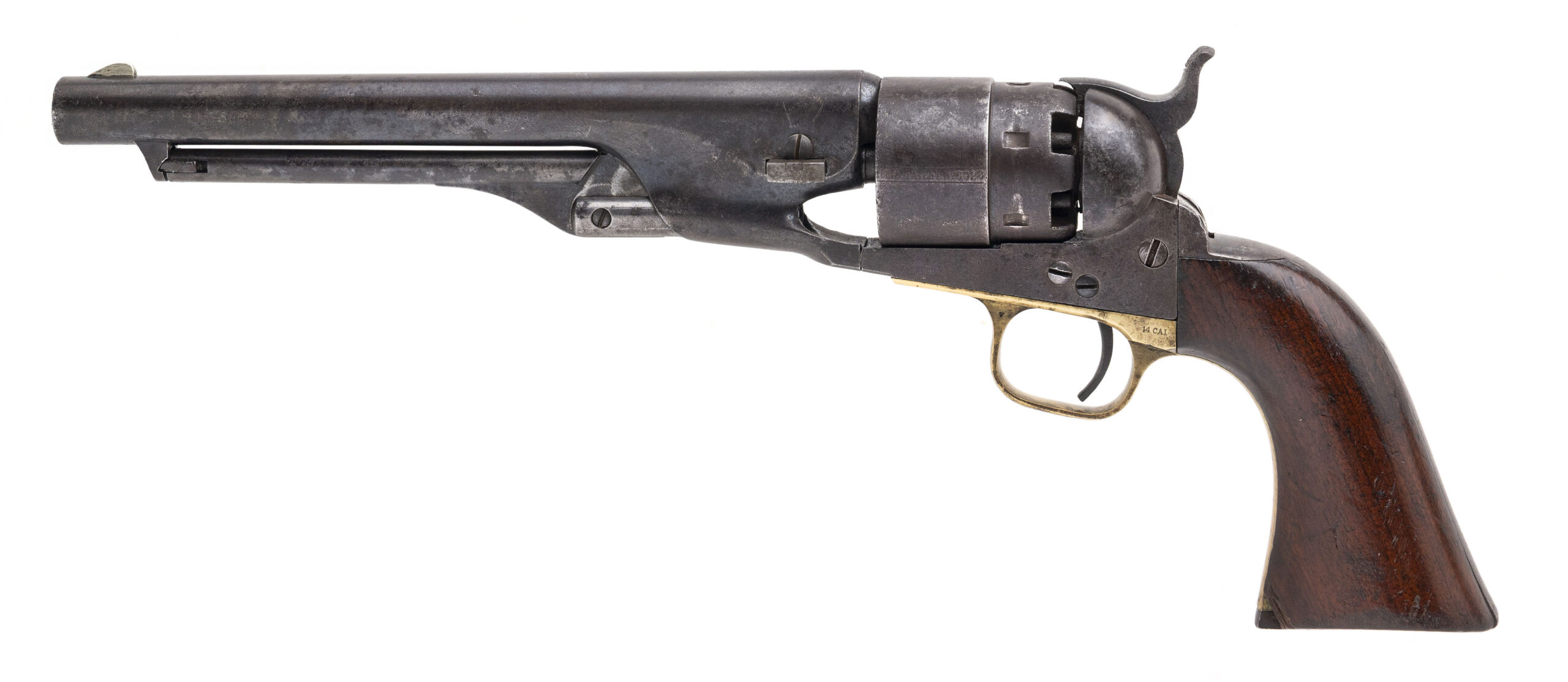
Colt 1860 Army
The Colt 1860 Army was the principal revolver of the Union cavalry in the American Civil War: a six-shot .44 caliber percussion revolver… Continued…
-
Minié Ball
The Minié ball is the conical, hollow-based lead bullet that made the rifled musket a practical infantry weapon. Developed by the French… Continued…
-
Model 1850 Foot Officer's Sword
The Model 1850 Foot Officer's Sword was the regulation sword of company-grade infantry officers of the United States Army from 1850 until… Continued…
-
Napoleon 12-Pounder
The 12-pounder Napoleon was the most common field gun of the American Civil War: a bronze smoothbore gun-howitzer of 4.62-inch bore… Continued…
-
Parrott Rifle
The Parrott rifle was a family of muzzle-loading rifled cannon designed by Robert Parker Parrott and made at the West Point Foundry in Cold… Continued…
-
Pattern 1853 Enfield
The Pattern 1853 Enfield was the British Army's .577 caliber percussion rifle-musket, adopted in 1853 and made at the Royal Small Arms… Continued…
-
Remington 1858 New Model Army
The Remington New Model Army was the second great Union revolver of the American Civil War: a six-shot .44 caliber percussion revolver… Continued…
-
Sharps Rifle
The Sharps was the finest breech-loading rifle of the American Civil War and the buffalo hunter's gun of the plains that followed.… Continued…
-
Springfield Model 1842
The Springfield Model 1842 was the United States Army's first regulation percussion musket and the last of its .69 caliber smoothbores.… Continued…