Second Battle of Fort Wagner
The Second Battle of Fort Wagner, fought on 18 July 1863 on Morris Island outside Charleston, South Carolina, was a failed Union night assault on a Confederate sand fort. The attack was led by the 54th Massachusetts, one of the first Black regiments raised in the North, whose colonel, Robert Gould Shaw, was killed on the parapet. The Union lost more than 1,500 men. The regiment's conduct did much to win acceptance for Black soldiers in the Union army.
Also known as Battle of Fort Wagner, Assault on Fort Wagner, Second Assault on Battery Wagner, Battery Wagner, Fort Wagner 1863, Morris Island, Second Assault on Morris Island, 54th Massachusetts, 54th Massachusetts Infantry, Robert Gould Shaw, Glory, Glory 1989
Background
Charleston, South Carolina, was where the American Civil War had begun, and by 1863 the United States government badly wanted to take it. A naval attack by ironclads failed in April. Brigadier General Quincy A. Gillmore then planned to seize Morris Island, a low sand island on the south side of the harbor mouth, and use it as a platform for heavy guns to destroy Fort Sumter. On 10 July his troops crossed from Folly Island and took the southern end of Morris Island. The way north was blocked by Battery Wagner, usually called Fort Wagner, an earthwork of sand, turf and palmetto logs that stretched across the island from the sea to the marsh. A first assault at dawn on 11 July was beaten off with over 300 Union casualties.
Among Gillmore's reinforcements was the 54th Massachusetts Infantry. Governor John A. Andrew had raised it early in 1863 as one of the first Black regiments recruited in the North. Its officers were white, and its colonel was Robert Gould Shaw, aged 25, the son of Boston abolitionists. Most of its men were free Black Northerners. On 16 July the regiment fought its first real action on James Island. Two days later, after a night march and with little food or rest, it reached Morris Island and was offered the lead in a new assault. Shaw accepted.
The Battle
On 18 July Union land batteries and the ironclads of Rear Admiral John A. Dahlgren shelled the fort for most of the day. The garrison, commanded by Brigadier General William B. Taliaferro and numbering roughly 1,700 men by most accounts, waited in a large bombproof shelter and lost very few men. The sand walls were hardly damaged.
At dusk, about 7:45 in the evening, Brigadier General Truman Seymour sent in his division, about 5,000 men in three brigades. The 54th, about 600 strong, led Brigadier General George C. Strong's brigade. The beach narrowed as it neared the fort, so that the regiment was squeezed between the surf and the marsh. At close range the defenders opened with cannon and rifles. The 54th crossed the ditch and climbed the sloping wall. Shaw reached the top and was shot dead. His men fought on the parapet for a time and were then driven back. Sergeant William H. Carney, though wounded several times, carried the national flag back from the wall. He received the Medal of Honor in 1900.
The regiments behind met the same fire. Men of the 6th Connecticut and 48th New York got into the fort's seaward bastion, which part of the garrison had failed to man, and troops of Colonel Haldimand S. Putnam's brigade joined them. They held a corner of the work for an hour or more in the dark. No support came, Putnam was killed, and the survivors withdrew or were captured. The third brigade was not sent in.
Weapons
The 54th Massachusetts was armed with the Pattern 1853 Enfield, and other regiments carried it or the Springfield Model 1861. Both fired the Minié Ball. The attackers were told to depend on the Socket Bayonet, and the fighting on the wall was at arm's length. Company officers led with the Model 1850 Foot Officer's Sword and revolvers such as the Colt 1860 Army. The Union bombardment used the Parrott Rifle, the Siege Mortar and the heavy guns of the fleet. Wagner mounted about a dozen guns, among them a heavy columbiad facing the sea and carronades and howitzers that swept the beach with canister.
Aftermath
Union losses were 1,515 killed, wounded and missing. The Confederates lost 174. The 54th lost about 270 of its 600 men, close to half. Strong died of his wound. The Confederates buried Shaw in a common grave with his soldiers.
Gillmore gave up direct assault and dug siege lines toward the fort, while his rifled guns wrecked Fort Sumter over the garrison's heads. The Confederates abandoned Wagner on the night of 6 to 7 September 1863. Charleston itself held out until February 1865.
The 54th's assault, widely reported in the North, answered doubts about whether Black soldiers would fight and helped recruiting. By the end of the war about 180,000 Black men had served in the Union army. The 54th refused its pay for more than a year rather than accept less than white soldiers received, until Congress granted equal pay in 1864.
On Screen
Glory (1989), directed by Edward Zwick, follows the 54th Massachusetts from its formation to the assault, which is the film's climax. Matthew Broderick plays Robert Gould Shaw, and the script draws on Shaw's letters. The main events are real: the recruiting, the dispute over pay, the raid on Darien, Georgia, the fight on James Island and the attack along the beach at dusk. The enlisted characters played by Denzel Washington, Morgan Freeman, Andre Braugher and Jihmi Kennedy are fictional, as is the officer played by Cary Elwes. The film suggests that most of the men were former slaves, when most were free Northerners. William Carney does not appear. The assault is shown with the sea on the attackers' left; in fact the 54th advanced north with the sea on its right. A closing caption says the fort was never taken. It was never taken by assault, but the Confederates gave it up seven weeks later.
Weapons used
-
Pattern 1853 EnfieldFor sale
The 54th Massachusetts carried Enfield rifle-muskets across the beach and up the fort's sand walls. Continued…
-
Springfield Model 1861For sale
Springfield rifle-muskets armed many of the Union regiments that followed the 54th into the assault. Continued…
-
Socket Bayonet
The attackers were ordered to rely on the bayonet, and the fight on the parapet was hand to hand. Continued…
-
Model 1850 Foot Officer's Sword
Company officers on both sides led with swords of this pattern, and Union officer losses were severe. Continued…
-
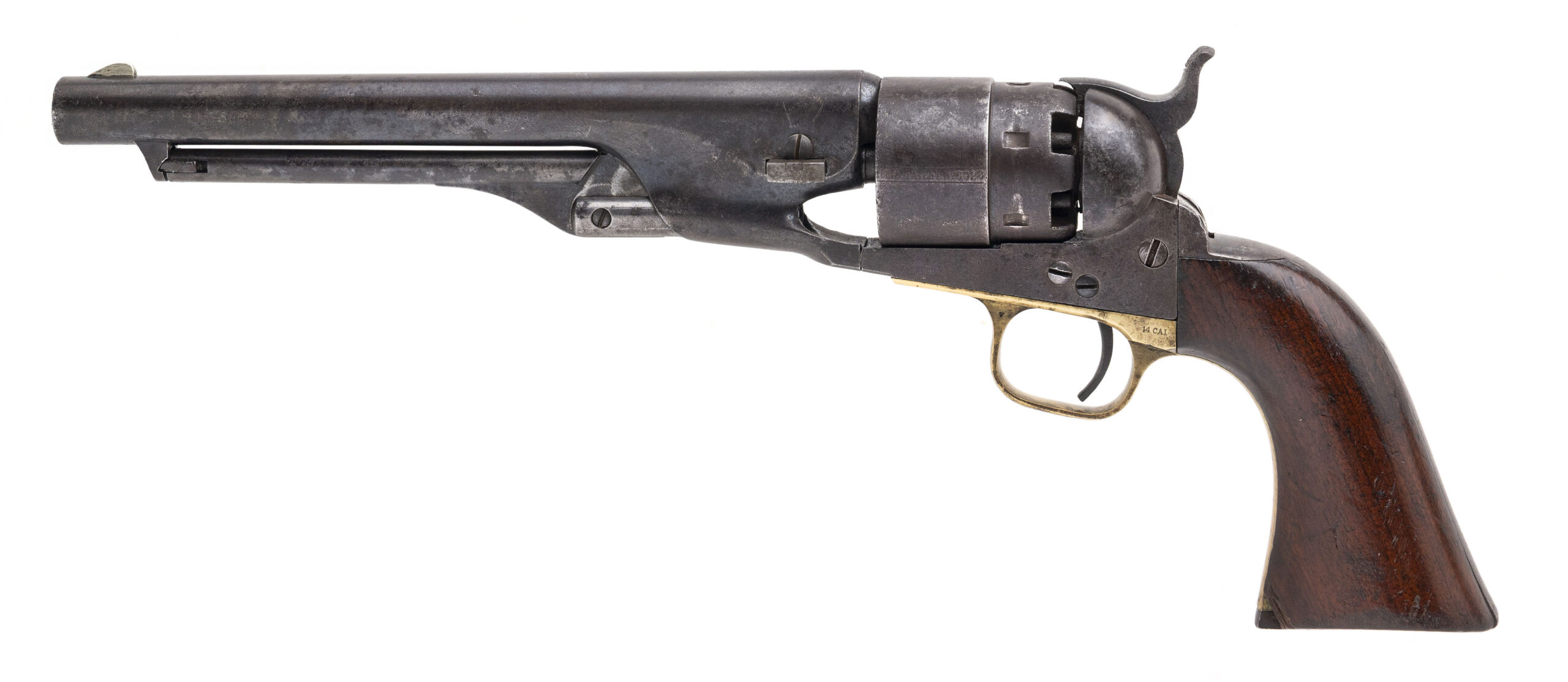
Colt 1860 ArmyFor sale
Officers carried revolvers such as the Colt Army as their real close-quarters weapon. Continued…
-
Minié Ball
The hollow-based Minié bullet was the standard rifle-musket ammunition of both sides. Continued…
-
Parrott Rifle
Union Parrott rifles on Morris Island joined the fleet in the day-long bombardment before the attack. Continued…
-
Siege Mortar
Union mortars dropped shells into the fort all afternoon, but the garrison sat out the fire in its bombproof shelter. Continued…
Sources
Wise, Stephen R. Gate of Hell: Campaign for Charleston Harbor, 1863. University of South Carolina Press, 1994.
Emilio, Luis F. A Brave Black Regiment: History of the Fifty-Fourth Regiment of Massachusetts Volunteer Infantry, 1863-1865. Boston Book Company, 1894.
Burchard, Peter. One Gallant Rush: Robert Gould Shaw and His Brave Black Regiment. St. Martin's Press, 1965.
Duncan, Russell, ed. Blue-Eyed Child of Fortune: The Civil War Letters of Colonel Robert Gould Shaw. University of Georgia Press, 1992.
Suggest an edit · account required · reviewed before publishing · how it works