Colt 1860 Army
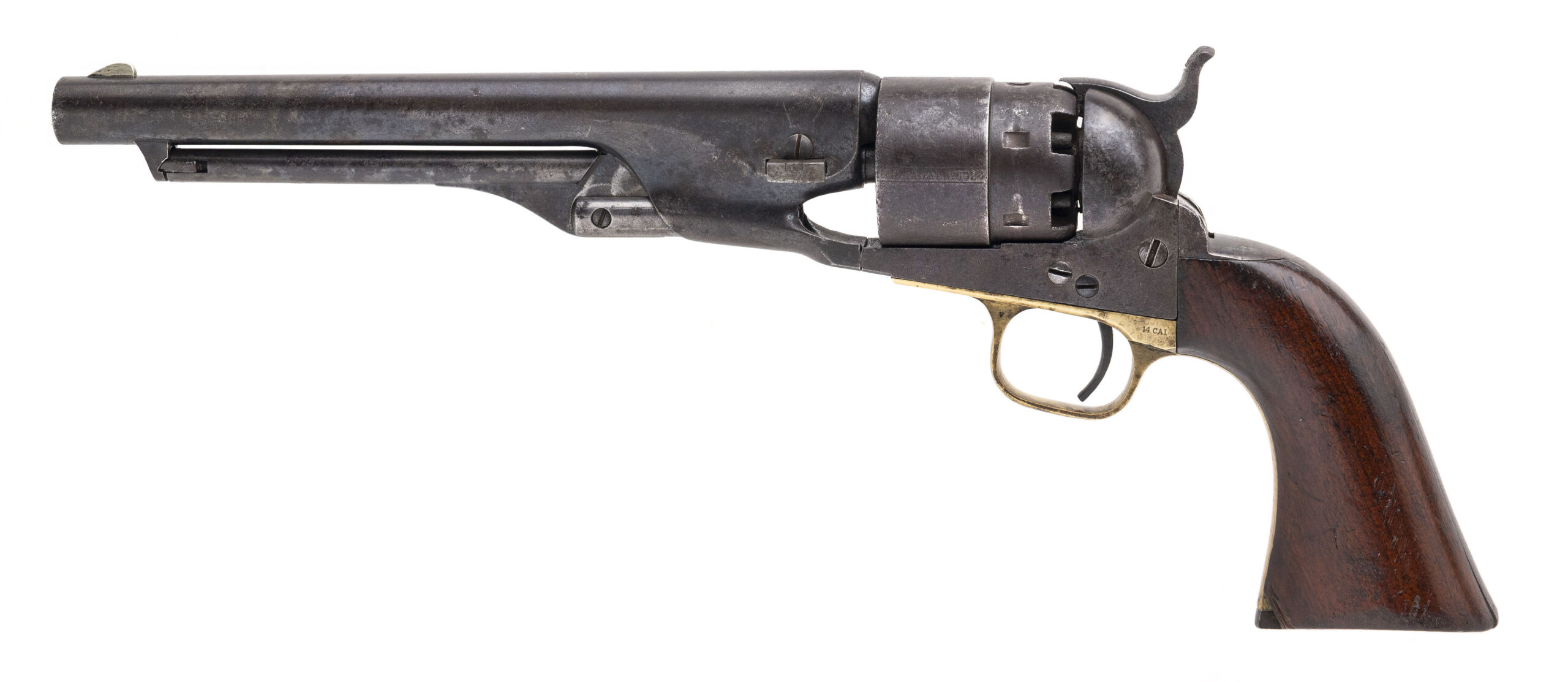
The Colt 1860 Army was the principal revolver of the Union cavalry in the American Civil War: a six-shot .44 caliber percussion revolver with an eight-inch round barrel, a streamlined rebated cylinder and a creeping loading lever. It put the stopping power of the four-pound Colt Dragoon into a gun weighing under three pounds. The United States government bought some 127,000 during the war, and about 200,000 were made before production ended in 1873, when the cartridge Single Action Army replaced it.
Also known as Colt Model 1860 Army, 1860 Army, New Model Army Pistol, Colt New Model Holster Pistol, Colt .44 Army
Origins
In the 1850s the U.S. Army's horse soldiers carried the Colt Dragoon, a .44 revolver so heavy — over four pounds — that it lived in a saddle holster rather than on the belt, and the lighter Colt 1851 Navy Revolver, whose .36 ball many officers thought too small. Colt's answer, introduced in 1860, combined the two. By using a new, stronger silicon steel, the factory could make a .44 cylinder with thinner walls, then step (rebate) the rear of the cylinder so it fitted a Navy-sized frame. The result, marketed as the "New Model Holster Pistol," weighed about 2 pounds 11 ounces, and the Ordnance Department adopted it as the Army's standard revolver.
Design & Construction
The 1860 Army is an open-frame, single-action percussion revolver: there is no strap over the cylinder, and the barrel is held to the frame by a wedge through the cylinder arbor. The shooter loads each of the six chambers from the front with powder and a conical or round ball — or a combustible paper cartridge — rams it home with the "creeping" loading lever under the barrel, which uses a rack-and-pinion for leverage, and places a percussion cap on each nipple. The eight-inch barrel is round and streamlined; the brass trigger guard and one-piece walnut grip are classic Colt, and many frames were cut to take a detachable shoulder stock that turned the pistol into a light carbine. The cylinder is roll-engraved with a naval scene carried over from the Navy model. Like every percussion revolver, it was slow to reload in action, and cavalrymen who could afford it carried a second revolver or spare loaded cylinders rather than recharge chambers in the saddle.
Combat Use
The 1860 Army armed the Union cavalry through the American Civil War; the government bought about 127,000 of them, more than any other revolver; the Remington 1858 New Model Army came second, and filled the gap after a fire destroyed much of Colt's Hartford armory in February 1864. Confederate troops captured and prized them. After the war the 1860 Army went west with the regulars, including the Buffalo Soldiers of the new 9th and 10th Cavalry, and many were converted in the early 1870s to fire metallic cartridges under the Richards and Richards-Mason patents.
Legacy
Colt made about 200,000 1860 Armies before production ended in 1873, the year the cartridge Colt Single Action Army replaced it; the SAA's lines descend directly from the 1860's. Original martially marked examples with cavalry history are highly prized by collectors. The 1860 is also one of the most reproduced revolvers in the world: Italian makers such as Uberti and Pietta, and importers such as Traditions, sell faithful black-powder copies that are a staple of Civil War reenacting and cowboy action shooting. Modern reproductions are not firearms under U.S. federal law, but several states regulate them.
Sources
Haven, Charles T., and Frank A. Belden. A History of the Colt Revolver. William Morrow, 1940.
Wilson, R. L. Colt: An American Legend. Abbeville Press, 1985.
Edwards, William B. Civil War Guns. Stackpole, 1962.
Flayderman, Norm. Flayderman's Guide to Antique American Firearms and Their Values. 9th ed. Gun Digest Books, 2007.
Suggest an edit · account required · reviewed before publishing · how it works