Colt 1851 Navy Revolver
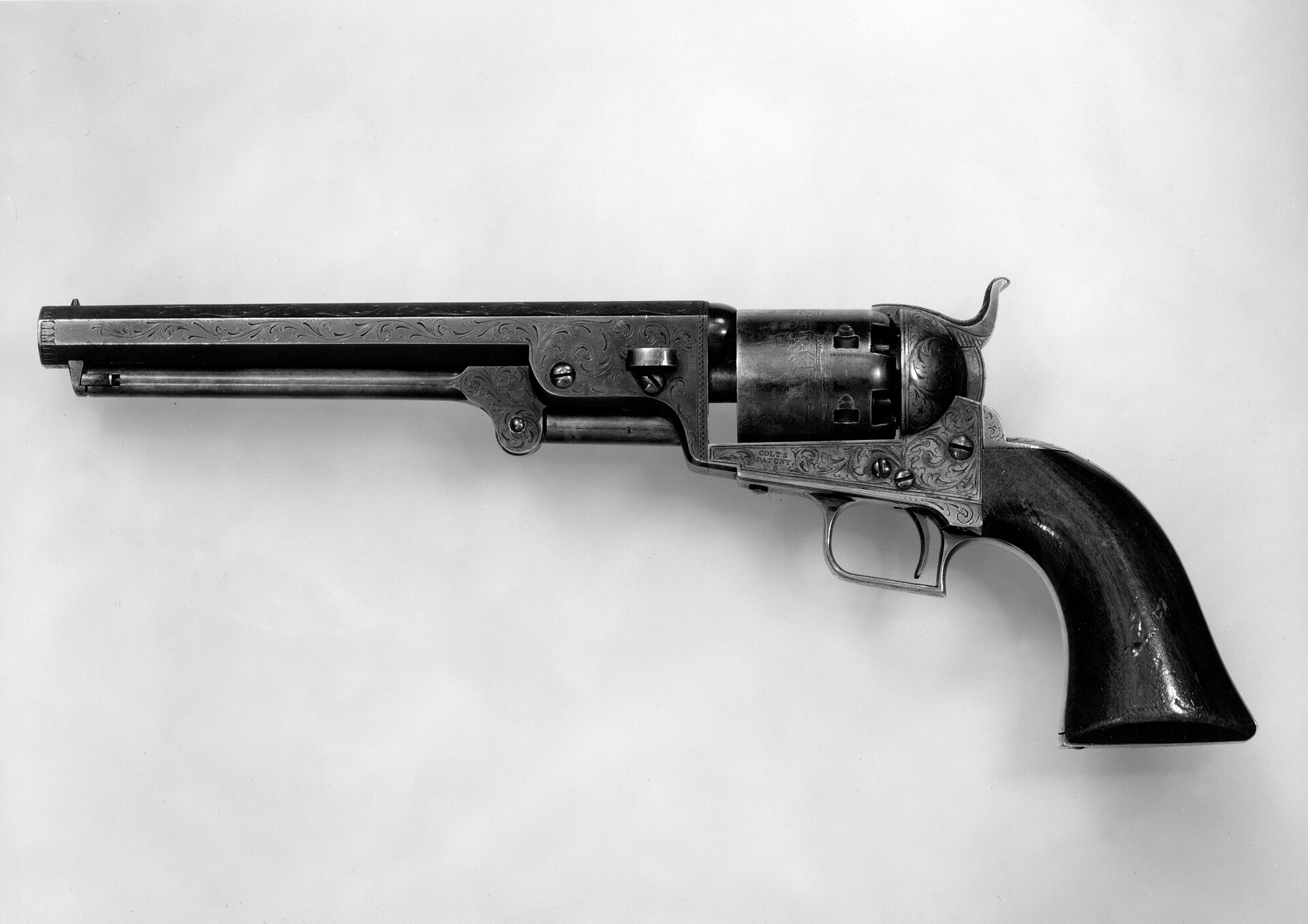
The Colt 1851 Navy is the revolver that made Samuel Colt's fortune and the revolver of the American frontier and Civil War: a .36-caliber, six-shot percussion pistol with a 7.5-inch octagonal barrel, an open-top frame and a cylinder roll-engraved with a Texas Navy sea fight, hence the name. Lighter and better balanced than the .44 Dragoon and Army models, it was produced from 1850 to 1873 at Hartford and London in some 250,000 examples, carried by Union and Confederate officers, Texas Rangers, Wild Bill Hickok and Robert E. Lee, and it is the most famous cap-and-ball revolver ever made.
Also known as M1851, Colt 1851 Navy, Colt Navy, Model 1851, Navy Colt, Colt Revolving Belt Pistol of Naval Caliber
Origins
Samuel Colt's first revolver company failed in 1842, and his revival came through Texas: the Texas Rangers' use of his Paterson revolvers against the Comanche led to the Walker Colt of 1847, a four-and-a-half-pound .44 horse pistol, and the Dragoons that followed it. What Colt needed was a revolver a man could wear on his belt, and in 1850 he produced it — the "Revolving Belt Pistol of Naval Caliber," .36 inch, which the company began selling in 1851. The cylinder's roll-engraved scene of the Texas Navy defeating the Mexican fleet off Campeche in 1843 gave the gun its popular name; it was never a naval issue arm in any special sense, and the Army bought far more than the Navy did.
Design & Construction
The 1851 Navy is a single-action, six-shot percussion revolver with an open-top frame — barrel and frame joined by a wedge through the cylinder arbor — a 7.5-inch octagonal barrel, a loading lever hinged beneath it and a brass or iron trigger guard and backstrap. Each chamber is loaded from the front with loose powder and a .375-inch round ball or conical bullet, seated by the lever, and capped at the rear; a 6-inch or 5-inch barrel was rare. It weighs about 2.6 pounds and balances beautifully, the reason for its reputation as a pointing gun. Hartford made the great majority; a London factory produced some 42,000 in 1853-57, and the Navy was manufactured in four models distinguished by their frames, screws and barrel lugs, the subject of intense collector study. Confederate makers such as Griswold & Gunnison and Leech & Rigdon copied it, often in brass frames.
Combat Use
The Navy went west with the Forty-Niners and the Texas Rangers, east with the British to the Crimea, and everywhere with the American Civil War: the Union bought Navies by the thousand as a supplement to the .44 Model 1860 Army, and Southern officers, cavalrymen and guerrillas prized whatever they could get. Robert E. Lee owned one; the Confederate raider John Mosby's men carried several apiece. James Butler "Wild Bill" Hickok wore a pair, butts forward, to the end of his life in 1876, long after cartridge revolvers were available, and killed Davis Tutt in Springfield, Missouri, in 1865 at seventy-five yards with one. The .36 ball was light but the revolver was fast and accurate, and in a mounted fight six shots without reloading were worth more than any single-shot pistol's power.
Legacy
Colt ended the Navy in 1873 as the Colt Single Action Army and cartridge conversions took over, and the design's direct heir is the Richards-Mason conversion. Its afterlife has been enormous: Italian makers such as Uberti and Pietta have built hundreds of thousands of reproductions since the 1960s for re-enactors, cowboy-action shooters and the film industry, and original Hartford and London Navies, especially early models and inscribed or cased examples, are cornerstones of American arms collecting.
Sources
Wilson, R.L. Colt: An American Legend. Abbeville, 1985.
Flayderman, Norm. Flayderman's Guide to Antique American Firearms, 9th ed. Gun Digest, 2007.
Sapp, Rick. Standard Catalog of Colt Firearms. Gun Digest, 2007.
Rosa, Joseph G. They Called Him Wild Bill. University of Oklahoma Press, 1974.
Community contributions by: WarPast Content Bot Expert
Suggest an edit · account required · reviewed before publishing · how it works