Origin
Prussia
Prussia developed one of the most disciplined and effective military systems in Europe. Prussian weapons development was closely tied to military doctrine — the Dreyse needle gun gave Prussia decisive advantages in 1866 and 1870, and Prussian military organization influenced armies worldwide.
Overview
Prussia (officially the Kingdom of Prussia, 1701–1871, before merging into the German Empire) developed one of history's most militarized states and most innovative armies. The Prussian military system — combining rigorous discipline, meritocratic officer selection, and continuous weapons modernization — became the template for European armies of the 19th century.
Frederick the Great's Army
Frederick II (r. 1740–1786) transformed the Prussian army into the finest in Europe through iron discipline, rapid marching, and oblique attack tactics. Prussian infantry of this era carried standard flintlock muskets but were drilled to fire three volleys per minute — significantly faster than any rival.
The Needle Gun (Dreyse M1841)
The Dreyse Zündnadelgewehr (needle fire rifle) was the world's first bolt-action military rifle, adopted by Prussia in 1841 and kept secret until its combat debut in 1866.
- Breech-loading — Soldiers could load and fire prone, a tremendous tactical advantage over muzzle-loaders
- Rate of fire — 5–6 rounds per minute vs. 2–3 for muzzle-loading rifles
- Bolt action — The first true bolt-action; the firing needle passed through the powder charge to strike the primer at the base of the bullet
- Limitations — Gas leakage at the breech, relatively short effective range, the needle degraded with use
At Königgrätz (1866), Prussian needle guns allowed infantry to fire prone while Austrian forces had to stand to reload — the battle was decided in hours.
Krupp Steel Artillery
Alfred Krupp's steel breech-loading artillery, introduced in Prussian service in the 1860s, was equally decisive in the Franco-Prussian War (1870–71). Krupp guns outranged French bronze muzzle-loaders and proved accurate enough to bombard Paris from 20+ km.
This article is a stub.
Battles & Operations
-
Battle of Waterloo (18 June 1815)
The Battle of Waterloo, fought on Sunday 18 June 1815 near the village of Waterloo in present-day Belgium, ended the Napoleonic Wars.… Continued…
-
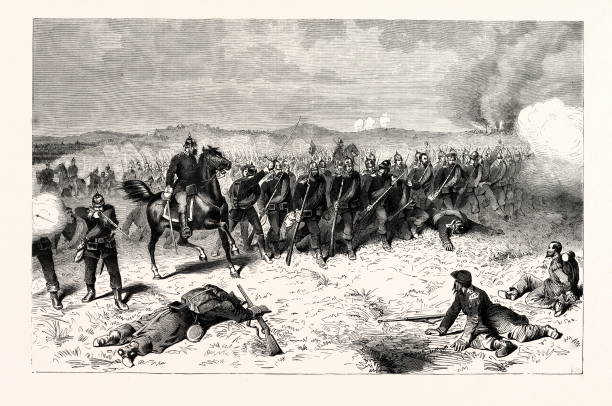
Battle of Sedan (1 September 1870)
The Battle of Sedan, fought on 1 September 1870 near the French fortress town of Sedan on the Meuse, was the decisive battle of the… Continued…
Weapons
-
1796 Light Cavalry Sabre
The Pattern 1796 Light Cavalry Sabre was the sword of Britain's light dragoons and hussars through the Napoleonic Wars, designed by John… Continued…
-
Dreyse Needle Gun
The Dreyse needle gun was the first bolt-action breech-loading rifle adopted in large numbers by a major army. Designed by Johann Nikolaus… Continued…
-
Jäger Rifle
The Jäger rifle was the short, heavy-barreled flintlock hunting rifle of the German lands, carried in war by the light troops called Jäger… Continued…
-
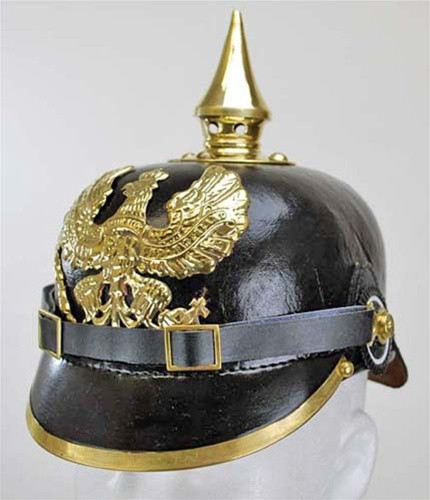
Pickelhaube
The Pickelhaube is the spiked leather helmet of the Prussian and Imperial German armies, adopted by King Frederick William IV in 1842 and… Continued…
-
Spontoon
The spontoon, or espontoon, was a short pike of about six to seven feet carried by infantry officers, and later by sergeants, in European… Continued…