Pickelhaube
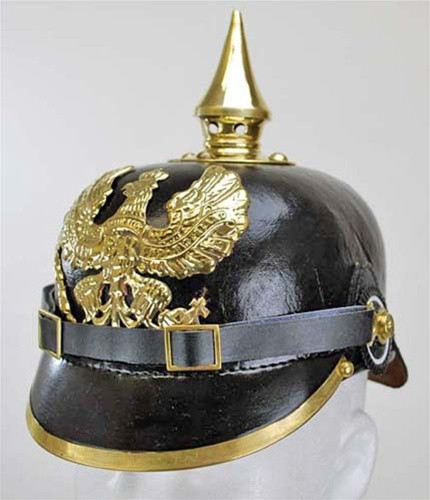
The Pickelhaube is the spiked leather helmet of the Prussian and Imperial German armies, adopted by King Frederick William IV in 1842 and worn into the trenches of the First World War. Made of molded, lacquered leather with brass or steel fittings, a spike on top and an eagle plate on the front, it marked its wearer's state and regiment at a glance. It gave almost no protection against shell fragments and was replaced by the steel Stahlhelm in 1916, but it remains the most recognizable symbol of Imperial Germany and a cornerstone of militaria collecting.
Also known as Pickelhaube, spiked helmet, Helm mit Spitze, Lederhelm, M1842, M1895, M1915
Origins
In 1842 Frederick William IV of Prussia introduced a new helmet for most of his army, replacing the shako. The design is often credited to the king himself, and several German states and Russia adopted similar helmets at about the same time. Its name, from the German Pickel (point) and Haube (bonnet), was at first informal slang. After the Franco-Prussian War and German unification in 1871 the Pickelhaube spread to nearly every contingent of the Imperial army except the Bavarians, who adopted their own version later, and it became the symbol of Prussian Arms & Weapons military power.
Design & Construction
The standard helmet is made of boiled and molded leather, lacquered black, with a front and a rear visor, a spike on a cruciform base, and a brass or steel frontplate bearing the arms of the wearer's state — the Prussian eagle, the Saxon star, the Württemberg arms. Chinscales or a leather strap held it on, and round cockades in national and state colors were fixed on each side. The spike was vented to help cool the head. Artillery helmets carried a ball, the Kugel, instead of a spike, and cuirassiers and some other units wore metal versions. Officers' helmets were finer, with higher crowns and better fittings. The model 1895 and later patterns were lowered and lightened, and in 1914 a cloth cover in field grey, the Überzug, hid the shiny fittings. Wartime shortages brought ersatz helmets of felt, pressed card and even sheet metal, and from 1915 the spike was made removable.
Combat Use
The Pickelhaube went to war in 1864 against Denmark, in 1866 against Austria and in 1870 against France, where Prussian columns armed with the needle gun made it the helmet of victory. It was issued to every German infantryman in 1914, alongside the Mauser Gewehr 98, and the first months of World War I showed its weakness: leather stopped nothing, and trench warfare brought a flood of head wounds from shell fragments and shrapnel. The spike stood above the parapet to invite a sniper's aim. The German army began issuing the steel Stahlhelm M1916 at Verdun and the Somme in 1916, and by 1917 the Pickelhaube had been withdrawn from the front, surviving only in parades and at home. Its British counterpart in the trenches was the Brodie Helmet.
Legacy
The Pickelhaube was abolished with the Imperial army in 1918, but not before Allied soldiers had carried home tens of thousands as prized souvenirs, which is why they are common today. The spiked helmet was also copied abroad: the British Home Service helmet of 1878 and the United States Army dress helmet of 1881 both borrowed its shape. For collectors the details matter — state plates, regimental markings, officer or enlisted grade, and wartime ersatz types — and reproductions are widespread. Allied propaganda made it the emblem of German militarism, and it remains the instant visual shorthand for Imperial Germany.
Sources
Kraus, Jürgen. Die deutsche Armee im Ersten Weltkrieg: Uniformierung und Ausrüstung 1914 bis 1918. Verlag Militaria, 2004.
Thomas, Nigel. The German Army in World War I (1): 1914-15. Osprey Men-at-Arms 394, 2003.
Dean, Bashford. Helmets and Body Armor in Modern Warfare. Yale University Press, 1920.
Baer, Ludwig. Vom Stahlhelm zum Gefechtshelm. Vol. 1. Neu-Anspach, 1994.
Suggest an edit · account required · reviewed before publishing · how it works