First Battle of the Marne
The First Battle of the Marne was fought east of Paris from 5 to 12 September 1914. After a month of German advances through Belgium and northern France, the French army under General Joseph Joffre and the British Expeditionary Force turned and counter-attacked. A gap opened between two German armies, and the Allies advanced into it. The Germans retreated to the River Aisne and dug in. The battle ended German hopes of a quick victory in the west and led to four years of trench warfare. Each side lost roughly a quarter of a million men in the campaign.
Also known as Battle of the Marne, Marne 1914, Miracle of the Marne, Première bataille de la Marne, Marneschlacht, Battle of the Ourcq
Background
When World War I began in August 1914, Germany planned to defeat France quickly before turning against Russia. Most of the German army swung through neutral Belgium to go around the French defenses and come down on France from the north. The French attacked in Lorraine and the Ardennes in the Battle of the Frontiers and lost very heavily. The British Expeditionary Force, about 100,000 regular soldiers under Sir John French, fought at Mons on 23 August and at Le Cateau on 26 August. The Allied armies then fell back for two weeks in the Great Retreat. By the end of August the German First Army under General Alexander von Kluck, on the outer edge of the advance, turned south-east to keep contact with the Second Army of General Karl von Bülow. This took it past the east side of Paris and exposed its flank. General Joseph Joffre had formed a new Sixth Army near Paris under General Michel-Joseph Maunoury, and General Joseph Gallieni, the military governor of Paris, urged an attack.
The Battle
On 5 September Maunoury's army ran into Kluck's flank guard near the River Ourcq, and on 6 September Joffre launched a general counter-offensive along a front of more than 100 miles. Kluck turned his whole army west to meet Maunoury, and this opened a gap of about 30 miles between his army and Bülow's. The British and the French Fifth Army, now under General Louis Franchet d'Espèrey, advanced slowly into the gap. To the east, General Ferdinand Foch's new Ninth Army held against heavy German attacks around the marshes of Saint-Gond. On the night of 6-7 September several thousand French soldiers were carried to the Ourcq front in Paris taxis. The episode became famous, although its military effect was small. The German commander, Helmuth von Moltke, was far away at his headquarters in Luxembourg and had poor communications with his armies. On 8 September he sent a staff officer, Lieutenant-Colonel Richard Hentsch, to visit them. Bülow was already preparing to fall back, and Hentsch agreed. On 9 September the German First and Second Armies began to retreat, and the other armies followed.
Weapons
Rifles, machine guns and quick-firing artillery made open ground deadly. The French relied on the French 75 and the Lebel Model 1886, with machine guns such as the Hotchkiss M1914 and its predecessors. French infantry still wore blue coats and red trousers. The Germans carried the Mauser Gewehr 98 and the Maxim Gun in its MG 08 form, and wore the Pickelhaube. The British fought with the Lee-Enfield Rifle, the Pattern 1907 Bayonet and the Vickers Machine Gun.
Aftermath
The Germans fell back about 40 miles to the River Aisne and dug trenches on the high ground north of it. The Allies attacked there from 13 September but could not break through. Moltke was replaced by Erich von Falkenhayn. Each side then tried to get around the other's northern flank in the so-called Race to the Sea, and by November a line of trenches ran from the Channel coast to Switzerland. Casualties are hard to separate from the rest of the campaign, but both the French and German armies lost roughly 250,000 men in the fighting of early September, and the British about 13,000. The French called it the Miracle of the Marne. It saved Paris and ended the German plan for a quick war, but it also began the long stalemate of the Western Front.
Weapons used
-
French 75
French batteries of the 75 mm quick-firing field gun broke up German attacks with shrapnel and supported the French counter-offensive. Continued…
-
Lebel Model 1886
The rifle of the French infantry who turned and attacked after the long retreat from the frontier. Continued…
-
Hotchkiss M1914
Hotchkiss guns, mostly still the earlier Model 1900, served with the French infantry alongside the Saint-Étienne machine gun. Continued…
-
Mauser Gewehr 98
The rifle of the German infantry of the five armies that fought along the Marne. Continued…
-
Maxim Gun
In its German MG 08 form it gave German infantry heavy defensive firepower on the Ourcq and at the Marne crossings. Continued…
-
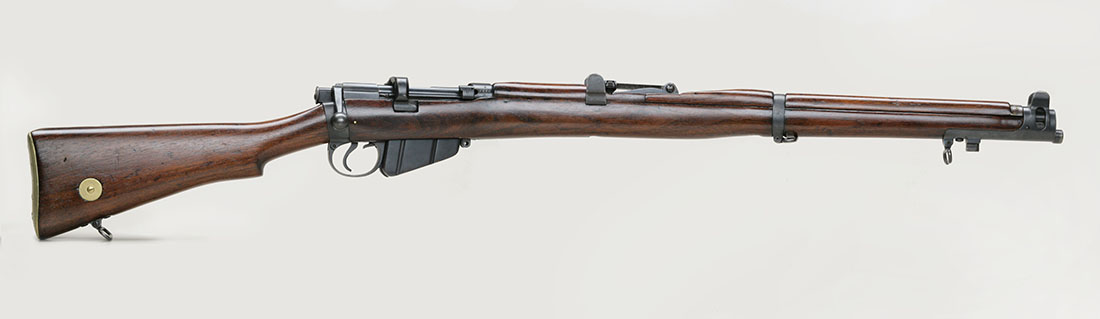
Lee-Enfield Rifle
The rifle of the British Expeditionary Force, whose regulars were trained for rapid, accurate fire. Continued…
-
Vickers Machine Gun
Each British battalion had two machine guns in 1914, Vickers or older Maxims. Continued…
-
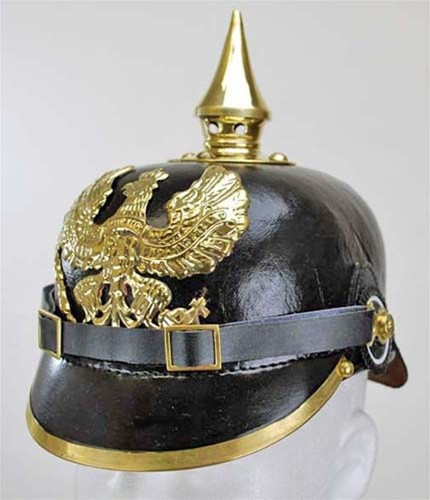
Pickelhaube
German soldiers still went to war in the spiked leather helmet, usually worn under a cloth cover. Continued…
-
Pattern 1907 Bayonet
The long sword bayonet fixed to the British Lee-Enfield. Continued…
Sources
Herwig, Holger H. The Marne, 1914: The Opening of World War I and the Battle That Changed the World. Random House, 2009.
Strachan, Hew. The First World War, Volume I: To Arms. Oxford University Press, 2001.
Doughty, Robert A. Pyrrhic Victory: French Strategy and Operations in the Great War. Belknap Press of Harvard University Press, 2005.
Tuchman, Barbara W. The Guns of August. Macmillan, 1962.
Suggest an edit · account required · reviewed before publishing · how it works