Lee-Enfield Rifle
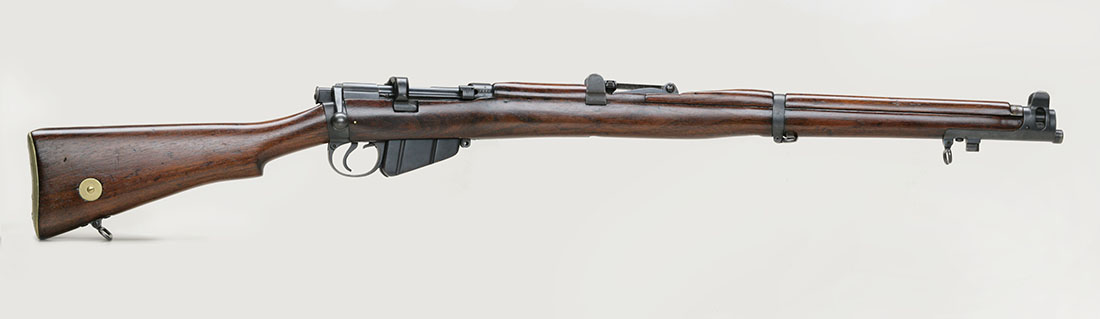
The Lee-Enfield was the British Empire's rifle for over half a century: a bolt-action .303 whose rear-locking action and ten-round magazine made it the fastest-cycling military bolt gun ever issued. The trained rapid fire of the BEF at Mons in 1914 was mistaken by the Germans for massed machine guns, and the rifle served from the Boer War's lessons through both World Wars into the 1950s, with well over ten million produced across the Empire.
Also known as SMLE, Short Magazine Lee-Enfield, Rifle No. 1 Mk III, Rifle No. 4
Origins
The rifle marries James Paris Lee's rear-locking bolt and detachable box magazine to Enfield's rifling, adopted together in 1895 as the Lee-Enfield after the Lee-Metford's black-powder rifling proved wrong for cordite. Boer War marksmanship embarrassed the long original pattern, and the 1903 answer was heresy that worked: one "short" rifle for every arm of service — the Short Magazine Lee-Enfield. The Mk III of 1907 was the rifle of the Great War; the simplified No. 4 of 1941 carried the Second.
Design & Construction
Everything about the action favors speed. The bolt's lugs lock at the rear, giving a short 60-degree lift; the striker cocks on closing, so the forward stroke does the work of the German Mauser's heavy opening lift; and the smooth, almost slippery cycle lets a practiced shot work the bolt with thumb and forefinger without leaving the aim. The detachable magazine held ten rounds of .303 — double the Mauser's five — fed by five-round chargers from the top. The full-length furniture, blunt nose cap, and long 17-inch sword bayonet of the SMLE made a distinctive silhouette; the No. 4 traded them for a heavier free-er floating barrel, an aperture rear sight, and production economy.
Combat Use
The pre-war British Army's musketry standard — the "mad minute," fifteen aimed rounds at 300 yards, with the best men far beyond — turned the rifle's mechanical speed into doctrine. At Mons and Le Cateau in 1914 the old Regulars fired so fast that German accounts speak of walking into machine-gun belts. The rifle proved equally sound in Flanders mud, Gallipoli dust, and the deserts of two wars — the rear-locking action that theorists called weak simply kept working dirty. It served every Empire and Commonwealth force, the Gurkhas among its most famous carriers, and No. 4 (T) sniper conversions were among the finest issue sniping rifles of the Second World War.
Legacy
India and Pakistan produced and issued Lee-Enfields for decades after 1945, and working examples still surface in conflicts across Asia — a service life stretching past a century. For shooters it remains the standard answer to the question of how fast a bolt action can be; for collectors, the profusion of marks, factories, and unit markings across ten-million-plus rifles makes it one of the deepest fields in military arms. Its great rival deserves the comparison: the Mauser action won the engineering argument and gunsmithing posterity, but as a soldier's rifle in a soldier's war, the Lee-Enfield has the better combat record — and the M1 Garand that ended the bolt era entirely was answering both.
Sources
Skennerton, Ian. The Lee-Enfield: A Century of Lee-Metford and Lee-Enfield Rifles and Carbines. Ian Skennerton, 2007.
Pegler, Martin. The Lee-Enfield Rifle. Osprey Publishing, 2012.
Reynolds, E. G. B. The Lee-Enfield Rifle. Herbert Jenkins, 1960.
Suggest an edit · account required · reviewed before publishing · how it works