Battle of Sedan
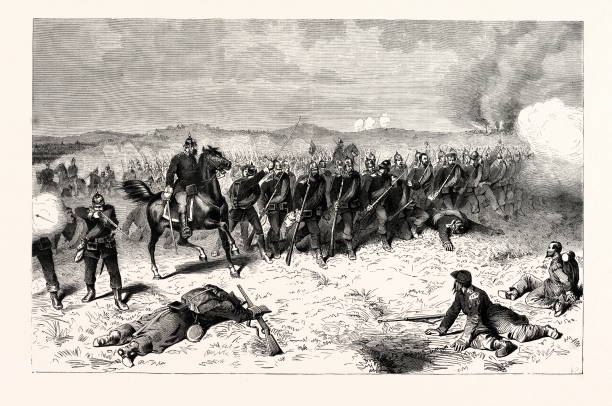
The Battle of Sedan, fought on 1 September 1870 near the French fortress town of Sedan on the Meuse, was the decisive battle of the Franco-Prussian War. German armies under Helmuth von Moltke surrounded Marshal MacMahon's Army of Châlons, and hundreds of Krupp breech-loading guns on the surrounding heights shelled the French into surrender. Emperor Napoleon III and more than 100,000 men were taken prisoner. Within days the Second Empire fell and the Third Republic was declared in Paris.
Also known as Sedan 1870, Bataille de Sedan, Schlacht von Sedan, Disaster of Sedan, Capitulation of Sedan, Sedantag, Battle of Bazeilles
Background
France declared war on Prussia on 19 July 1870, after a quarrel over the Spanish throne that Bismarck turned to his advantage. Prussia and its allies in the North German Confederation and the south German states mobilized faster, using their railways, and invaded Alsace and Lorraine. French defeats at Wissembourg, Wörth and Spicheren in early August were followed by the bloody battles of Mars-la-Tour and Gravelotte-St Privat on 16 and 18 August. Marshal Bazaine's Army of the Rhine was then shut up in the fortress of Metz. A new French army was formed at Châlons under Marshal Patrice de MacMahon, and Emperor Napoleon III, who was ill, went with it. Under pressure from Paris, MacMahon marched north-east to try to relieve Metz. Moltke, the Prussian chief of staff, turned the Third Army and the new Army of the Meuse north to follow him. After a sharp defeat at Beaumont on 30 August, MacMahon fell back on Sedan, a small fortress in a bowl of hills beside the Meuse near the Belgian border. The French army, about 120,000 men, camped there on 31 August, and German troops began to close round it.
The Battle
Fighting began before dawn on 1 September when Bavarian troops attacked the village of Bazeilles, south-east of the town, where French marine infantry defended the houses street by street. Early in the morning MacMahon was wounded by a shell. General Ducrot, who took over, ordered a retreat west toward Mézières, which might still have saved part of the army. General de Wimpffen then produced an order from Paris giving him the command, canceled the retreat and tried to break out to the east. Meanwhile two Prussian corps had crossed the Meuse west of Sedan and marched round the French northern flank. Around midday they joined the Prussian Guard near Illy, and the ring was closed. German batteries, massing on the heights on every side, poured fire into the crowded French positions in the valley and the Bois de la Garenne. In the early afternoon French cavalry under General Margueritte, including the Chasseurs d'Afrique, made repeated charges near Floing to open a way out. Margueritte was mortally wounded and the charges failed with heavy losses. By late afternoon beaten troops were pouring into Sedan itself, where shells were falling on the streets. Napoleon III ordered a white flag raised and wrote to King Wilhelm I to surrender his sword.
Weapons
The battle was won above all by the German artillery. After a poor showing in 1866, the Prussians had equipped their batteries with Krupp steel breech-loading field guns, the 4-pounder and 6-pounder, and trained them to move forward boldly and mass their fire. These guns fired shells with percussion fuzes that burst on impact, out-ranged the French bronze muzzle-loading rifled guns and could be fired faster. At Sedan several hundred German guns ringed the French army, and their fire decided the day. The French Chassepot Rifle out-ranged the Dreyse Needle Gun of the German infantry, but the French could not use that advantage when they were trapped and under shellfire. The Reffye Mitrailleuse batteries fought as artillery and suffered like the rest of the French guns. Prussian infantry wore the Pickelhaube.
Aftermath
The capitulation was signed on 2 September at the Château de Bellevue near Frénois. Napoleon III met Bismarck and became a prisoner. French losses on 1 September were roughly 17,000 killed and wounded and some 21,000 captured, and about 83,000 more surrendered with the army, so well over 100,000 men went into captivity. German losses were about 9,000 killed, wounded and missing, though figures vary. On 4 September a crowd in Paris overthrew the empire and the Third Republic was proclaimed. The war did not end: the Germans besieged Paris, Metz surrendered in October, and new French armies fought on until an armistice in January 1871. On 18 January the German Empire was proclaimed at Versailles, and the Treaty of Frankfurt in May gave Germany Alsace and much of Lorraine. The whole war is covered in the Franco-Prussian War overview.
Weapons used
-
Chassepot Rifle
The French infantry's long-ranged Chassepot could not break the German ring once the French army was trapped under artillery fire. Continued…
-
Dreyse Needle Gun
Prussian and other German infantry closed the encirclement armed with the Dreyse needle gun. Continued…
-
Reffye Mitrailleuse
French mitrailleuse batteries fought beside the field guns and were shelled and overrun as the ring tightened. Continued…
-
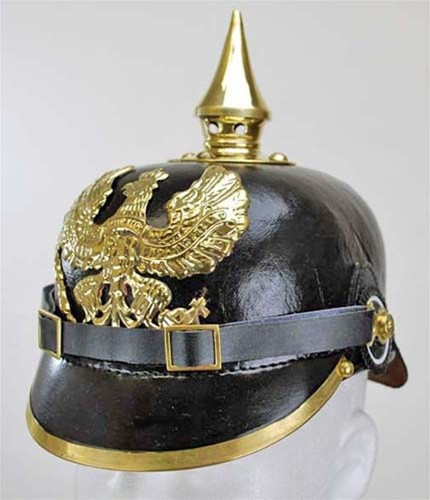
Pickelhaube
The spiked leather helmet was worn by the Prussian infantry who fought at Sedan. Continued…
Sources
Howard, Michael. The Franco-Prussian War: The German Invasion of France, 1870-1871. Rupert Hart-Davis, 1961.
Wawro, Geoffrey. The Franco-Prussian War: The German Conquest of France in 1870-1871. Cambridge University Press, 2003.
Showalter, Dennis. The Wars of German Unification. Arnold, 2004.
Badsey, Stephen. The Franco-Prussian War 1870-1871. Osprey, 2003.
Suggest an edit · account required · reviewed before publishing · how it works