Battle of Waterloo
The Battle of Waterloo, fought on Sunday 18 June 1815 near the village of Waterloo in present-day Belgium, ended the Napoleonic Wars. Napoleon Bonaparte, returned from exile on Elba, attacked the Anglo-allied army of the Duke of Wellington on the ridge of Mont-Saint-Jean; Wellington's line held through a day of assaults on Hougoumont, La Haye Sainte and the infantry squares until Blücher's Prussians broke into the French right flank and the Imperial Guard's final attack was repulsed. Napoleon abdicated four days later and died in exile on St Helena.
Also known as Waterloo, Bataille de Waterloo, Battle of Mont-Saint-Jean, La Belle Alliance
Background
Fought near Waterloo (present day Belgium) on Sunday June 18, 1815, this battle saw the final defeat of Napoleon Bonaparte. Napoleon had abdicated in 1814 and been exiled to Elba, but he landed in France on 1 March 1815, marched on Paris without a shot fired against him, and reclaimed his throne while the allied powers were still arguing at the Congress of Vienna. Two allied armies stood in Belgium: the Duke of Wellington's Anglo-allied force of British, King's German Legion, Hanoverian, Brunswick and Dutch-Belgian troops, and Field Marshal Blücher's Prussians. Napoleon's plan was to strike between them and beat each in turn. On 16 June he mauled the Prussians at Ligny while Marshal Ney fought Wellington to a draw at Quatre Bras; Wellington fell back to a ridge at Mont-Saint-Jean, south of the village of Waterloo, on Blücher's promise to march to his aid.
The Battle
Rain on the night of the 17th soaked the ground, and Napoleon delayed his attack until late morning to let it dry — time that mattered later. The battle opened around 11:30 with a diversionary assault on the walled château of Hougoumont on Wellington's right, which drew in ever more French troops and was held all day by the Guards. At about 1:30 d'Erlon's corps advanced against the allied center-left in dense columns and was broken by Picton's infantry and the charge of the Union and Household cavalry brigades, whose own pursuit then ran on to destruction among the French guns. Through the afternoon Ney launched massed cavalry — cuirassiers, lancers, Guard chasseurs — against Wellington's infantry, formed in squares on the reverse slope; the squares held. At about 6:30 the farm of La Haye Sainte in the center fell when its King's German Legion garrison ran out of rifle ammunition, and Wellington's line was at its thinnest. But by then Bülow's Prussian corps was fighting for the village of Plancenoit on the French right rear, and when Napoleon sent the Middle Guard up the slope at about 7:30 it was met by Maitland's Guards and the 52nd Foot and turned back. The cry "La Garde recule!" broke the French army, and the Prussian cavalry pursued it through the night.
Weapons
Waterloo was the last great battle of the flintlock age. The infantry of both sides fought with smoothbore muskets — the French Charleville Musket in its Model 1777 and An IX forms, the British Brown Bess Musket — effective in massed volleys at under a hundred yards. The rifled Baker Rifle of the 95th and the KGL light battalions picked off officers and gunners at longer range. Cavalry fought with lance and saber, the British light regiments carrying the 1796 Light Cavalry Sabre, and the day's killing was done above all by artillery: some 250 French guns against about 150 allied, firing round shot and canister, with the British also using Shrapnel's new spherical case shot.
Aftermath
Casualties were enormous for a single day on a few square miles: roughly 17,000 in Wellington's army, 7,000 Prussians, and perhaps 25,000 French killed and wounded with thousands more captured. Napoleon abdicated for the second time on 22 June and was exiled to St Helena, where he died in 1821. The battle ended twenty-three years of war and fixed the map of Europe for a generation. Britain issued the Waterloo Medal to every man present, the first campaign medal given to all ranks, and the battlefield — with Hougoumont, La Haye Sainte and the Lion's Mound — remains one of the most visited in the world.
Weapons used
-
Charleville Musket
The Model 1777 and its An IX revision armed every French line and Guard infantry battalion on the field. Continued…
-
Brown Bess Musket
The India Pattern Brown Bess armed Wellington's British line infantry, firing from line and from square against Ney's cavalry. Continued…
-
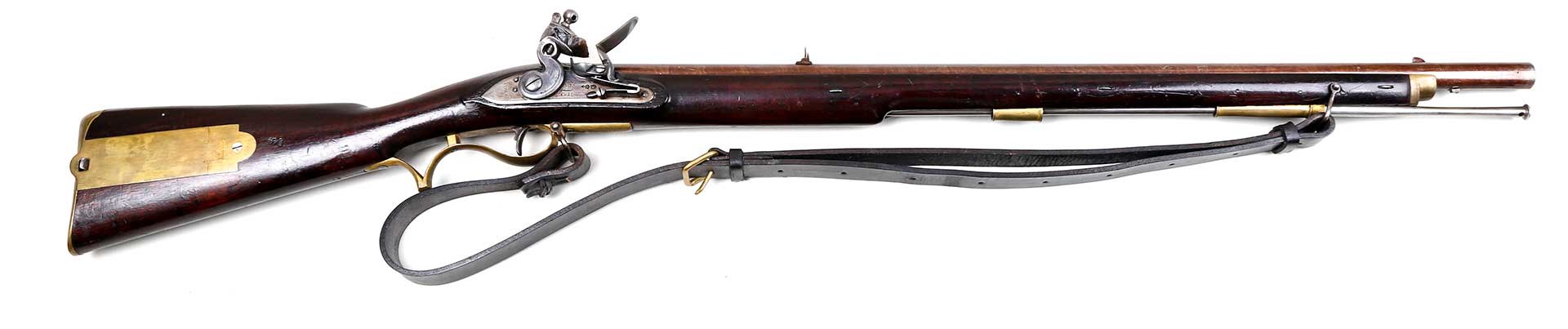
Baker Rifle
Carried by the 95th Rifles at the sandpit below La Haye Sainte and by the King's German Legion light battalions holding the farm. Continued…
-
1796 Light Cavalry Sabre
The saber of the British and KGL light dragoons and hussars, and of many Prussian cavalry regiments. Continued…
Sources
Barbero, Alessandro. The Battle: A New History of Waterloo. Atlantic Books, 2005.
Hofschröer, Peter. 1815: The Waterloo Campaign. 2 vols. Greenhill Books, 1998-1999.
Adkin, Mark. The Waterloo Companion. Aurum Press, 2001.
Siborne, William. History of the War in France and Belgium in 1815. T. & W. Boone, 1844.
Suggest an edit · account required · reviewed before publishing · how it works