Baker Rifle
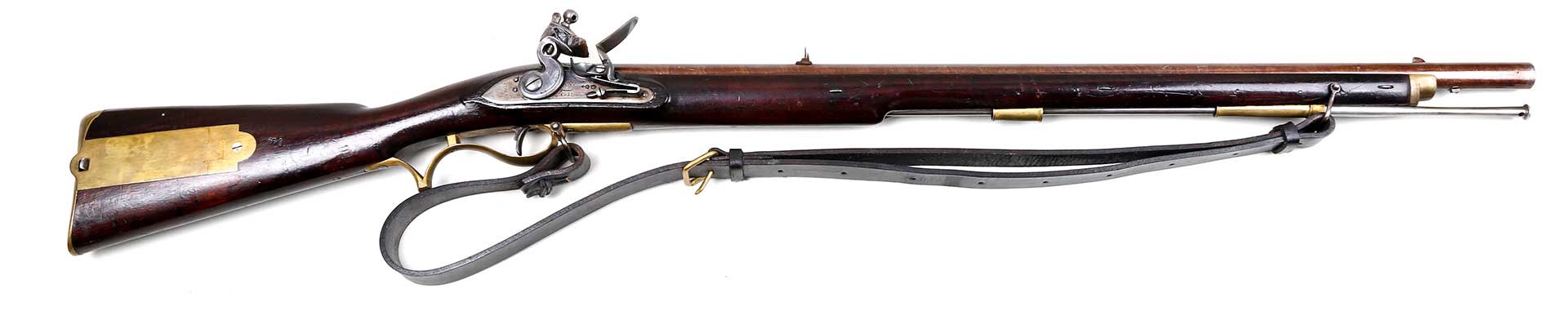
The Baker rifle was the first rifle officially adopted by the British Army, the weapon of the green-jacketed 95th Rifles and the rifle battalions of the 60th in the Peninsular War and at Waterloo. Designed by the London gunmaker Ezekiel Baker and adopted in 1800, it was a short, heavy flintlock of .625 caliber with seven-groove rifling and a long sword bayonet. Slower to load than a musket but accurate at two hundred yards and beyond, it let British skirmishers pick off officers and gunners, and it served until the Brunswick rifle replaced it in the late 1830s.
Also known as Baker, Pattern 1800 Infantry Rifle, rifle gun, 95th rifle
Origins
The British Army had used rifles in America, and had been on the wrong end of them, but it entered the Napoleonic Wars with no rifle of its own and hired German riflemen to fill the gap. In 1800 the Board of Ordnance held trials at Woolwich, and the design submitted by Ezekiel Baker, a Whitechapel gunmaker, outshot its rivals. It was adopted the same year for the new Experimental Corps of Riflemen, soon the 95th Regiment, and for the 5th Battalion of the 60th Foot. Baker himself published Remarks on Rifle Guns in 1803, a practical treatise that ran to many editions and remains one of the best period accounts of rifle shooting.
Design & Construction
The Baker is a short, stout flintlock with a 30-inch barrel of .625 bore, cut with seven grooves making a quarter turn in the barrel's length — a slow twist suited to a round ball. Overall it measures about 45¾ inches and weighs around nine pounds. A folding leaf rear sight and a blade fore sight replaced the musket's bare barrel, the butt carried a brass-lidded patchbox for greased leather or linen patches, and a scroll trigger guard gave the shooter a pistol-style grip. The rifle took the Pattern 1800 sword bayonet with a 23-inch blade, which made the short rifle as long as a musket in a bayonet fight, though the heavy sword spoiled its balance for shooting. Carbine-bore and musket-bore variants appeared later to simplify ammunition supply. Loading a patched ball was slow, and in action riflemen often used paper cartridges and a looser fit, trading accuracy for speed.
Combat Use
The Baker's campaign was the Peninsula, 1808-1814, where the 95th and the 5/60th, and the light battalions of the King's German Legion, screened Wellington's army, fought in open order, and targeted the French officers, sergeants and gunners who drove the enemy's attacks. Rifleman Thomas Plunket of the 95th became a legend for shooting the French general Auguste-Marie-François Colbert at Cacabelos in January 1809 at what witnesses called a very long range. At Waterloo in 1815 the 95th held the sandpit near La Haye Sainte, firing from cover into French columns carrying the Charleville Musket. The line infantry around them carried the Brown Bess Musket, and the rifle's slower rate of fire meant it complemented rather than replaced the smoothbore; the riflemen's value was in their marksmanship, their independence, and their dark green uniforms.
Legacy
The Baker served until 1838-40, when the Brunswick rifle with its two-groove belted ball replaced it, and it established the Rifle Brigade's tradition of light infantry marksmanship that still defines the British Army's rifle regiments. Bernard Cornwell's Sharpe novels and their television series made it famous again. Original Bakers are scarce and highly prized, particularly early examples with the Tower lock and 95th markings, and the rifle is widely reproduced for reenactors portraying the green jackets alongside the 1796 Light Cavalry Sabre of the same wars.
Sources
Blackmore, Howard L. British Military Firearms 1650-1850. Herbert Jenkins, 1961.
Bailey, De Witt. British Military Flintlock Rifles 1740-1840. Andrew Mowbray, 2002.
Baker, Ezekiel. Remarks on Rifle Guns. London, 1803 (and later editions).
Haythornthwaite, Philip J. British Rifleman 1797-1815. Osprey Warrior 47, 2002.
Suggest an edit · account required · reviewed before publishing · how it works