Battle of Stalingrad
The Battle of Stalingrad, fought from the late summer of 1942 to February 1943 in and around the Soviet city on the Volga, was the turning point of the war on the Eastern Front. The German Sixth Army fought its way into the city but could not drive the Soviet 62nd Army from a narrow strip along the river. In November 1942 Soviet offensives broke through the Romanian armies on the flanks and surrounded the Sixth Army. Relief and air supply failed, and Field Marshal Paulus surrendered at the start of February 1943.
Also known as Stalingrad, Siege of Stalingrad, Operation Uranus, Volgograd, Stalingrad campaign
Background
After the failure to take Moscow in 1941, Hitler turned his summer offensive of 1942, Operation Blue, to the south. Its main aim was the oil of the Caucasus, and a second thrust was to reach the Volga at Stalingrad, an industrial city of factories and workers' housing stretched for miles along the river's west bank. Taking it would cut Soviet river traffic and protect the flank of the drive to the oil fields. The German Sixth Army under General Friedrich Paulus crossed the Don and, on 23 August 1942, its tanks reached the Volga just north of the city while a huge Luftwaffe raid set much of Stalingrad on fire. Stalin's Order No. 227 of July, known as "Not a step back", forbade retreat.
The Battle
Through September and October the Germans fought their way into the city block by block. The Soviet 62nd Army under General Vasily Chuikov held on in the ruins with its back to the river, supplied by boats crossing the Volga under fire at night. Rodimtsev's 13th Guards Rifle Division crossed on 14-15 September and fought for the central landing stage and the hill of Mamayev Kurgan. The fighting moved to the great factories in the north, the Tractor Works, the Barrikady and Red October, where battles for a single workshop could last days. Chuikov ordered his men to stay as close as possible to the German lines so that the Luftwaffe could not bomb them without hitting its own troops. Small Soviet assault groups with submachine guns and grenades fought for cellars, stairwells and sewers. By November the Germans held most of the city, but the Soviets still clung to pockets along the bank. On 19 and 20 November the Red Army launched Operation Uranus, which smashed the weaker Romanian armies guarding the flanks north and south of the city. The two Soviet pincers met at Kalach on 23 November, trapping the Sixth Army and parts of the Fourth Panzer Army, perhaps 250,000 to 300,000 men. Hitler forbade a breakout. Göring promised to supply the pocket by air, but the Luftwaffe delivered only a fraction of what was needed. A relief attack under Field Marshal Erich von Manstein in December came within about 30 miles before it was stopped, and a new Soviet offensive against the Italian army on the Don forced it to turn back.
Weapons
The street fighting favored weapons for close range. Soviet assault groups carried the PPSh-41 and grenades, while riflemen held the ruins with the Mosin-Nagant M1891 and the SVT-40 Rifle, and snipers made the Mosin Nagant 1891/30 Sniper Rifle famous. The Molotov Cocktail was used against German tanks. The Germans fought with the Karabiner 98k, the MP40, machine guns and the Model 24 Stielhandgranate, and both sides relied heavily on artillery and mortars.
Aftermath
The Soviet final offensive, Operation Ring, began on 10 January 1943. Hitler promoted Paulus to field marshal on 30 January, expecting that no German field marshal would surrender, but Paulus gave himself up the next day, and the last Germans in the northern pocket surrendered on 2 February. About 91,000 prisoners were taken, and only some 5,000 to 6,000 of them returned home after the war. Estimates of total casualties on both sides run well over a million. Stalingrad destroyed a whole German army and ended Germany's offensive power in the south, and after it the initiative on the Eastern Front passed largely to the Red Army in World War II.
Weapons used
-
Mosin-Nagant M1891
The 91/30 bolt-action rifle was the standard arm of the Soviet riflemen who held the ruins along the Volga. Continued…
-
Mosin Nagant 1891/30 Sniper Rifle
Soviet snipers such as Vasily Zaitsev used the scoped 91/30 to hunt German officers and observers among the ruins. Continued…
-
PPSh-41
Soviet assault groups fighting through factories and cellars were armed heavily with PPSh submachine guns. Continued…
-
SVT-40 Rifle
The Tokarev semi-automatic rifle served alongside the Mosin in Soviet units, some of them fitted with telescopic sights. Continued…
-
Molotov Cocktail
Soviet infantry used bottles of flammable liquid against German tanks in the streets and at close range. Continued…
-
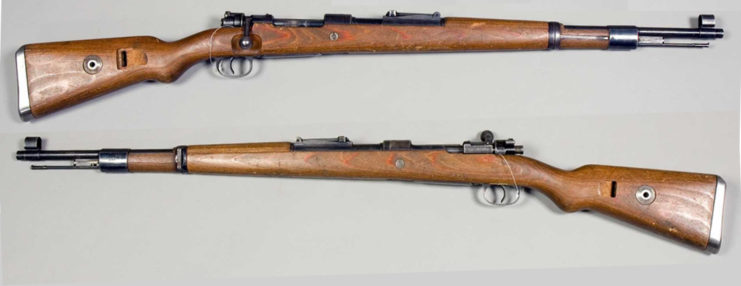
Karabiner 98k
The standard rifle of the German Sixth Army's infantry. Continued…
-
MP40
Carried by German squad leaders, and much prized in the room-to-room fighting the Germans called the 'war of the rats'. Continued…
-
Model 24 Stielhandgranate
The German stick grenade was used in huge numbers to clear cellars, sewers and factory halls. Continued…
Sources
Beevor, Antony. Stalingrad. Viking, 1998.
Glantz, David M., and Jonathan M. House. Armageddon in Stalingrad: September-November 1942. University Press of Kansas, 2009.
Glantz, David M., and Jonathan M. House. When Titans Clashed: How the Red Army Stopped Hitler. University Press of Kansas, 1995.
Erickson, John. The Road to Stalingrad. Harper & Row, 1975.
Suggest an edit · account required · reviewed before publishing · how it works