Karabiner 98k
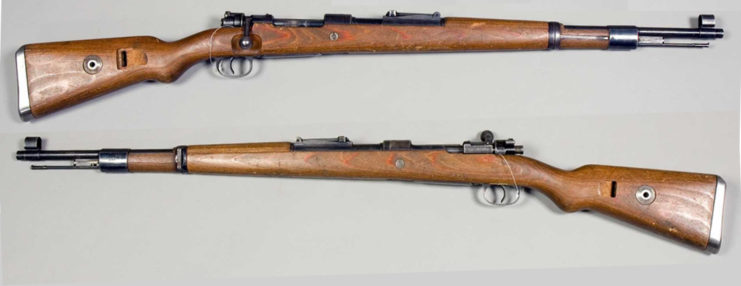
The Karabiner 98k was the standard rifle of the German armed forces in the Second World War. Adopted in 1935, it was a shortened version of the Gewehr 98 of 1898, with a 23.6-inch barrel, a turned-down bolt handle and the same strong Mauser action. It was loaded with five-round stripper clips. More than fourteen million were made. Accurate and reliable, it was also Germany's main sniper rifle, and it armed German soldiers from Poland in 1939 to Berlin in 1945, as well as many armies after the war.
Also known as K98k, Kar98k, Kar 98k, Mauser 98k, Karabiner 98 kurz, K98
Origins
After the First World War the German Army kept the Mauser Gewehr 98 and its shorter carbine versions. By the 1920s it had settled on a rifle between the two lengths, first in the commercial 'Standardmodell' that Mauser sold abroad. When Germany began to rearm openly, the Wehrmacht adopted a version of it on 21 June 1935 as the Karabiner 98 kurz (short carbine 98), or K98k. Despite its name it was the standard rifle for all German troops.
Design & Construction
The K98k used the Mauser 98 action, with two large front locking lugs, a third safety lug, a long extractor that held the cartridge from the magazine to the chamber, and a three-position wing safety. Its barrel was 23.6 inches long, and the rifle was 43.6 inches overall and weighed about eight pounds. The bolt handle was turned down, which made it easier to carry and to mount a scope. It had a five-round internal magazine loaded from stripper clips, a tangent rear sight graduated to 2,000 meters and a hooded front sight. From 1937 the stock was made of laminated wood, which was stronger and less likely to warp. During the war, simplifications were introduced to speed up production, such as stamped parts and cruder finishing.
Combat Use
The K98k was carried by German infantry in every campaign of World War II, from Poland and France to North Africa, the Soviet Union, Italy and Normandy, by the Fallschirmjäger and by the Waffen-SS and Luftwaffe field units. The German infantry squad was built around its machine gun, the MG 42, and the riflemen with their K98ks supplied ammunition and protected it. Selected rifles were fitted with scopes, such as the long-eye-relief ZF41 and the 4x Zf39 and ZF4, and German snipers like Matthäus Hetzenauer and Josef Allerberger used them on the Eastern Front, where they faced Soviet snipers with the Mosin Nagant 1891/30 Sniper Rifle. Even as the MP40 and StG 44 came into use, the K98k remained the most common German weapon until the end of the war.
Legacy
After 1945 K98ks were used by many armies, including the new armies of Norway, Czechoslovakia, Yugoslavia and Israel, where many were converted to 7.62mm NATO. Yugoslavia and Belgium built close copies, and the rifle turned up in wars from Indochina to the Middle East. It is today one of the most collected military rifles in the world, and its action is still the model for many sporting rifles.
Sources
Law, Richard D. Backbone of the Wehrmacht: The German K98k Rifle, 1934-1945. Collector Grade Publications, 1991.
Ball, Robert W. D. Mauser Military Rifles of the World. 5th ed. Krause Publications, 2011.
Senich, Peter R. The German Sniper, 1914-1945. Paladin Press, 1982.
Pegler, Martin. Out of Nowhere: A History of the Military Sniper. Osprey Publishing, 2004.
Suggest an edit · account required · reviewed before publishing · how it works