Battle of Kursk
The Battle of Kursk, fought from 5 July to 23 August 1943 in western Russia and eastern Ukraine, was the last major German offensive on the Eastern Front. In Operation Citadel the Germans attacked both sides of a large Soviet-held salient around Kursk, but they ran into the deepest defenses of the war and were stopped within about a week. The Red Army then launched Operations Kutuzov and Rumyantsev, retaking Orel, Belgorod and Kharkov. After Kursk the strategic initiative passed permanently to the Soviet Union.
Also known as Kursk, Operation Citadel, Unternehmen Zitadelle, Battle of Prokhorovka, Operation Kutuzov, Operation Rumyantsev, Kursk salient, Kursk bulge
Background
After the German defeat at the Battle of Stalingrad and Field Marshal Erich von Manstein's counterstroke that retook Kharkov in March 1943, the front line around the city of Kursk bulged deep into German-held territory. The German plan, Operation Citadel, was to cut it off with two converging attacks: Field Marshal Walter Model's Ninth Army from the north and Manstein's Army Group South, with the Fourth Panzer Army and Army Detachment Kempf, from the south. Hitler postponed the attack several times between May and July, partly to bring up the new Panther tank, more Tiger tanks and the heavy Ferdinand tank destroyer. Warned by their intelligence, Stalin's commanders, led by Georgy Zhukov and Aleksandr Vasilevsky, chose to stand on the defensive first, wear the Germans down and then counterattack. The Central Front under Konstantin Rokossovsky and the Voronezh Front under Nikolai Vatutin built three main defensive belts and several more lines behind them, with the Steppe Front under Ivan Konev in reserve. Engineers laid several thousand mines per kilometer of front in the most threatened sectors, and anti-tank strongpoints were sited so that groups of guns could fire together on the same target. Germany gathered roughly 780,000 men and about 2,500 to 3,000 tanks and assault guns; the Soviets had about 1.9 million men and some 5,000 tanks, counting the reserve front.
The Battle
On the night of 4-5 July Soviet artillery fired a counter-preparation bombardment on the German assembly areas, and the attack began on 5 July. In the north, Model's infantry and armor advanced less than 10 miles before being held at Ponyri and the Olkhovatka heights. The heavily armored Ferdinands had no machine gun for close defense, and many were disabled by mines. In the south the German panzer divisions went deeper, about 20 miles, but at heavy cost. Many of the new Panthers broke down or were lost to mines, while the Tiger's 88mm gun could destroy the Soviet T-34 at ranges the T-34's 76mm gun could not match. On 12 July the II SS Panzer Corps met the counterattack of the Soviet 5th Guards Tank Army near Prokhorovka. Soviet accounts long described it as a German defeat in the largest tank battle in history. Recent research, notably by the Russian historian Valeriy Zamulin, shows that the Soviet army lost well over 300 tanks and self-propelled guns destroyed or damaged that day, while German permanent losses were small, only a handful of tanks written off, although dozens were damaged. The Soviets still stopped the SS advance. The same day the Red Army opened Operation Kutuzov against the Orel salient north of Kursk, and the Allies had landed in Sicily on 10 July. On 13 July Hitler called off Citadel, although fighting in the south went on for several days.
Weapons
Soviet riflemen held the trenches with the Mosin-Nagant M1891, the PPSh-41 and the Degtyaryov DP-27. The anti-tank defenses combined the ZiS-3 and other guns with PTRD-41 teams, minefields and tanks dug in to their turrets, and the Katyusha Rocket Launcher added heavy rocket fire. German infantry carried the Karabiner 98k, the MP40 and the MG 42, and the 8.8 cm Flak fought both aircraft and tanks.
Aftermath
Operation Rumyantsev began in the south on 3 August. Orel and Belgorod were retaken on 5 August. Kharkov fell on 23 August, the date usually given for the end of the battle. German casualties in Citadel are estimated at about 50,000 to 55,000, and perhaps 170,000 to 200,000 for the whole summer campaign. Soviet losses were far heavier: about 177,000 in the defensive phase and, by the official Russian count, over 860,000 killed, wounded and missing in all. Germany never again mounted a major strategic offensive in the east, and the Red Army kept the initiative for the rest of World War II.
Weapons used
-
Mosin-Nagant M1891
The 91/30 bolt-action rifle was the standard weapon of the Soviet riflemen holding the trenches and strongpoints of the Kursk defenses. Continued…
-
PPSh-41
Soviet infantry and tank-riding submachine gunners used the PPSh in the close fighting for villages and trench lines. Continued…
-
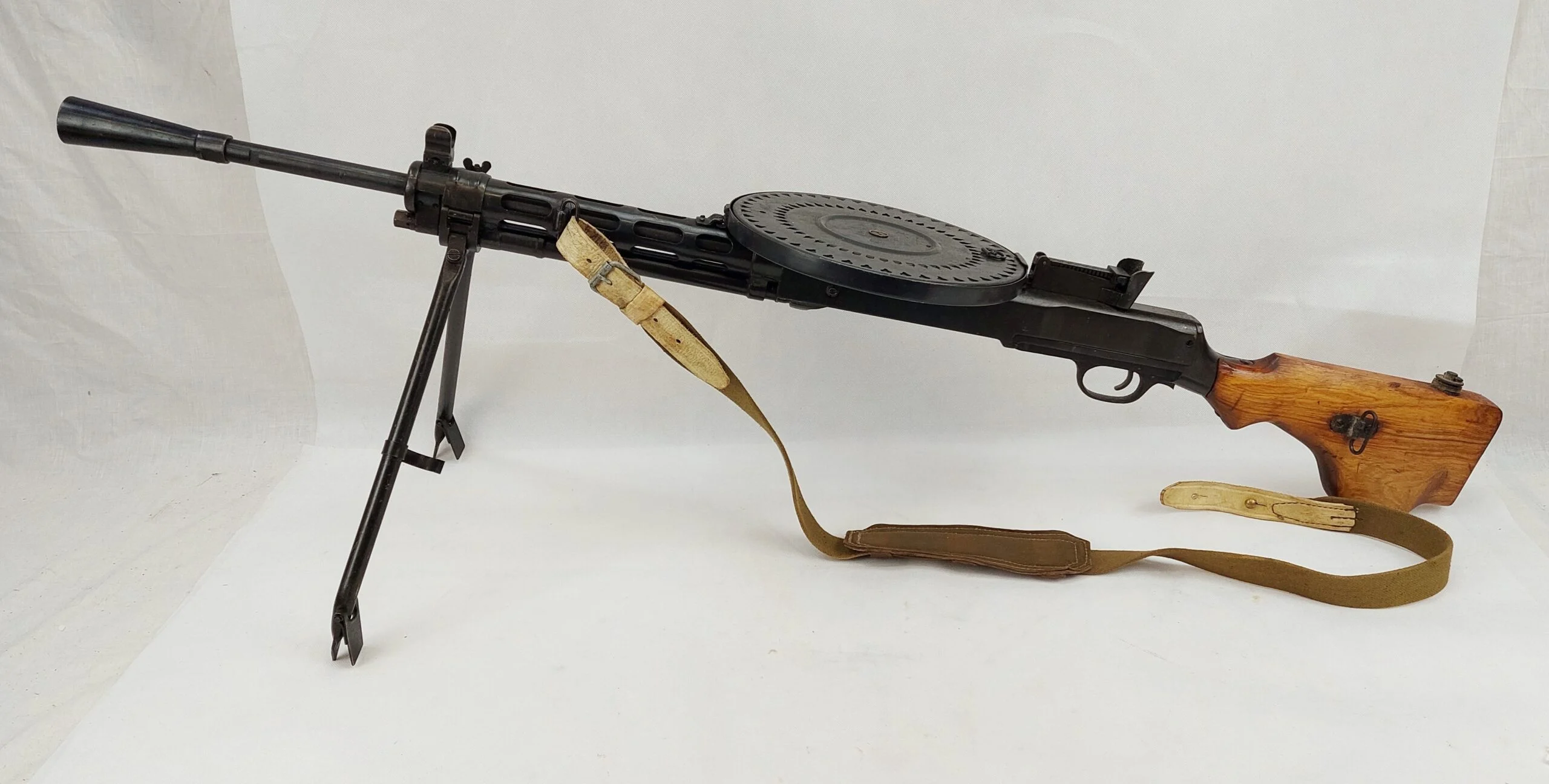
Degtyaryov DP-27
The Degtyaryov light machine gun gave Soviet rifle squads their automatic fire against German infantry following the tanks. Continued…
-
PTRD-41
Anti-tank rifle teams dug in around the strongpoints fired at the sides and tracks of German tanks and at their half-tracks. Continued…
-
ZiS-3
The 76mm divisional gun formed the core of many Soviet anti-tank strongpoints, firing at German tanks from concealed positions. Continued…
-
Katyusha Rocket Launcher
Guards Mortar units fired rocket salvoes in the Soviet counter-preparation of 5 July and in the barrages that opened the counteroffensives. Continued…
-
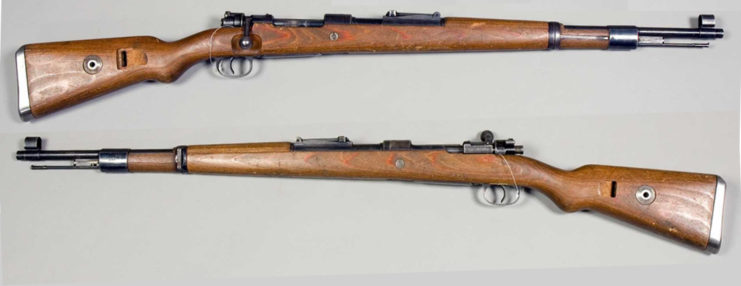
Karabiner 98k
The standard rifle of the German infantry who followed the panzers into the Soviet defense belts. Continued…
-
MG 42
The German squad machine gun supported the infantry attacks on Soviet trench lines and strongpoints. Continued…
-
8.8 cm Flak
German 88mm flak guns defended against Soviet aircraft and engaged Soviet tanks, and a tank version of the gun armed the Tigers. Continued…
Sources
Glantz, David M., and Jonathan M. House. The Battle of Kursk. University Press of Kansas, 1999.
Zamulin, Valeriy. Demolishing the Myth: The Tank Battle at Prokhorovka, Kursk, July 1943. Helion, 2011.
Frieser, Karl-Heinz, et al. Germany and the Second World War, Volume VIII: The Eastern Front 1943-1944. Oxford University Press, 2017.
Krivosheev, G. F., ed. Soviet Casualties and Combat Losses in the Twentieth Century. Greenhill Books, 1997.
Suggest an edit · account required · reviewed before publishing · how it works