Degtyaryov DP-27
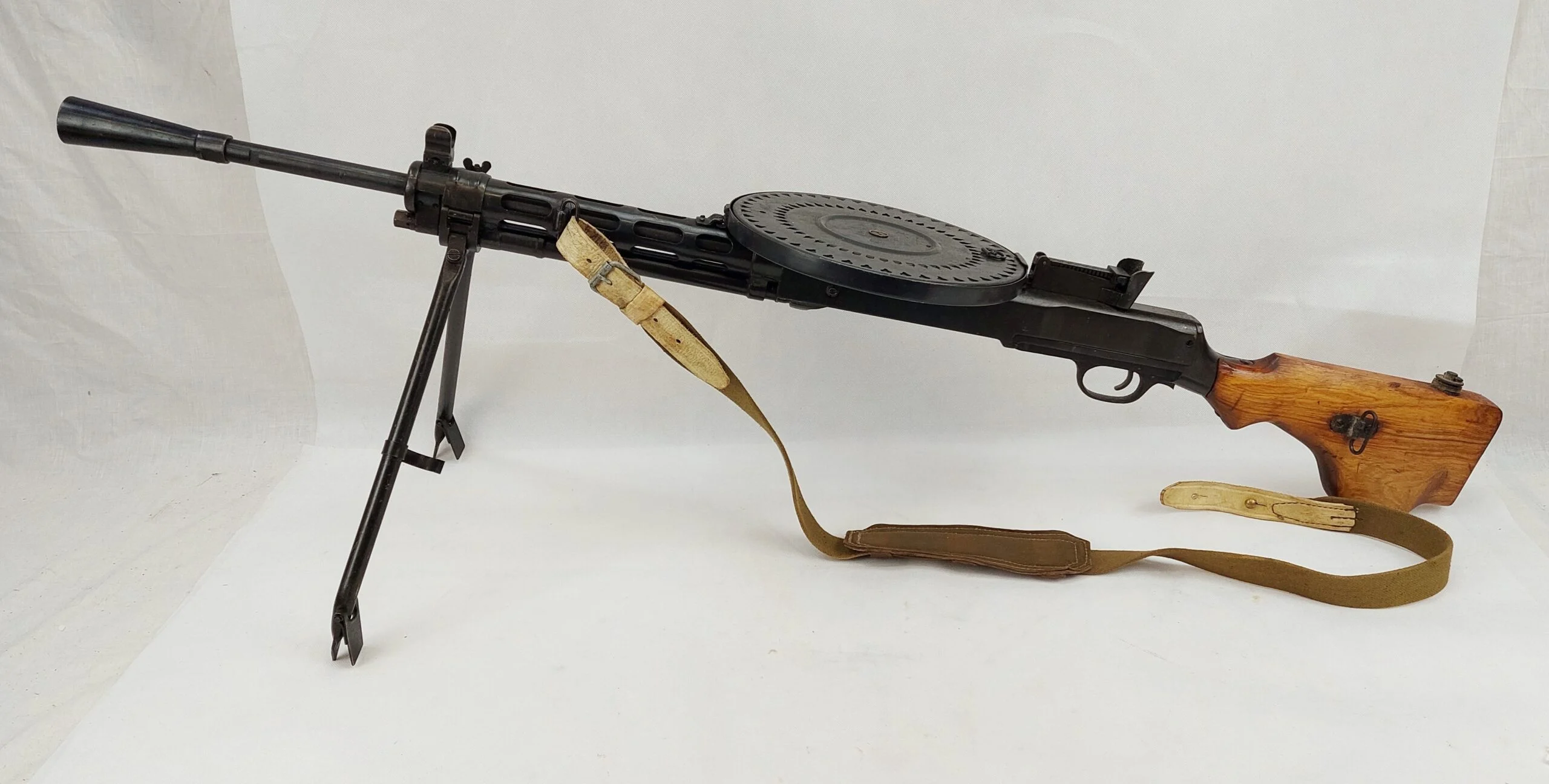
The DP-27 was the standard light machine gun of the Soviet Army from the late 1920s through the Second World War. Designed by Vasily Degtyaryov, it was a simple gas-operated gun with very few parts, fed from a flat 47-round pan magazine on top of the receiver. Soviet soldiers called it the 'record player' because of the pan, and the Finns, who captured many, called it 'Emma'. It fought in the Spanish Civil War, the Winter War and the Second World War, and later in Korea and Vietnam, and it was followed by the improved DPM and the belt-fed RP-46.
Also known as DP, DP-27, DP-28, Degtyaryov light machine gun, Degtyarev DP, Emma, record player, DPM, RP-46, DT
Origins
In the 1920s the young Red Army had a mix of worn-out foreign machine guns, such as the Lewis Gun and French Chauchats, and only the heavy water-cooled Maxim Gun of its own. It needed a light machine gun that could be made in Soviet factories and used by poorly trained conscripts. Vasily Degtyaryov, a gunsmith who had worked with the designer Vladimir Fyodorov, produced a design at the Kovrov works. After trials, it was adopted in 1927 and went into full production in 1928, so it is known both as the DP-27 and the DP-28. DP stands for "Degtyaryov Pekhotny", Degtyaryov infantry.
Design & Construction
The DP was gas-operated and fired from an open bolt. It could fire only in fully automatic, at about 550 rounds a minute. Its locking system was unusual. Two flaps, one on each side of the bolt, were pushed outward into recesses in the receiver by the firing pin as it moved forward, locking the bolt at the moment of firing. The gun had very few parts and was hard to break. It fired the rimmed 7.62x54R rifle cartridge of the Mosin-Nagant M1891. Because rimmed rounds jam easily in a box magazine, it used a flat pan holding 47 rounds, laid flat on top of the receiver, with the bullets pointing in toward the center. The gun weighed about twenty pounds and had a light bipod. Its weak point was the recoil spring, which sat around the gas piston under the barrel. After long bursts the heat from the barrel softened the spring. The bipod was also easily bent. A tank version, the DT, was fitted in Soviet tanks.
Combat Use
The DP's first war was the Spanish Civil War of 1936-39, where the Soviet Union supplied it to the Republican side. In the Winter War of 1939-40 the Finns captured large numbers of DPs from destroyed Soviet units and used them in their own army. They called the gun "Emma", a name usually said to come from a popular waltz of the time. In World War II the DP was the light machine gun of the Soviet rifle section, from the defeats of 1941 to the Battle of Stalingrad and Berlin, alongside the PPSh-41 and the Mosin rifle. It was lighter than the German MG 42 used as a squad gun, but its pan held far fewer rounds than a belt. After the war, the Soviet Union and China supplied DPs and copies to North Korean and Chinese forces in the Korean War, and to the Viet Minh and later North Vietnamese forces in Indochina and the Vietnam War.
Legacy
In 1944 the Red Army adopted the DPM, which moved the recoil spring into a tube behind the receiver, away from the heat, and added a pistol grip and a stronger bipod. The RP-46 of 1946 was a heavier version that could be fed by belt as a company machine gun. China built the DPM as the Type 53. The whole family was replaced in Soviet service by the RPD and later the PK. The DP was never refined, but it was cheap, simple and tough, and with the Bren and the M1918 BAR it was one of the main squad automatic weapons of the Second World War.
Sources
Bolotin, David N. Soviet Small-Arms and Ammunition. Finnish Arms Museum Foundation, 1995.
Zaloga, Steven J., and Leland S. Ness. Red Army Handbook 1939-1945. Sutton Publishing, 1998.
Hogg, Ian V., and John Weeks. Military Small Arms of the 20th Century. Arms and Armour Press, 1973 and later editions.
Smith, W. H. B. Small Arms of the World. Stackpole, 1943 and later editions.
Suggest an edit · account required · reviewed before publishing · how it works