M1918 BAR
The Browning Automatic Rifle was John Moses Browning's shoulder-fired automatic weapon, adopted by the United States Army in 1918 and the backbone of American infantry squads through the Second World War and Korea. Firing the full-power .30-06 cartridge from a 20-round magazine, it sat between the rifle and the machine gun — too heavy for one, too light for the other — and it gave each rifle squad its base of fire. Around 350,000 were made, and it stayed in American service until the late 1950s and in allied armies long after.
Also known as Browning Automatic Rifle, BAR, M1918, M1918A1, M1918A2, Monitor R-80
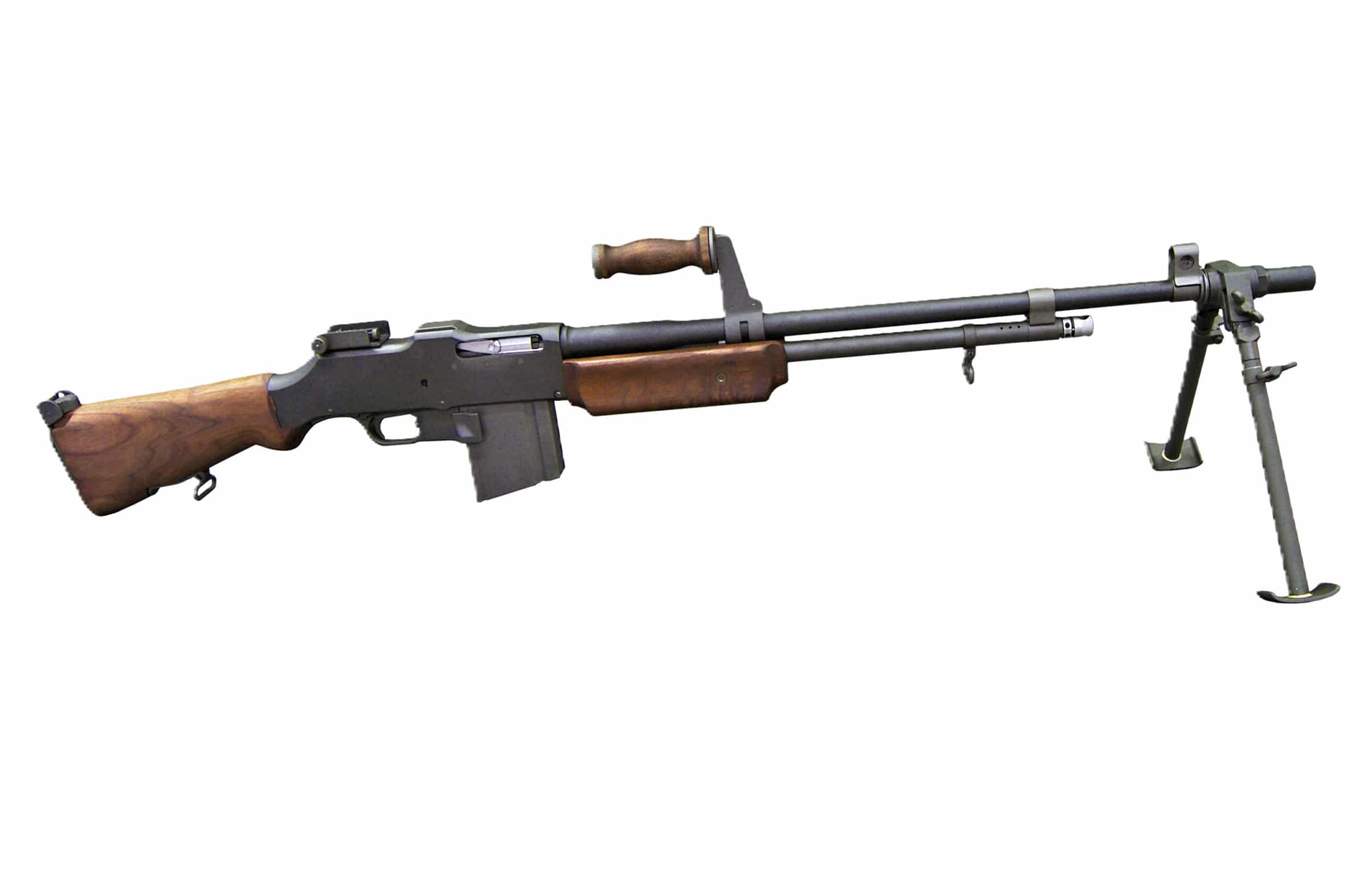
Origins
When the United States entered the World War I in April 1917 it had no modern light automatic weapon, and the French were already practicing 'walking fire' — advancing infantry firing automatic rifles from the hip to keep enemy heads down during an assault. John Browning had designed both a heavy machine gun and an automatic rifle on his own initiative; in February 1917 he demonstrated them to officials in Washington, and the rifle was adopted as the M1918. Colt, Winchester, and Marlin-Rockwell tooled up for production, and the first BARs reached France in the summer of 1918, going into action with the 79th Division in the Meuse-Argonne offensive in September. Browning's son Val, a lieutenant, demonstrated it at the front.
Design & Construction
The BAR is gas-operated: gas tapped from the barrel drives a piston that unlocks a bolt which tilts up into a recess in the receiver. It fires from an open bolt to prevent cook-offs and feeds from a 20-round detachable box magazine. The original M1918 weighed about 16 pounds, had selective semi-automatic and fully automatic fire, and no bipod. The M1918A1 of 1937 added a hinged butt plate and a bipod at the gas cylinder; the M1918A2, standardized in 1940, moved the bipod to the muzzle, added a monopod option, and replaced semi-automatic with two automatic rates, about 300-450 and 500-650 rounds per minute. With bipod and accessories the A2 weighed nearly 20 pounds. Its fixed barrel limited sustained fire, and its 20-round magazine was small next to belt-fed guns, but it was reliable, accurate, and could be carried and fired by one man.
Combat Use
The BAR's first war was short, but its second was its greatest. In the World War II each American rifle squad was built around a single BAR, with the M1 Garand riflemen maneuvering under its fire. The US Marine Corps went further in 1944, giving every four-man fire team its own BAR, so a Marine squad had three. The US Army Rangers and airborne carried it, and BAR men were favorite targets of enemy snipers. In the Korean War it was still the squad automatic weapon, fighting alongside the belt-fed M1919 Browning Machine Gun in the defensive battles of 1950-53. Between the wars it gained a different reputation, when Clyde Barrow and other gangsters stole BARs from National Guard armories; the FBI adopted a commercial version, the Colt Monitor R-80.
Legacy
The BAR was replaced in American service from 1957 by the M14 and the M15 and then by the M60 Machine Gun, though it served into the early Vietnam era with American advisers and South Vietnamese forces and much longer with allied armies. It foreshadowed both the squad automatic weapon and the battle rifle. Transferable original BARs are among the most valuable collectible American automatic weapons, and semi-automatic reproductions made from new receivers let civilian collectors own the look and feel. Its silhouette — long, heavy, bipod at the muzzle — remains one of the defining images of the American infantryman of the Second World War.
Sources
Ballou, James L. Rock in a Hard Place: The Browning Automatic Rifle. Collector Grade, 2000.
Hodges, Robert R., Jr. The Browning Automatic Rifle. Osprey Weapon 41, 2012.
Chinn, George M. The Machine Gun, Vol. I. US Navy Bureau of Ordnance, 1951.
US Army Field Manual FM 23-15, Browning Automatic Rifle, Caliber .30, M1918A2.
Suggest an edit · account required · reviewed before publishing · how it works