Meuse-Argonne Offensive
The Meuse-Argonne Offensive, fought from 26 September to 11 November 1918, was the main American battle of the First World War and part of the final Allied offensive on the Western Front. More than a million soldiers of the American Expeditionary Forces under General John J. Pershing attacked north between the Meuse River and the Argonne Forest, through deep German defenses. It cost about 26,000 American dead, the deadliest battle in United States history, and it ended only with the Armistice.
Also known as Meuse-Argonne, Battle of the Argonne Forest, Battle of the Meuse-Argonne, Argonne Offensive, Meuse-Argonne campaign, Argonne 1918, Lost Battalion, The Lost Battalion, Sergeant York, Sergeant York battle, Alvin York, Offensive Meuse-Argonne
Background
By the late summer of 1918 the German offensives of the spring had failed, and the Allies under Marshal Ferdinand Foch were attacking along the Western Front. Foch planned a series of converging blows for the end of September. The American part was a drive north from the area of Verdun, between the Meuse River and the Argonne Forest, toward the railway through Sedan and Mézières that supplied much of the German army in France. The French Fourth Army would attack on the Americans' left.
General John J. Pershing's First Army had just fought its first large battle at St Mihiel, from 12 to 16 September. In about ten days it had to move hundreds of thousands of men and their guns some 100 km to the new front, mostly by night, a transfer planned largely by Colonel George C. Marshall. The ground favored the defender. The Argonne was a tangle of wooded ridges and ravines, the heights east of the Meuse gave German gunners a view across the American right, and the hill of Montfaucon stood in the center. The Germans had fortified the sector for four years in several belts, the strongest of which was the Kriemhilde Stellung.
The Battle
The attack opened on 26 September after a bombardment by about 2,700 guns. Nine American divisions, several with little or no combat experience, advanced with French-built Renault tanks and several hundred aircraft in support. They gained ground on the first day, but Montfaucon did not fall until 27 September, and the Germans rushed in reserves. Within days the advance stalled amid congested roads, supply failures, rain and machine-gun fire.
Pershing brought in veteran divisions and renewed the attack on 4 October. In the Argonne, troops of the 77th Division under Major Charles Whittlesey were cut off in a ravine from 2 to 7 October. Of roughly 550 men, fewer than 200 walked out unhurt when they were relieved. On 8 October, near Châtel-Chéhéry, Corporal Alvin York of the 82nd Division took charge of a patrol that had lost most of its leaders, silenced a line of German machine guns and helped bring in 132 prisoners. The forest was cleared by about 10 October. On 14 October American troops broke into the Kriemhilde Stellung around Romagne and the Côte Dame Marie.
In mid-October Pershing handed the First Army to Lieutenant General Hunter Liggett, who rested and reorganized it. The last phase began on 1 November with a well-prepared assault that broke through the final German line. The Americans then pursued the retreating Germans to the Meuse, and by 7 November they held the heights overlooking Sedan. The Armistice of 11 November ended the fighting.
Weapons
Most American infantry carried the M1917 Enfield. Regular Army units had the M1903 Springfield, and officers, machine gunners and many sergeants carried the M1911 Pistol. The usual automatic rifle was the French Chauchat, which jammed readily in the mud. The new M1918 BAR reached some divisions from September. Much of the Americans' heavy equipment was French, including the Hotchkiss M1914 machine gun and the French 75 field gun. American soldiers wore a steel helmet copied from the British Brodie Helmet.
The German defense rested on the machine gun. Crews with the MG 08, the German form of the Maxim Gun, fought from concealed nests that covered one another, backed by artillery firing high explosive and gas. German riflemen carried the Mauser Gewehr 98.
Aftermath
About 1.2 million Americans took part over 47 days. American losses were roughly 26,000 killed and 95,000 wounded, more dead than in any other battle in the country's history. German casualties are less certain. They are often put at around 100,000 or more, including some 26,000 prisoners. Historians have criticized the First Army's early tactics and supply arrangements, and have also noted how quickly it learned. Together with British and French attacks farther north and west, the offensive helped force Germany to seek an armistice. More than 14,000 of the dead lie in the Meuse-Argonne American Cemetery at Romagne, the largest American military cemetery in Europe.
On Screen
Sergeant York (1941), directed by Howard Hawks, stars Gary Cooper as Alvin York and gives its last part to the action of 8 October 1918. It follows the outline of the event, including the ambushed patrol and the 132 prisoners. It arms York with a Springfield rifle and a Luger P08; he most likely carried an M1917 Enfield and certainly used an M1911 pistol. It also plays down the part of the other men in the patrol. The Lost Battalion (2001), a television film directed by Russell Mulcahy, has Rick Schroder as Major Charles Whittlesey and covers the five days in the ravine, including the American barrage that fell on the position by mistake and the carrier pigeon that carried the message to stop it. The unit was in fact a mixed force from several battalions, and its location was known throughout.
Weapons used
-
M1917 Enfield
The M1917 was the rifle of most American infantry in the offensive, including the National Army and National Guard divisions. Continued…
-
M1903 Springfield
Regular Army and Marine units, and the snipers of other divisions, carried the Springfield. Continued…
-
M1911 PistolFor sale
The .45 pistol was carried by officers, machine gunners and many NCOs; Alvin York used one on 8 October. Continued…
-
Chauchat
The French-made Chauchat was the automatic rifle of most American divisions and jammed often in the Argonne mud. Continued…
-
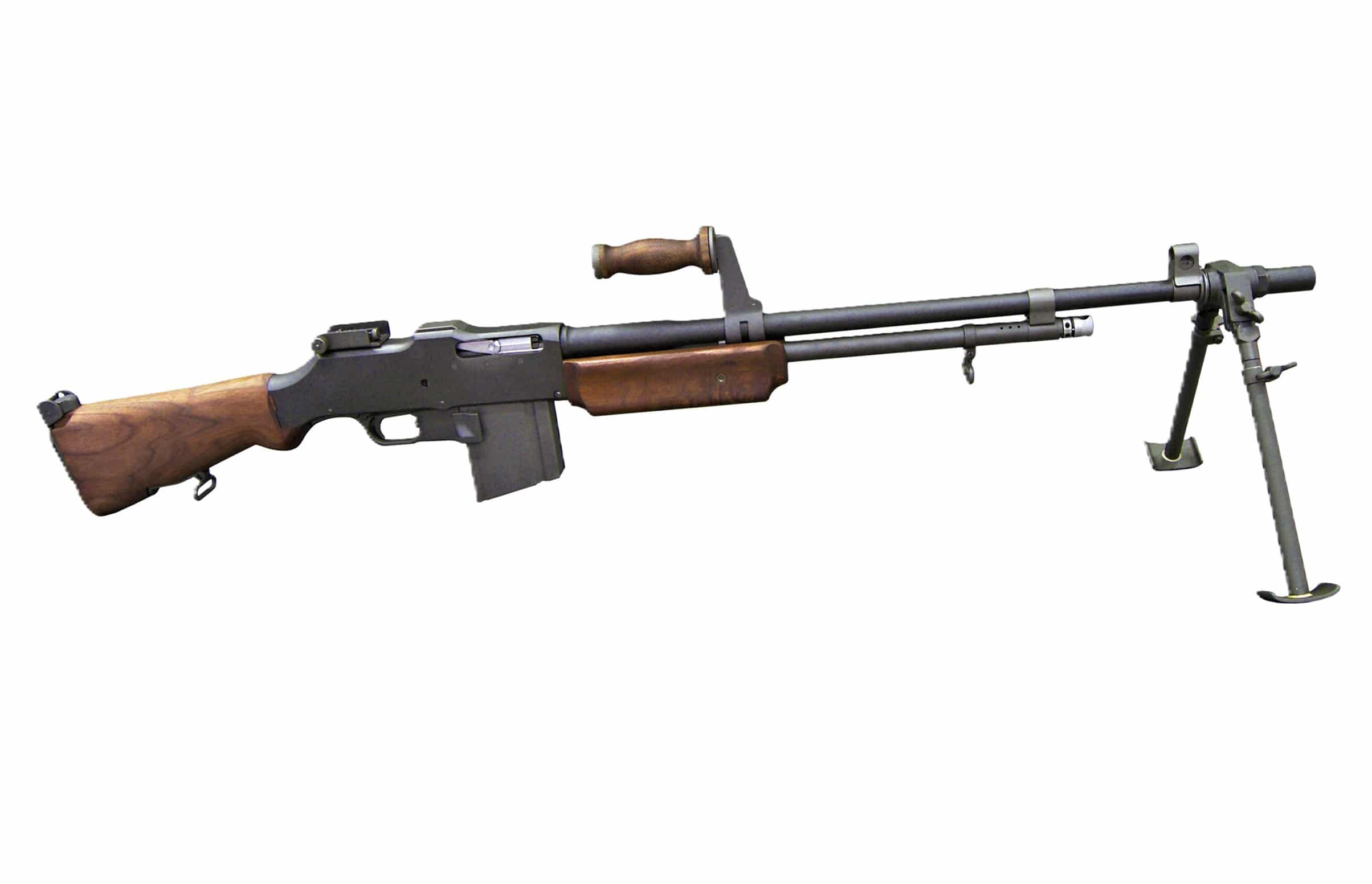
M1918 BAR
The Browning Automatic Rifle first reached combat units in September 1918 and replaced the Chauchat in some divisions. Continued…
-
Mauser Gewehr 98
The Gewehr 98 was the standard rifle of the German infantry defending the Argonne and the Meuse heights. Continued…
-
Maxim Gun
German MG 08 Maxim guns in concealed, mutually supporting nests caused a large share of American losses. Continued…
-
French 75
American field artillery regiments fired French-supplied 75 mm guns in the barrages that covered each attack. Continued…
Sources
Lengel, Edward G. To Conquer Hell: The Meuse-Argonne, 1918. Henry Holt, 2008.
Ferrell, Robert H. America's Deadliest Battle: Meuse-Argonne, 1918. University Press of Kansas, 2007.
Coffman, Edward M. The War to End All Wars: The American Military Experience in World War I. Oxford University Press, 1968.
Mastriano, Douglas V. Alvin York: A New Biography of the Hero of the Argonne. University Press of Kentucky, 2014.
Suggest an edit · account required · reviewed before publishing · how it works