Battle of Okinawa
The Battle of Okinawa, fought from 1 April to 22 June 1945, was the last major battle of the Pacific War and one of its largest. The US Tenth Army landed on the island, about 550 km south of Japan, to win a base for the planned invasion. The Japanese 32nd Army fought a long defense from caves and ridges around Shuri while kamikaze aircraft struck the fleet offshore. More than 12,000 Americans, most of the Japanese garrison and perhaps 100,000 or more Okinawan civilians died.
Also known as Operation Iceberg, Okinawa 1945, Typhoon of Steel, Tetsu no ame, Tetsu no bofu, Okinawa-sen, Battle of Hacksaw Ridge, Hacksaw Ridge, Maeda Escarpment, Shuri Line, Sugar Loaf Hill, Ryukyu campaign, Desmond Doss
Background
By early 1945 American forces had retaken most of the Philippines and captured Iwo Jima. The next objective was Okinawa, the largest of the Ryukyu Islands, about 550 km south of Kyushu. Its airfields and anchorages were wanted as the base for the planned invasion of Japan. The operation, code-named Iceberg, was given to the Tenth Army under Lieutenant General Simon Bolivar Buckner Jr. It combined the Army's XXIV Corps and the III Amphibious Corps of the US Marine Corps, about 180,000 men in the assault force, carried and supported by the Fifth Fleet under Admiral Raymond Spruance.
The island was held by the Japanese 32nd Army under Lieutenant General Mitsuru Ushijima, with roughly 100,000 men, including naval troops and many conscripted Okinawans. Ushijima's staff decided not to fight on the beaches. Following a plan drawn up largely by Colonel Hiromichi Yahara, the army dug in across the southern third of the island, in lines of caves, tunnels and fortified ridges centered on the old castle town of Shuri. Its aim was to hold out as long as possible and bleed the attackers.
The Battle
After the 77th Infantry Division had seized the nearby Kerama Islands, the main landing took place on 1 April 1945, Easter Sunday, on the Hagushi beaches of the west coast. It was almost unopposed, and the airfields at Yontan and Kadena fell on the first day. The Marines turned north and cleared the northern part of the island, including the Motobu Peninsula, by about 20 April. The 77th Division took the small island of Ie Shima after several days of hard fighting.
XXIV Corps, moving south, ran into the outer Shuri defenses in the first week of April. At Kakazu Ridge and then along the Urasoe-Mura or Maeda Escarpment, which the Americans called Hacksaw Ridge, attacks gained ground slowly and at heavy cost. A Japanese counter-offensive on 4 and 5 May failed with severe losses. With the Marines brought into the line, the Tenth Army attacked across the whole front on 11 May. The 6th Marine Division took Sugar Loaf Hill, west of Shuri, after about a week of repeated assaults, and the 96th Division took Conical Hill to the east. Heavy rain then turned the battlefield to mud. In the last days of May Ushijima withdrew from Shuri to the Kiyan Peninsula at the southern tip of the island, and Marines entered the ruins of Shuri Castle on 29 May.
The final fighting lasted three more weeks. Buckner was killed by Japanese artillery fire on 18 June. Organized resistance ended on 21 and 22 June, and Ushijima and his chief of staff, Isamu Cho, killed themselves.
At sea, the fleet endured the heaviest air attacks of the war. Japan launched ten massed kamikaze raids, with roughly 1,900 suicide sorties by most counts. Thirty-six American ships were sunk and 368 damaged, and about 4,900 sailors were killed. The battleship Yamato, sent on a one-way sortie toward Okinawa, was sunk by carrier aircraft on 7 April.
Weapons
American riflemen carried the M1 Garand, supported by the M1918 BAR, with the M1 Carbine for officers, crews and support troops. Japanese infantry had the Type 99 Rifle, the Type 96 Light Machine Gun and the Type 89 Grenade Discharger. The Type 92 Heavy Machine Gun fired from caves and reverse slopes. Unusually for the Pacific War, the 32nd Army also had plentiful artillery and mortars and used them in mass.
Rifle fire could not clear such positions. Buckner called the American method "blowtorch and corkscrew": the M2 Flamethrower and flame-throwing tanks burned the defenders out, and the Satchel Charge sealed the caves. Tanks, the Bazooka, naval gunfire and heavy artillery supported each advance.
Aftermath
American losses were about 12,500 killed or missing, including the sailors, and total battle casualties of roughly 50,000, with many more non-battle casualties, a large share of them from combat fatigue. Japanese military dead are usually put at 90,000 to 110,000, and more than 7,000 men surrendered, far more than in earlier battles. Okinawan civilians suffered terribly. Estimates of civilian deaths range from about 100,000 to 150,000, from shellfire, starvation and suicides, some of them forced by Japanese troops.
The cost of Okinawa weighed heavily on American planning for the invasion of Japan, and historians still debate its part in the decision to use the atomic bomb. Okinawa remained under American administration until 1972. The battle is covered in the wider story of World War II.
On Screen
Hacksaw Ridge (2016), directed by Mel Gibson, shows the fighting for the Maeda Escarpment through the story of Desmond Doss, played by Andrew Garfield. Doss was a medic of the 77th Infantry Division and a Seventh-day Adventist who refused to carry a weapon. His Medal of Honor citation credits him with saving about 75 wounded men, lowering them one by one down the cliff by rope. The film is accurate about that, about the cargo nets used to climb the cliff, and about his refusal to bear arms. It departs from the record in several ways. Okinawa appears as Doss's first battle, although he had already served on Guam and Leyte. Weeks of fighting are compressed into a few days. His wounding, which happened later in May during a night attack near Shuri, is moved to the escarpment. His comrade Smitty is an invented character, and the courtroom scene is dramatized.
Weapons used
-
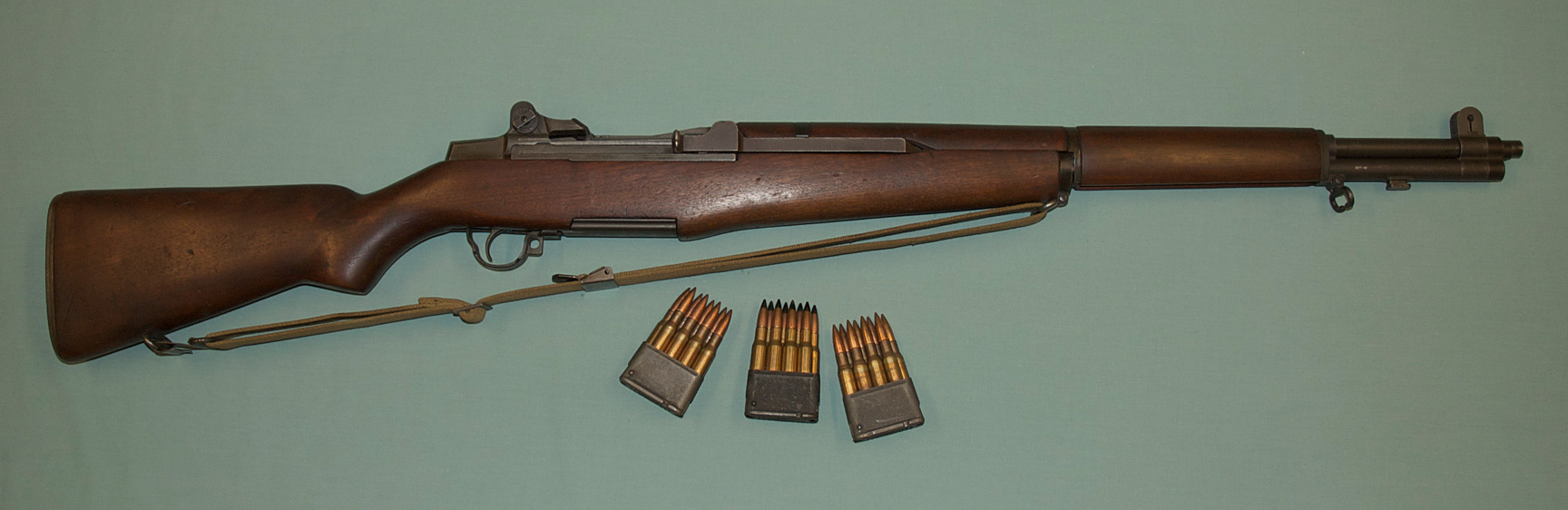
M1 Garand
The semi-automatic M1 Garand was the standard rifle of the American soldiers and Marines who fought across the island. Continued…
-
Type 99 Rifle
Japanese infantry defended the Shuri Line with the bolt-action Type 99 and the older Type 38. Continued…
-
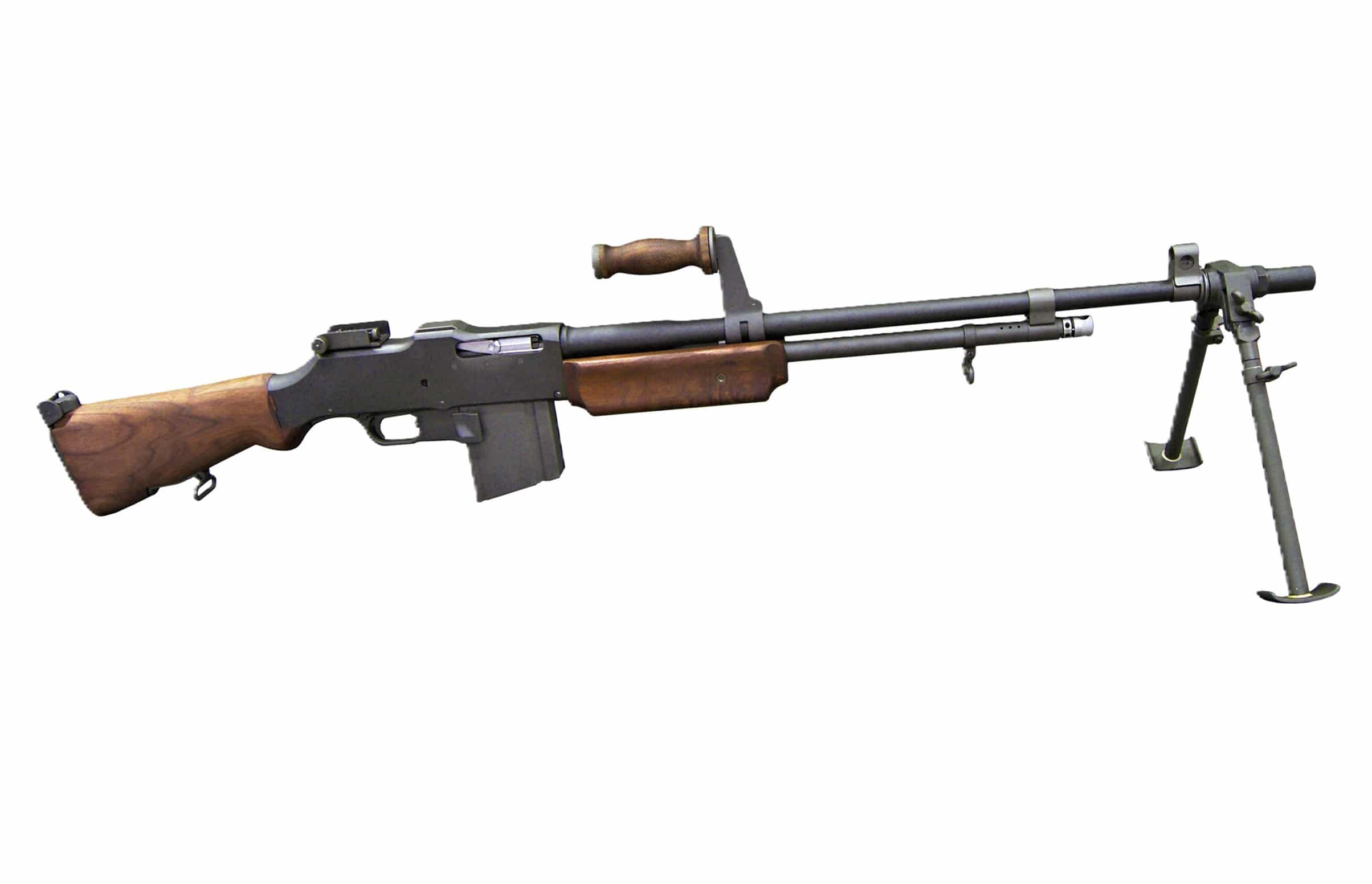
M1918 BAR
The BAR gave each American rifle squad its automatic fire during the ridge-by-ridge advance. Continued…
-
Type 96 Light Machine Gun
Japanese light machine guns covered the approaches to cave and tomb positions. Continued…
-
Type 89 Grenade Discharger
The so-called knee mortar dropped grenades on American troops from behind the ridges. Continued…
-
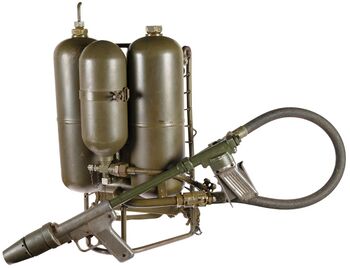
M2 Flamethrower
Portable flamethrowers were the 'blowtorch' in the American method of burning out caves and bunkers. Continued…
-
Satchel Charge
Demolition charges were the 'corkscrew', used to seal cave mouths once the defenders had been suppressed. Continued…
-
Type 92 Heavy Machine Gun
Type 92 heavy machine guns fired from caves and reverse slopes across the front of the Japanese positions. Continued…
Sources
Appleman, Roy E., James M. Burns, Russell A. Gugeler, and John Stevens. Okinawa: The Last Battle. Historical Division, Department of the Army, 1948.
Feifer, George. Tennozan: The Battle of Okinawa and the Atomic Bomb. Ticknor & Fields, 1992.
Yahara, Hiromichi. The Battle for Okinawa. John Wiley & Sons, 1995.
Sledge, E. B. With the Old Breed at Peleliu and Okinawa. Presidio Press, 1981.
Suggest an edit · account required · reviewed before publishing · how it works