Winter War
The Winter War was a conflict between Finland and the Soviet Union that began with a Soviet invasion on 30 November 1939 and ended on 13 March 1940. Stalin wanted Finnish land near Leningrad and a naval base, and when Finland refused, the Red Army attacked with far larger forces. Finnish ski troops, fighting in extreme cold, destroyed whole Soviet divisions in the northern forests, and the Mannerheim Line held on the Karelian Isthmus until February. A massive Soviet offensive then broke through. Finland gave up about a tenth of its territory in the Moscow Peace Treaty but kept its independence.
Also known as Talvisota, Russo-Finnish War, Soviet-Finnish War, Soviet-Finnish War of 1939-1940, Zimnyaya voyna
Background
The Winter War was a conflict between Finland and the Soviet Union. It began on 30 November 1939, early in World War II, and ended on 13 March 1940. The Nazi-Soviet Pact of August 1939 had placed Finland in the Soviet sphere of interest. That autumn Stalin demanded that Finland move its border on the Karelian Isthmus back from Leningrad, which lay only about 32 kilometers away, and lease the Hanko peninsula to the Soviet Union as a naval base. The Finns offered smaller border changes but refused the base. On 26 November the Soviets claimed that Finnish artillery had shelled the border village of Mainila and killed Soviet soldiers. Finnish guns had been pulled back out of range, and historians generally agree the shelling was staged by the Soviet side. Four days later the Red Army attacked along the whole frontier, and Soviet bombers struck Helsinki. Moscow set up a puppet government under the exiled communist Otto Kuusinen, and the League of Nations expelled the Soviet Union.
The Battle
The Red Army expected a short campaign. It attacked with roughly 450,000 men and more than 2,000 tanks. Marshal Carl Gustaf Mannerheim's army of about 300,000 had almost no tanks and few anti-tank guns. On the Karelian Isthmus the main Soviet attack ran into the Mannerheim Line, a belt of trenches, barbed wire, granite anti-tank boulders and a limited number of concrete bunkers. It held until February. Further north, Soviet divisions pushed along narrow forest roads in one of the coldest winters of the century, with temperatures near -40°C. Finnish ski troops in white snowsuits cut the road-bound columns into isolated pockets and destroyed them one by one. The Finns called these pockets motti, after a stack of firewood left in the forest to be collected later. At Suomussalmi in December, Colonel Hjalmar Siilasvuo's much smaller force destroyed the Soviet 163rd Division. In early January it wiped out the 44th Division, sent to help and strung out along the Raate road.
In January Semyon Timoshenko took over the Soviet command and massed artillery. On 11 February, after a huge bombardment, the Red Army broke through the main line in the Summa sector. With its army close to exhaustion, Finland asked for terms.
Weapons
Finns carried versions of the Mosin-Nagant M1891, including the Mosin-Nagant M/28-30. With one, fitted only with iron sights, the sniper Simo Häyhä is credited with around 500 kills, a figure that is hard to confirm. The Suomi KP/-31 submachine gun was deadly in forest ambushes, and most soldiers carried a Puukko knife. Both sides used the Maxim Gun. The Red Army brought the SVT-38, forerunner of the SVT-40 Rifle, and the Degtyaryov DP-27 light machine gun, and the Finns captured many of both. Short of anti-tank guns, the Finns attacked tanks with satchel charges and fire bottles. Soviet foreign minister Vyacheslav Molotov had claimed that Soviet bombers were dropping bread to hungry Finns, so the Finns named the bottle the Molotov Cocktail, a drink to go with the food. The Lahti L-39 anti-tank rifle was only just entering production.
Aftermath
Under the Moscow Peace Treaty, signed on 12 March 1940, Finland gave up about a tenth of its territory, including most of Finnish Karelia and Viipuri, then its second-largest city, and leased Hanko to the Soviet Union. Some 400,000 people left the lost areas rather than live under Soviet rule. Finland lost about 25,000 killed and missing. Soviet figures later gave about 127,000 dead and missing; some historians put it higher. Finland kept its independence. The Red Army's poor showing led to reforms, but it also convinced Hitler and many German officers that the Soviet army was weak. In June 1941 Finland joined the German attack on the Soviet Union in the Continuation War, hoping to win back the lost lands, and lost them again in 1944.
Weapons used
-
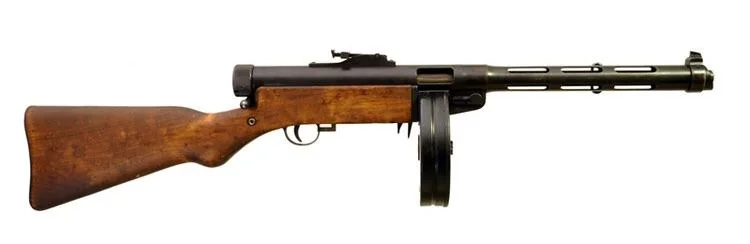
Suomi KP/-31
The Finnish submachine gun, designed by Aimo Lahti. Ski patrols armed with it ambushed Soviet columns on the forest roads, and the Red Army… Continued…
-

Mosin-Nagant M/28-30
The Civil Guard's accurate Finnish-built Mosin, the rifle Simo Häyhä used with iron sights on the Kollaa front. Continued…
-
Mosin-Nagant M1891
The standard rifle of both armies: the Red Army's M1891/30 and the Finns' own rebuilt Mosins, together with many rifles captured from the… Continued…
-
SVT-40 Rifle
The Red Army fought the Winter War with the earlier SVT-38, which proved heavy and unreliable in the cold; the improved SVT-40 was adopted… Continued…
-
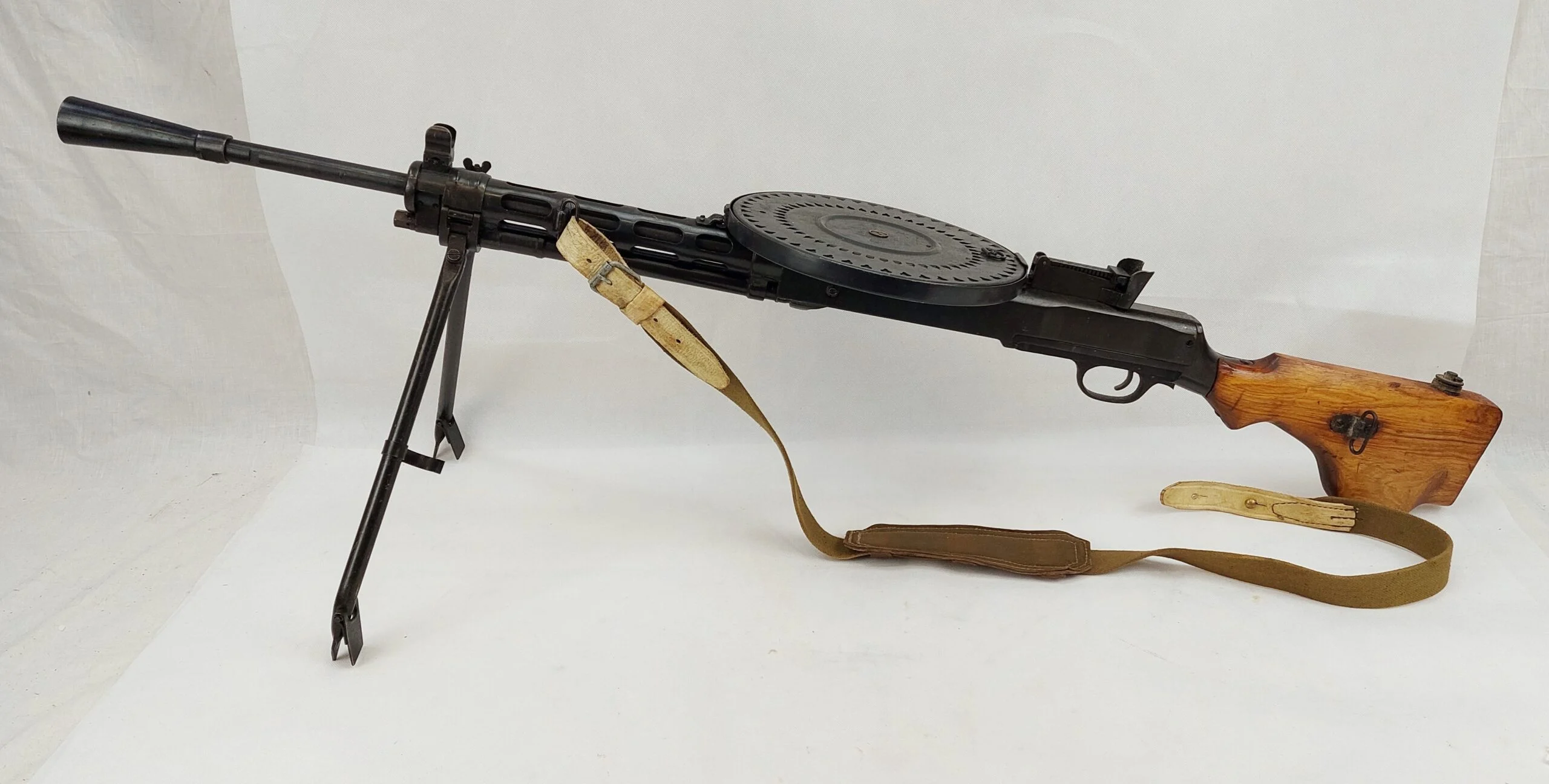
Degtyaryov DP-27
The Soviet squad light machine gun. The Finns captured large numbers from destroyed Soviet units and turned them against their makers. Continued…
-
Puukko
The traditional Finnish belt knife, carried by Finnish soldiers for everyday work and as a last-resort weapon. Continued…
-
Molotov Cocktail
The fire bottle got its name in this war. Finnish soldiers used it with satchel charges to destroy Soviet tanks cut off in the forests. Continued…
-
Maxim Gun
The heavy machine gun of both sides: the Soviet M1910 on its wheeled mount and the Finnish M/09-09 and M/32-33 versions. Continued…
-
Lahti L-39
Finland's 20mm anti-tank rifle was only entering production when the war began; very few, if any, reached the front before the fighting… Continued…
Sources
Trotter, William R. A Frozen Hell: The Russo-Finnish Winter War of 1939-1940. Algonquin Books, 1991.
Van Dyke, Carl. The Soviet Invasion of Finland, 1939-40. Frank Cass, 1997.
Edwards, Robert. White Death: Russia's War on Finland 1939-40. Weidenfeld & Nicolson, 2006.
Engle, Eloise, and Lauri Paananen. The Winter War: The Russo-Finnish Conflict, 1939-40. Charles Scribner's Sons, 1973.
Suggest an edit · account required · reviewed before publishing · how it works