Suomi KP/-31
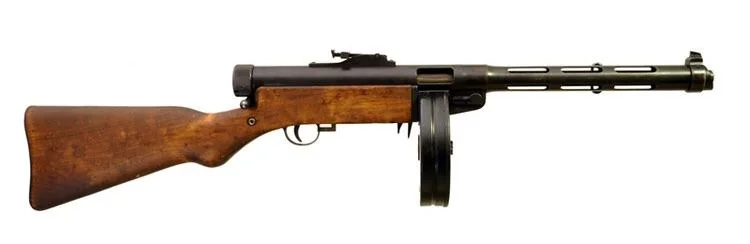
The Suomi KP/-31 was the Finnish Army's submachine gun in the Second World War. Designed by Aimo Lahti and made by the Tikkakoski company, it fired the 9mm Parabellum pistol cartridge, most often from a 70-round drum magazine. It was heavy and expensive, machined from solid steel, but it was also accurate and very reliable in deep cold. Finnish ski troops used it to deadly effect against Soviet columns in the Winter War of 1939-40. Sweden, Denmark and Switzerland built it under license, and its drum magazine was copied for Soviet submachine guns.
Also known as Suomi, KP/-31, Suomi-konepistooli, Suomi M/31, Suomi submachine gun, kpist m/37-39, Madsen-Suomi M/41, MP 43/44
Origins
Aimo Lahti was a self-taught Finnish gun designer who became the country's most important small-arms engineer between the wars. In the early 1920s, only a few years after Finland won its independence, he began work on a submachine gun. An early model of 1926, in the small 7.65mm Parabellum cartridge, was built in small numbers. Lahti then improved the design and moved it to the more powerful 9mm Parabellum round. The new gun was adopted in 1931 as the KP/-31, short for "konepistooli" (machine pistol) model 1931, and it was made by the Tikkakoski arms company in central Finland. Most people simply called it the Suomi, the Finnish word for Finland. Lahti later designed the Lahti L-39 anti-tank rifle and the Lahti pistol.
Design & Construction
The Suomi was a blowback submachine gun that fired from an open bolt. It was built like a rifle, with a full wooden stock and a long barrel inside a cooling jacket. The barrel could be changed quickly, and its length made the Suomi more accurate than most submachine guns. The bolt fitted closely inside the round receiver, and Lahti used the air trapped behind it as a cushion to slow its movement, which helped control the fire rate of about 750 to 900 rounds a minute. The cocking handle was at the back of the receiver and did not move when the gun fired. The best-known feature was Lahti's 70-round drum magazine. There were also a 40-round drum, a 20-round box and a 50-round box with four columns of cartridges. Almost every part was machined from solid steel. This made the Suomi strong and reliable, but also heavy, at about ten pounds empty, and slow and costly to build, like the American Thompson Submachine Gun of the same era.
Combat Use
When the Soviet Union invaded in November 1939, the Finnish Army had only a few thousand Suomis. It made the most of them in the Winter War. In the frozen forests, Finnish ski patrols moved fast and struck Soviet columns stuck on narrow roads, cutting them into isolated pockets the Finns called "motti". At Suomussalmi and on the Raate road in December 1939 and January 1940, whole Soviet divisions were destroyed this way. At close range among the trees, the Suomi's heavy fire was ideal, and it kept working in temperatures far below zero. Soviet soldiers came to fear it. The Suomi was used again, in much larger numbers, in the Continuation War of 1941-44, alongside the Mosin-Nagant M/28-30 and other rifles. A version with a short barrel and a muzzle brake was made for firing from bunkers and armored vehicles.
Legacy
Roughly 80,000 Suomis were made in Finland before production ended in the early 1950s. Sweden bought it and built its own versions as the m/37-39, Denmark built it under license as the Madsen-Suomi M/41, and in Switzerland Hispano-Suiza built it for the Swiss Army as the MP 43/44. The Winter War also taught the Red Army to value submachine guns. The Soviet PPD-40 used a drum magazine closely based on the Suomi's, and the PPSh-41 kept a 71-round drum of the same type. Finland later adopted a copy of the Soviet PPS-43, but the Suomi stayed in Finnish reserve stores for decades, and it remains a symbol of the Winter War.
Sources
Trotter, William R. A Frozen Hell: The Russo-Finnish Winter War of 1939-1940. Algonquin Books, 1991.
Nenye, Vesa, et al. Finland at War: The Winter War 1939-40. Osprey Publishing, 2015.
Hogg, Ian V., and John Weeks. Military Small Arms of the 20th Century. Arms and Armour Press, 1973 and later editions.
Smith, W. H. B. Small Arms of the World. Stackpole, 1943 and later editions.
Suggest an edit · account required · reviewed before publishing · how it works