Battle of Trafalgar
The Battle of Trafalgar was fought on 21 October 1805 off Cape Trafalgar in southern Spain. A British fleet of 27 ships of the line under Vice-Admiral Horatio Nelson attacked a combined French and Spanish fleet of 33 ships under Vice-Admiral Pierre-Charles Villeneuve. Nelson's ships attacked in two columns and broke the enemy line. The British captured or destroyed 18 enemy ships and lost none, but Nelson was shot and killed. Trafalgar confirmed British command of the sea for the rest of the Napoleonic Wars and long after.
Also known as Trafalgar, Batalla de Trafalgar, Bataille de Trafalgar, Nelson's last battle, Cape Trafalgar
Background
In 1805 Napoleon gathered a large army at Boulogne to invade Britain, but he could not cross the Channel while the Royal Navy controlled it. His plan was for his fleets to escape British blockades, join together and win control of the Channel for a few days. Vice-Admiral Pierre-Charles Villeneuve took the Toulon fleet to the West Indies, with Nelson chasing him, and then back to Europe. After an indecisive action with a British squadron off Cape Finisterre in July, Villeneuve took refuge in Cádiz, where he joined the Spanish fleet, since Spain was then allied with France. In August Napoleon gave up the invasion and marched his army east against Austria. He ordered Villeneuve into the Mediterranean, and when Villeneuve learned he was about to be replaced, he sailed from Cádiz on 19 and 20 October. Nelson's fleet was waiting offshore.
The Battle
On the morning of 21 October the two fleets sighted each other off Cape Trafalgar. Villeneuve had 33 ships of the line, 18 French and 15 Spanish, with the Spanish admiral Federico Gravina as his second. Nelson had 27. Villeneuve turned his fleet north toward Cádiz, which left his line ragged and bent. Nelson had told his captains in advance that he would not fight a long line battle. Instead the British attacked in two columns at right angles to the enemy line, Nelson in HMS Victory leading the northern column and Vice-Admiral Cuthbert Collingwood in Royal Sovereign the southern. Before the battle Nelson raised the signal "England expects that every man will do his duty". The winds were light, and the leading British ships took enemy fire for a long time before they could reply. Royal Sovereign broke into the line first, at about noon. Victory passed astern of the French flagship Bucentaure and fired into her stern, then became locked alongside the Redoutable. At about 1:15 in the afternoon a musket ball fired from Redoutable's mizzen top struck Nelson in the shoulder and passed into his spine. He was carried below and died at about 4:30, after hearing that the battle was won. The fighting broke into close ship-to-ship actions. Villeneuve surrendered in Bucentaure, the Santísima Trinidad was dismasted and taken, and the French Achille caught fire and blew up. Rear-Admiral Dumanoir's van division was slow to turn back, and four of its ships escaped, only to be captured two weeks later.
Weapons
This was a battle of the Ship of the Line and its guns. British crews fired broadsides from the 32-Pounder Naval Long Gun and at close range from the Carronade. Marines and soldiers on both sides fired the Brown Bess Musket and the Charleville Musket from decks and fighting tops. When ships locked together, sailors fought with the Boarding Pike, the Boarding Cutlass, the Boarding Axe and the Sea Service Pistol.
Aftermath
The British took or destroyed 18 enemy ships without losing any of their own. A severe storm followed, and many prizes were wrecked or scuttled, while others were retaken; only four reached Gibraltar. The British lost about 450 killed and 1,200 wounded. French and Spanish losses are less certain, but most estimates put them at around 4,000 killed or drowned, some 2,500 wounded and about 7,000 taken prisoner. Gravina died of his wounds in 1806. Villeneuve was taken to England and released, and he died in France in 1806, probably by suicide. Napoleon won his great land victory at Austerlitz six weeks later, but Trafalgar ended any serious threat of invasion. Britain kept command of the sea for the rest of the Napoleonic Wars, and Nelson became a national hero, remembered by the column in Trafalgar Square.
Weapons used
-
Ship of the Line
Twenty-seven British ships of the line met thirty-three French and Spanish ones, from the 74-gun two-decker to the four-decked Santísima… Continued…
-
32-Pounder Naval Long Gun
The heavy guns on the lower decks of the British ships fired the broadsides that raked the enemy line once Nelson's columns broke through. Continued…
-
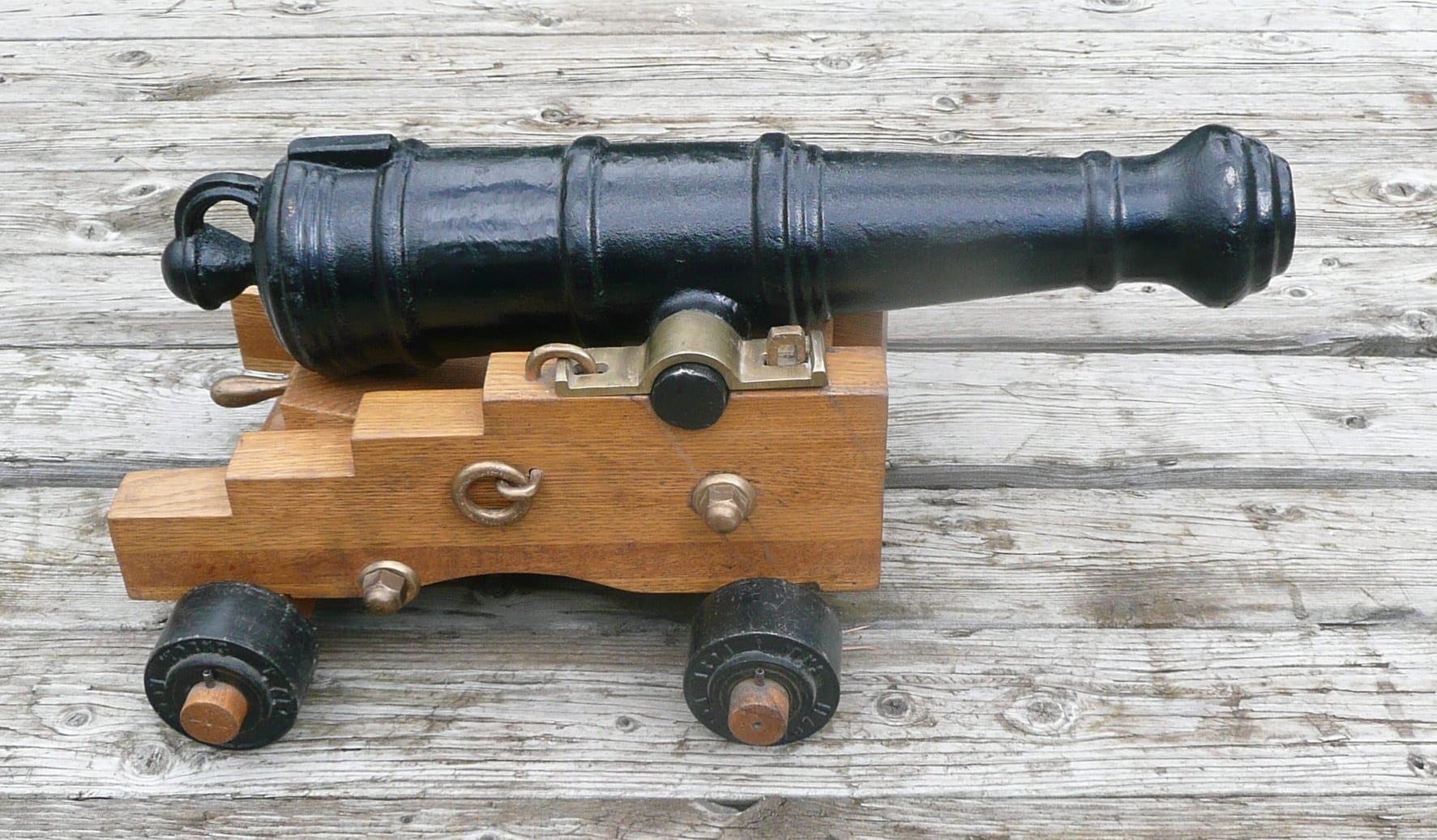
Carronade
HMS Victory opened with her 68-pounder carronade, firing round shot and a keg of musket balls through the stern of the French flagship… Continued…
-
Charleville Musket
French soldiers and marines fired muskets from the tops of the Redoutable, and a ball from one of them mortally wounded Nelson. Continued…
-
Brown Bess Musket
Royal Marines on the British upper decks fired Sea Service versions of the Brown Bess at enemy crews at close range. Continued…
-
Boarding Pike
British crews used pikes to beat off the Redoutable's attempt to board HMS Victory. Continued…
-
Boarding CutlassFor sale
The standard sidearm of sailors in the boarding and repelling of boarders as ships locked together. Continued…
-
Boarding Axe
Used to clear wreckage and fallen rigging and as a weapon when British crews boarded beaten ships. Continued…
-
Sea Service Pistol
Carried by boarders and officers for the close fighting across the decks. Continued…
Sources
Adkins, Roy. Trafalgar: The Biography of a Battle. Little, Brown, 2004.
Adkin, Mark. The Trafalgar Companion. Aurum Press, 2005.
Clayton, Tim, and Phil Craig. Trafalgar: The Men, the Battle, the Storm. Hodder & Stoughton, 2004.
Rodger, N. A. M. The Command of the Ocean: A Naval History of Britain, 1649-1815. Allen Lane, 2004.
Suggest an edit · account required · reviewed before publishing · how it works