Gjermundbu Helmet
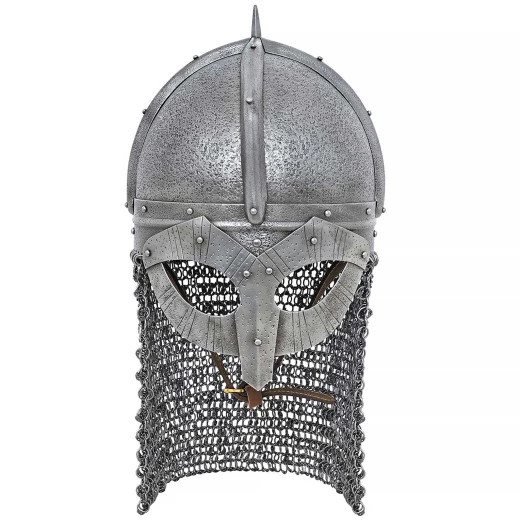
The Gjermundbu helmet is the only nearly complete helmet known from the Viking Age. It was found in 1943 in a tenth-century burial mound on the Gjermundbu farm at Ringerike, Norway, broken into pieces and buried with a warrior's other equipment, including rare fragments of mail. It is a round iron cap with a 'spectacle' guard that protected the eyes and nose. It is the best evidence for what Viking warriors actually wore on their heads, and it shows that the horned helmet of popular imagination is a nineteenth-century invention.
Also known as Gjermundbu helm, Viking helmet, spectacle helmet, Norse spectacle-guard helmet
Origins
In March 1943 a farmer digging on the Gjermundbu farm at Haugsbygd in Ringerike, north-west of Oslo, broke into a large burial mound. Archaeologists from the University of Oslo found that it held a cremation grave of the later tenth century, probably from around 970, in which a man had been buried with a great deal of weapons and equipment: a sword, spearheads, axes, a shield boss, arrowheads, horse gear, stirrups and spurs, gaming pieces, and fragments of a mail shirt. Among them were the broken pieces of an iron helmet. When they were put back together, they formed the only Viking-age helmet complete enough to show its whole design. The grave's contents suggest that the dead man was a chieftain or wealthy warrior. The find is now in the Museum of Cultural History in Oslo.
Design & Construction
The helmet is a rounded cap made of four iron plates held together by a cross-shaped frame of iron bands, with a band running round the brim. A short spike rises from the top where the bands meet. Riveted to the front is a 'spectacle' guard, a mask of iron that circles the eyes and runs down over the nose, protecting the upper face while leaving good vision. It is related to the much earlier helmets of the Vendel and pre-Viking periods found in Sweden, such as those from Valsgärde, which have similar spectacle guards, but it is simpler and more practical. Traces of mail around the brim may come from an aventail, a curtain of mail protecting the neck.
Combat Use
A helmet like this would have been the equipment of a well-off warrior, since iron and skilled smithing were expensive. Most men in a Viking army probably fought with a leather cap or no helmet at all, and the simpler conical helmet with a nasal bar became more common by the eleventh century. Warriors with helmet and mail stood in the front of the shield wall, where the fighting with spear, sword and axe was hardest, as in the battles of the late tenth century such as the Battle of Maldon in 991. The helmet was worn with the Mail Hauberk and the Viking Round Shield.
Legacy
The Gjermundbu helmet is the model for nearly every modern reconstruction of Viking armor, from museum displays to reenactors and films. It also shows clearly that the Vikings did not wear horned helmets. That image comes from the costume designs of Carl Emil Doepler for the first full production of Wagner's Ring cycle in 1876, and from romantic painting of the same period. Since 1943 a few more fragments of Viking-age helmets have been found, and in 2020 a helmet found at Yarm in England was dated to the tenth century, but none is as complete as Gjermundbu.
Sources
Grieg, Sigurd. Gjermundbufunnet: En høvdingegrav fra 900-årene fra Ringerike. Norske Oldfunn VIII. Universitetets Oldsaksamling, Oslo, 1947.
Hjardar, Kim, and Vegard Vike. Vikings at War. Casemate, 2016.
Harrison, Mark. Viking Hersir, 793-1066 AD. Osprey Publishing, 1993.
Caple, Chris. 'The Yarm Helmet.' Medieval Archaeology 64 (2020).
Suggest an edit · account required · reviewed before publishing · how it works