McMillan TAC-338
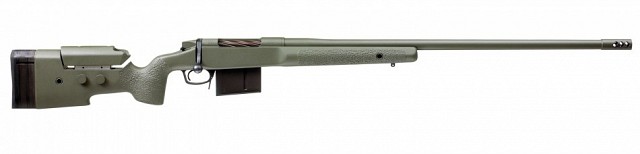
The McMillan TAC-338 is a bolt action sniper rifle built by McMillan Firearms of Phoenix, Arizona, and chambered for the powerful .338 Lapua Magnum cartridge. It fills the gap between 7.62 mm sniper rifles and .50 caliber anti-materiel rifles, reaching well past 1,500 meters while remaining light enough for one man to carry. It is best known as a US Navy SEAL rifle of the Iraq War: SEAL sniper Chris Kyle used one for his longest recorded kill, at about 2,100 yards near Sadr City in 2008.
Also known as TAC-338, McMillan TAC 338, TAC-338A, McMillan .338 Lapua
Origins
McMillan began as a family business in Arizona, famous among competitive shooters for its fiberglass rifle stocks, its precision barrels and its match actions. In the 1980s and 1990s the company built rifles for military and police snipers and for long-range competition. The TAC-338 was McMillan's answer to a new cartridge. The .338 Lapua Magnum was developed in the late 1980s, partly by the Finnish ammunition maker Lapua, as a dedicated long-range sniper round. It fires a heavy .338 inch bullet much farther and flatter than the 7.62x51mm NATO round of the M24 Sniper Weapon System, without the weight and bulk of a .50 caliber rifle such as the Barrett M82. McMillan built the TAC-338 around a long, strong bolt action able to handle the cartridge's high pressure.
Design & Construction
The TAC-338 is a conventional bolt action sniper rifle built to match-rifle standards. It has a heavy free-floating barrel of about 26.5 inches, a McMillan fiberglass tactical stock with an adjustable cheek piece and length of pull, and a detachable five-round box magazine. A rail on top of the action carries a long-range telescopic sight, and a muzzle brake reduces the considerable recoil. The rifle is built by hand, and McMillan guarantees fine accuracy with match ammunition. It is heavier than a 7.62 mm rifle but far lighter than a .50 caliber weapon, so a sniper can carry it on foot. Its effective range is usually given as 1,500 meters or more, and in the right conditions it can hit targets beyond that.
Service
The TAC-338 was bought by American special operations units, most famously the US Navy SEALs, and it saw heavy use in the Iraq War as part of the Global War on Terror. Chris Kyle, the SEAL sniper whose memoir "American Sniper" became a best-selling book and film, wrote that his longest confirmed shot was made with a McMillan TAC-338. In 2008, near Sadr City in Baghdad, he hit an insurgent aiming a rocket launcher at an American convoy from about 2,100 yards (1,920 meters). The rifle was also sold to police and to the armed forces of other countries. In US service, special operations snipers later moved toward multi-caliber rifles such as the Mk 22 Advanced Sniper Rifle, which can be switched between 7.62 mm and Norma magnum calibers.
Legacy
The TAC-338 helped prove the value of the .338 caliber class for military snipers. Its success, and that of rival .338 Lapua rifles from Britain and Finland, pushed armies to adopt magnum sniper cartridges, and the US Army's M2010 Enhanced Sniper Rifle in .300 Winchester Magnum followed the same logic of more range from a man-portable bolt action. Because of its link to Chris Kyle, the TAC-338 is one of the best-known sniper rifles of the modern era, and McMillan still builds it for military, police and civilian buyers.
Sources
Kyle, Chris, with Scott McEwen and Jim DeFelice. American Sniper. William Morrow, 2012.
Pegler, Martin. Sniper Rifles: From the 19th to the 21st Century. Osprey Publishing (Weapon series), 2010.
Plaster, John L. The Ultimate Sniper: An Advanced Training Manual for Military and Police Snipers. Updated edition, Paladin Press, 2006.
Suggest an edit · account required · reviewed before publishing · how it works