Barrett M82
The Barrett M82 is a semi-automatic rifle chambered for the .50 BMG machine-gun cartridge, designed by Ronnie Barrett in Tennessee in the early 1980s. It was made to destroy equipment rather than men: vehicles, radar, parked aircraft and munitions at ranges beyond 1,500 meters. Adopted by the US Marine Corps and Army and more than thirty other militaries, and standardized by the Army as the M107, it made the heavy 'anti-materiel' rifle a standard weapon and was used heavily in the Gulf War, Afghanistan and Iraq.
Also known as M82A1, M107, Barrett Light Fifty, M82A3, .50 caliber sniper rifle, anti-materiel rifle
Origins
Ronnie Barrett was a commercial photographer in Murfreesboro, Tennessee, with no engineering training, when in 1982 he began sketching a shoulder-fired semi-automatic rifle for the .50 BMG cartridge of the Browning M2 heavy machine gun. American snipers had used scoped M2 machine guns for long shots in Korea and Vietnam, but no practical rifle existed for the round. Barrett built a prototype in his garage, founded Barrett Firearms, and put the M82 into production in 1982; the improved M82A1 followed in 1986. Sweden was the first military buyer, in 1989, and the US Marine Corps followed in 1990.
Design & Construction
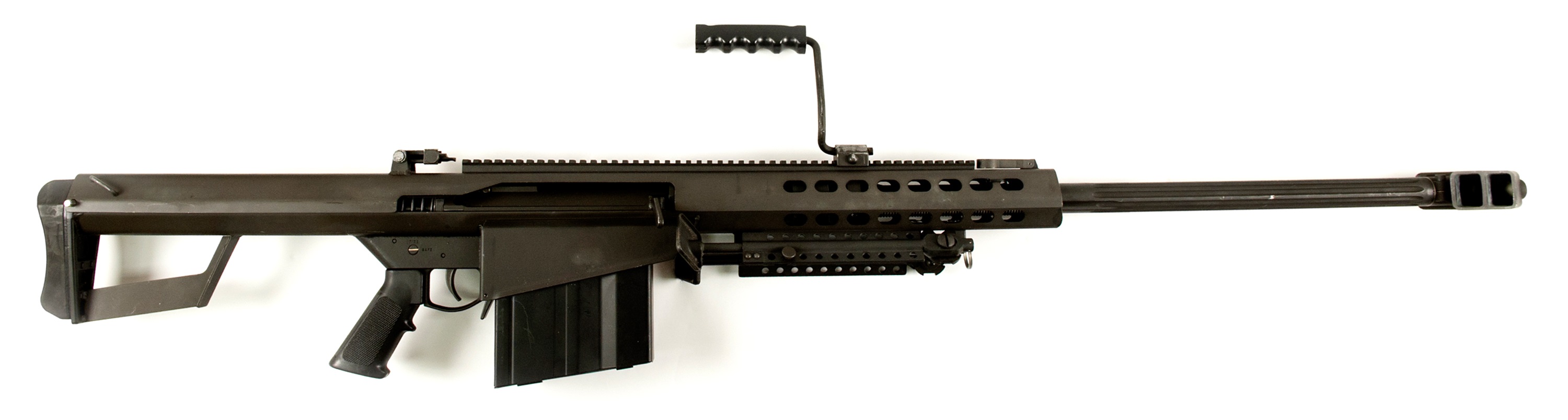
The M82 is a large rifle, almost five feet long and weighing about thirty pounds. Its action is short recoil: when it fires, the barrel and bolt move back together a short distance before the bolt unlocks and the barrel returns forward. A spring-loaded barrel inside the upper receiver and a large double-chamber muzzle brake reduce the recoil to something a man can fire from the shoulder, roughly like a heavy shotgun. It feeds from a ten-round box magazine. The M82A1 has a carrying handle, a bipod and a scope rail, and the rifle can be broken into two parts for carrying. The Army's M107 version has a longer rail, a rear monopod and a lighter build.
Combat Use
The M82's first war was the Gulf War of 1991, when Marines and Army units used it against Iraqi vehicles, bunkers and equipment. It was designed as an anti-materiel weapon: its armor-piercing and incendiary rounds could disable a truck, an armored personnel carrier, radar, aircraft on the ground or explosive devices from far outside small-arms range. In Afghanistan and Iraq it was also used against enemy fighters at very long range, and it remains one of the longest-range shoulder-fired weapons in service. In 2005 the Army adopted it as the M107 Long Range Sniper Rifle, and it has been used by the US Army Rangers, US Navy SEALs and many allied forces.
Legacy
The M82 created the modern class of .50-caliber anti-materiel rifles and inspired rivals and copies from many countries. It made Barrett one of the best-known names in firearms, and in 2016 the state of Tennessee named the Barrett M82 its official state rifle. The US Army and Marine Corps are now replacing some of their M107s with the multi-caliber Mk 22 Advanced Sniper Rifle, also made by Barrett, but the heavy .50 remains in service for work that needs its power.
Sources
Plaster, John L. The History of Sniping and Sharpshooting. Paladin Press, 2008.
Pegler, Martin. Out of Nowhere: A History of the Military Sniper. Osprey Publishing, 2004.
Barrett Firearms Manufacturing. M82A1 / M107 Operator's Manual. Barrett, Murfreesboro, Tennessee.
Dockery, Kevin. Stalkers and Shooters: A History of Snipers. Berkley Caliber, 2006.
Suggest an edit · account required · reviewed before publishing · how it works