M24 Sniper Weapon System
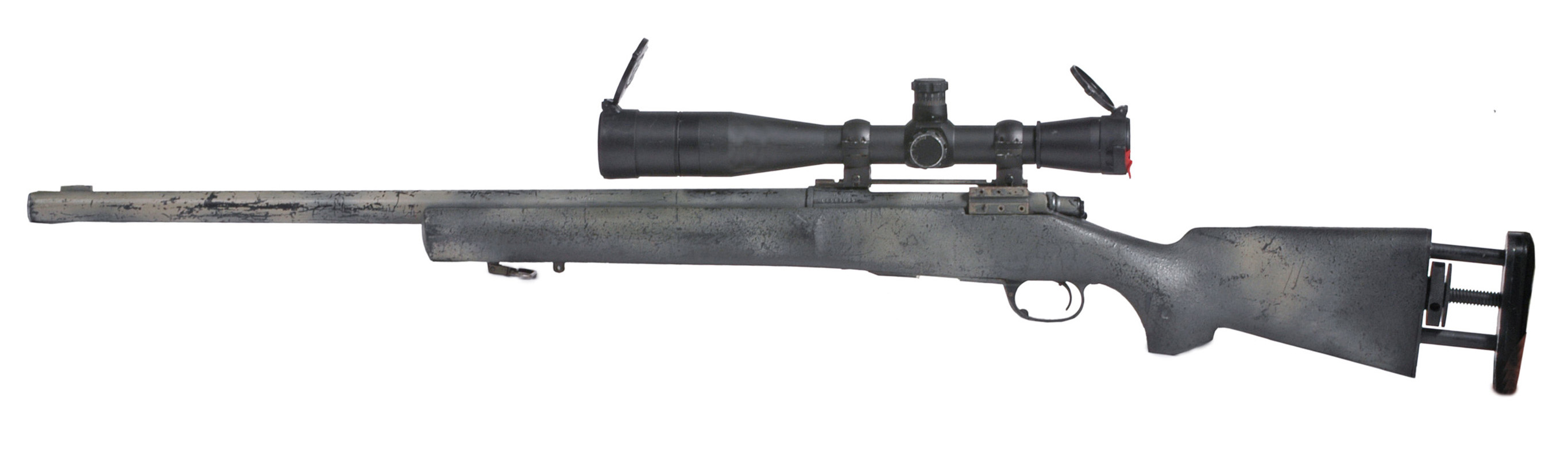
The M24 Sniper Weapon System was the United States Army's standard sniper rifle from 1988 until the 2010s: a Remington Model 700 long action in 7.62mm NATO, bedded in a fiberglass-and-Kevlar H-S Precision stock with a 24-inch heavy barrel and a fixed ten-power Leupold scope. Issued as a complete system with scope, detachable iron sights, sling, cleaning kit and carrying case, it replaced the semi-automatic M21 and served through Panama, the Gulf War, Iraq and Afghanistan before most were rebuilt into the .300 Winchester Magnum XM2010.
Also known as M24 SWS, M24 Sniper Weapon System, M24A2, M24E1
Origins
The Army came out of Vietnam with the M21 Sniper Weapon System, an accurized M14 Rifle that had done well but was aging, and through the 1980s it sought a purpose-built replacement. The competition of 1987 pitted Remington's Model 700 against Steyr's SSG and a Winchester Model 70 entry; Remington won, and the M24 was type-classified in 1988 and fielded from 1989. Unusually, the Army specified a long action rather than the short action the 7.62mm cartridge needs, deliberately leaving room to rebarrel the rifles to .300 Winchester Magnum later — a decision that paid off two decades on.
Design & Construction
The M24 is a Remington 700 built to military tolerances. The 24-inch stainless-steel barrel is a heavy contour with a five-groove, right-hand 1-in-11.25-inch twist matched to the 175-grain M118LR match cartridge; the action sits in an H-S Precision composite stock with an aluminum bedding block and an adjustable butt. Feed is from a five-round internal magazine loaded from the top. The issued optic was the Leupold Mark 4 M3A, a fixed 10x with a mil-dot reticle and a bullet-drop-compensating elevation turret, mounted on a Leupold base; detachable Redfield-Palma iron sights were carried as a backup. With scope the rifle weighs about twelve pounds. Everything — rifle, scope, sights, bipod, sling, cleaning gear, deployment case — was issued as one accountable system, hence the name.
Combat Use
M24s went to Panama in 1989 and the Gulf in 1991, and then to the Balkans, Korean War's demilitarized zone, Afghanistan and Iraq, where they became the workhorse rifle of Army sniper teams, including those of the US Army Rangers, Green Berets and the 101st Airborne. Effective range with M118LR is a nominal 800 meters against a point target and considerably more in practice; the rifle's combination of a superb barrel and a stiff stock gave it a reputation for holding half a minute of angle straight from the case. Its limitations were those of any bolt gun in a war of rapid engagements at unpredictable ranges, which is why the semi-automatic M110 Semi-Automatic Sniper System was introduced alongside it from 2008.
Legacy
In 2010 the Army began returning M24s to Remington to be rebuilt as the XM2010 Enhanced Sniper Rifle in .300 Winchester Magnum — the long action finally used as intended — with a chassis stock, detachable magazine and a variable-power scope, extending engagement range to 1,200 meters for Afghanistan. Unconverted M24s remain in service with the National Guard and with the many allied armies that bought the system. The Army's replacement was the M2010 Enhanced Sniper Rifle and then the multi-caliber Mk 22 Advanced Sniper Rifle; the M24 nonetheless set the pattern for the modern issued sniper rifle as a complete, standardized kit.
Sources
US Army Technical Manual TM 9-1005-306-10, Sniper Weapon System M24.
Pegler, Martin. Out of Nowhere: A History of the Military Sniper. Osprey, 2004.
Senich, Peter R. The Long-Range War: Sniping in Vietnam. Paladin, 1994.
Remington Arms Company, M24 production records.
Suggest an edit · account required · reviewed before publishing · how it works