M110 Semi-Automatic Sniper System
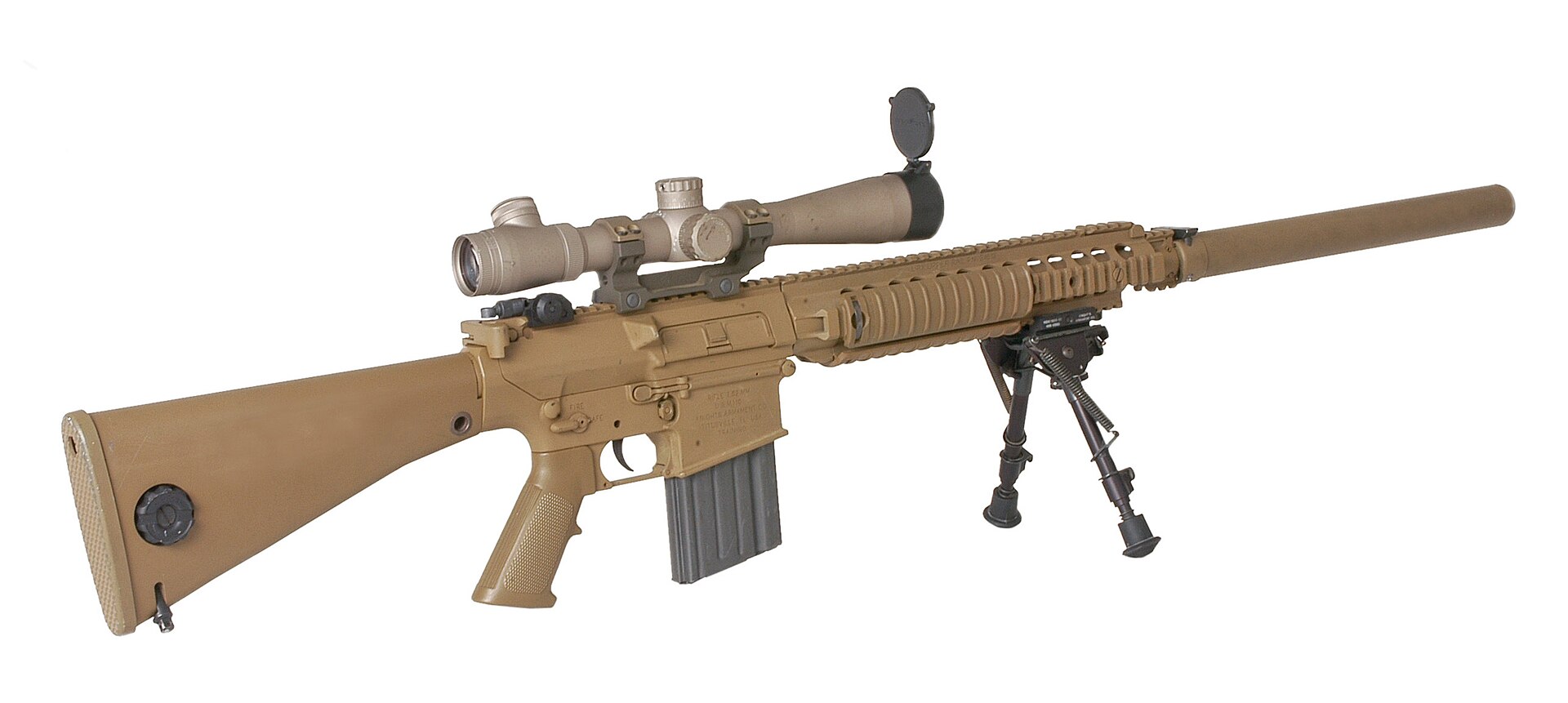
The M110 Semi-Automatic Sniper System is the United States Army's self-loading 7.62mm sniper rifle, adopted in 2008 to give sniper teams rapid follow-up shots against multiple targets at the ranges of Iraq and Afghanistan. Built by Knight's Armament Company on Eugene Stoner's SR-25 — an AR-10 refined with AR-15 parts — it carries a twenty-inch match barrel, a quick-detach suppressor, a Leupold 3.5-10x scope and a rail handguard, and shoots the M118LR cartridge to 800 meters and beyond. It supplements rather than replaces the bolt-action M24 and is being succeeded by the compact M110A1.
Also known as M110, SASS, M110 SASS, Knight's Armament M110, SR-25 (basis), M110K1
Origins
Eugene Stoner's AR-10 of 1956 lost the Army's rifle trials to the M14 Rifle but fathered the M16 Rifle, and in the early 1990s Stoner, then at Knight's Armament Company in Florida, returned to it: the SR-25 married an AR-10 receiver and barrel to as many AR-15 parts as would fit, producing a 7.62mm semi-automatic accurate to a minute of angle. The US Navy SEALs adopted a version as the Mk 11 Mod 0 in 2000. The Army, needing a self-loading sniper rifle after early combat in Iraq showed the bolt-action M24 Sniper Weapon System too slow against fleeting targets in cities, ran a competition in 2005 that KAC won over Remington and others; the M110 was type-classified that year and fielded to sniper teams from 2007-08.
Design & Construction
The M110 is a direct-impingement AR-pattern rifle with a 20-inch free-floated stainless barrel of 1-in-11.25 twist, a URX rail handguard, a collapsible stock adjustable for length, and a Leupold Mark 4 3.5-10x variable scope on a quick-release mount. A KAC sound suppressor clips onto the muzzle in seconds, cutting both report and flash; backup iron sights fold along the rail. Feed is from 10- or 20-round magazines. With scope the rifle weighs just over fifteen pounds — heavier than the M24, the price of the semi-automatic action — and the complete system is issued with a bipod, spotting kit and hard case. Accuracy with M118LR ammunition is specified at one minute of angle.
Combat Use
The M110 reached Iraq and Afghanistan at the height of both wars and was carried by Army and US Marine Corps snipers and by designated marksmen of the US Army Rangers and the airborne divisions. Its value showed in exactly the engagements it was bought for: an insurgent team spotted at 400 meters could be engaged man by man without working a bolt, and a sniper pair could deliver rapid precision fire in a firefight in a way a bolt gun never allowed. The suppressor, standard rather than optional, made the shooter far harder to locate. Complaints were about length and weight in vehicles and on the climb.
Legacy
The M110 established the semi-automatic precision rifle as a standard Army system and directly shaped its successor, the M110A1 Compact Semi-Automatic Sniper System, a Heckler & Koch G28 with a shorter barrel and a piston action, adopted in 2016 and issued from 2019 also as the Squad Designated Marksman Rifle. Original M110s remain in service and with the many allies who bought them, and the SR-25 line continues at KAC.
Sources
US Army Technical Manual TM 9-1005-317-10, M110 Semi-Automatic Sniper System.
Pegler, Martin. Sniper Rifles: From the 19th to the 21st Century. Osprey Weapon 6, 2010.
Knight's Armament Company. M110 SASS product documentation.
Jane's Infantry Weapons, 2010-2011.
Suggest an edit · account required · reviewed before publishing · how it works