M21 Sniper Weapon System
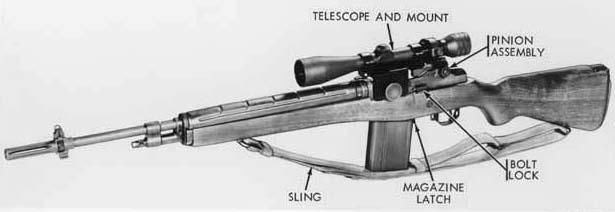
The M21 Sniper Weapon System was the United States Army's sniper rifle from 1969 to 1988: a National Match M14 selected for accuracy, glass-bedded in a walnut stock, fitted with a Leatherwood ART auto-ranging 3-9x telescope and, in Vietnam, often a Sionics suppressor. Built at Rock Island Arsenal from the best M14s in the inventory, it gave Army snipers a semi-automatic rifle accurate to 900 meters at a time when every other army issued bolt guns, and it was recalled from storage for Iraq and Afghanistan forty years after its adoption.
Also known as M21, XM21, M21 SWS, M14 National Match sniper
Origins
The Army entered Vietnam War with no sniper rifle and no sniper program, and the US Marine Corps embarrassed it by fielding bolt-action Winchesters and Remingtons with trained marksmen from 1966. The Army Marksmanship Unit at Fort Benning proposed the obvious answer: the M14 Rifle in the accurized National Match form the unit already built for competition, which could be produced quickly from existing stocks. The Limited War Laboratory added the Leatherwood Adjustable Ranging Telescope, and the package was type-classified as the XM21 in 1968 and the M21 in 1969. Rock Island Arsenal built about 1,400 for Vietnam and more later.
Design & Construction
An M21 begins as an M14 receiver and bolt selected for tight tolerances, mated to a heavy Match barrel of 1-in-12 twist and a selector welded to semi-automatic only. The action is glass-bedded into the stock — walnut, later fiberglass — with an epoxy compound so that it returns to exactly the same position after every shot; the gas system is unitized and the flash suppressor reamed for concentricity. The Leatherwood ART scope is the clever part: a cam links the power ring to the mount, so that when the shooter zooms until a 30-inch target fills the reticle's stadia the scope has automatically elevated for range, from 300 to 900 meters, with no holdover. James Leatherwood, its designer, was a Vietnam veteran. Many M21s carried a Sionics suppressor, which did not silence the supersonic bullet but hid the rifle's flash and position. With scope the system weighs just over eleven pounds.
Combat Use
Army snipers with the M21 recorded kills to 900 meters and beyond in Vietnam, and the rifle's semi-automatic action, unique among the world's sniper rifles, let them engage several targets or fire a rapid second shot without losing the sight picture — the great argument for the type that the M110 Semi-Automatic Sniper System would revive decades later. The M21 remained the Army's sniper rifle through the 1970s and 1980s, with the Green Berets, US Army Rangers and the divisions, until the bolt-action M24 Sniper Weapon System replaced it in 1988 for its greater consistency and simpler maintenance.
Legacy
Retired M21s went to the National Guard and into storage, and came out again after 2001 when the Army needed 7.62mm precision rifles faster than the M110 could be delivered; rebuilt M21s and M14-based designated marksman rifles served in Iraq and Afghanistan alongside the M24. The rifle's lineage runs to the M25 built for Special Forces in the 1980s and the Mk 14 Enhanced Battle Rifle, and semi-automatic M21 clones are a favorite of American service-rifle enthusiasts.
Sources
Senich, Peter R. The Long-Range War: Sniping in Vietnam. Paladin, 1994.
Stevens, R. Blake. U.S. Rifle M14: From John Garand to the M21. Collector Grade, 1991.
US Army Technical Manual TM 9-1005-223-35, Rifle 7.62-mm M21 Sniper.
Pegler, Martin. Out of Nowhere: A History of the Military Sniper. Osprey, 2004.
Suggest an edit · account required · reviewed before publishing · how it works