Ottoman Yatagan
The yatagan is the signature short sword of the Ottoman world: a single-edged blade curving forward like the kopis and kukri family, a hilt without any guard, and a pommel spreading into the distinctive 'ears' of bone, ivory, or silver. Thrust through the sash, it was the constant sidearm of the janissaries and of irregulars across the Balkans and Anatolia for three centuries, and surviving examples are among the most richly decorated of all Islamic arms.
Also known as Yatagan, yataghan, ataghan
Origins
The forward-curving single edge is one of the oldest ideas in edged weapons — the Greek kopis and the Iberian falcata worked the same way two thousand years earlier — and the yatagan is its great Ottoman revival. The earliest and most famous dated example is imperial: the yatagan made by the workshop of Ahmed Tekelü for Sultan Süleyman the Magnificent in 1526/27, now in the Metropolitan Museum, its blade inlaid with gold dragons and phoenixes. From court showpiece the form spread to become the everyday sidearm of the empire's soldiery, above all the janissary corps, and of every armed man from Bosnia to the Caucasus by the eighteenth century.
Design & Construction
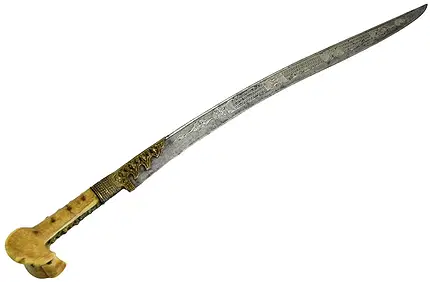
A yatagan blade runs typically 60 to 75 centimeters, single-edged on the concave side, its edge line dropping forward from the hilt and then sweeping to the point so that a cut lands with the mass and geometry of a chop while the point stays in line for the thrust. There is no guard at all. The grip plates — bone, ivory, walrus tusk, horn, or silver — flare into two broad wings, the famous 'ears,' which seat the hand and balance the blade-heavy weapon; the join is usually covered by a decorated silver or brass bolster. Blades frequently carry inscriptions — the owner, the maker, a Quranic verse or talismanic formula — in inlaid gold or silver, and Balkan examples in particular are sheathed in silver-clad scabbards of spectacular workmanship. Thrust through the waist sash, guardless and slightly curved, it rode flat against the body: a weapon designed to be worn always.
Combat Use
The yatagan was the close-quarter arm of men whose main weapons were the musket and the pistol. Janissaries — who in the capital, by long custom, went about armed with the yatagan when full war gear was out of place — used it as boarding parties used the Boarding Cutlass: at grappling distance, in trench and street fighting, where a short, guardless chopper that clears the sash instantly beats a long saber. The forward-curved edge bites deep in a short arc; the same mechanics that make the Gurkha Kukri fearsome scale up in the yatagan to sword length. It served through the empire's wars from the seventeenth century to the Russo-Turkish wars of the nineteenth, and gave its name — via French — to the yataghan-bladed sword bayonets half of Europe adopted mid-century.
Legacy
The yatagan is inseparable from the image of the janissary and of the Balkan warrior; travelers' accounts and Orientalist painting fixed the eared hilt in the European imagination as the very shape of the Ottoman blade. The corps that carried it was destroyed in 1826, and regulation European-style sabers replaced it in the reformed army, but workshop production for irregulars and for status wear continued to the century's end. Collectors today read the silver work, the ear material, and the inscriptions like a map of the empire — Istanbul court work, Bosnian silver, Greek and Cretan niello — and dated, inscribed examples connect surviving pieces to named men with a directness few weapon types allow.
Sources
Astvatsaturian, E. G. Turkish Weapons. Atlant, 2002.
Elgood, Robert. The Arms of Greece and Her Balkan Neighbours in the Ottoman Period. Thames & Hudson, 2009.
Metropolitan Museum of Art, yatagan of Süleyman the Magnificent, workshop of Ahmed Tekelü, dated 1526/27 (acc. 1993.14).
Suggest an edit · account required · reviewed before publishing · how it works