Kukri
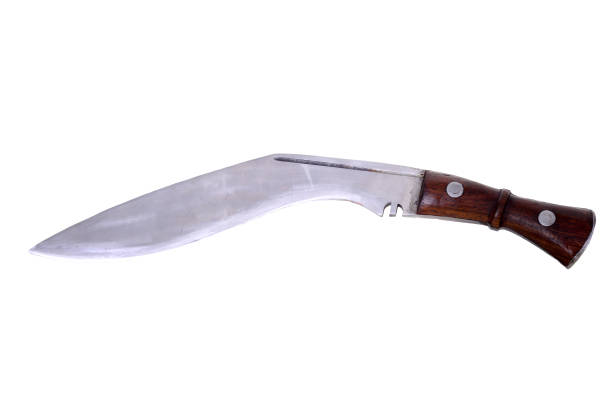
The kukri is the forward-curved knife of Nepal: a broad, downward-angled blade that concentrates a blow like a hatchet while handling like a knife, equally at home splitting kindling and splitting helmets. It is the national blade of the Nepalese hill peoples, the universal tool of the Himalayan farmstead, and — as the issue sidearm of the Gurkha regiments for two centuries — one of the most famous and most instantly recognized fighting knives anywhere on earth.
Also known as Khukuri, khukri, Gurkha knife
Origins
The kukri's ancestry is argued — descent from the Greek kopis via Alexander's campaigns is the romantic theory, local evolution from Himalayan agricultural blades the likelier one — but the weapon is documented in Nepal by the seventeenth century and was ancient in pattern when the British met it in the Anglo-Nepalese War of 1814-16. The East India Company's respect for the men who carried it led directly to the founding of the Gurkha regiments, and the knife enlisted with them.
Design & Construction
The kukri is defined by its bend: a blade of 25 to 35 centimeters that angles downward a third of the way along its spine, putting the sweet spot of a heavy chopper ahead of the hand while the edge's inward curve draws the target into the cut. Blades are thick at the spine — a centimeter is common — and distally tapered, sprung from truck-spring steel in the village workshops of modern Nepal exactly as from bloomery iron before. The traditional grip is water buffalo horn or hardwood with a flared butt; the sheath carries two small companion tools, the sharpening chakmak and the small karda knife. The notch at the blade's base — the kaudi or cho — drains blood off the edge in folklore and marks tradition in fact.
Combat Use
As a weapon the kukri is a short, brutal chopper: issue drill is minimal because the blow is instinctive, a downward or diagonal cut with the mass-forward blade doing the work. Gurkha soldiers carried it through every campaign of the Lee-Enfield Rifle era and both World Wars — trench raids in Flanders, jungle fighting in Burma where it doubled daily as a path-cutter, and hand-to-hand actions that built a reputation the regiments never discouraged: the drawn kukri was worth a platoon of propaganda. It remains issue equipment in the British, Indian, and Nepalese armies today.
Legacy
Few blades are so completely both tool and weapon, and almost none carries a regiment's identity the same way — the crossed kukris of the Gurkha badge are among the most recognized insignia in the world. Collectors distinguish military-issue patterns (MkI through MkV and the modern service No.1) from village and presentation pieces, with WWI and WWII issue examples the heart of the field. The pattern's fighting reputation keeps modern makers producing it continuously, from Nepalese forges to Western production lines.
Sources
Flook, Ron. British and Commonwealth Military Knives. Howell Press, 1999 (covers issue kukris in depth).
Parker, John. The Gurkhas. Headline, 1999.
Gurkha Museum, Winchester — regimental kukri collections.
Suggest an edit · account required · reviewed before publishing · how it works