Historical Context
Ottoman Wars in Europe
The long series of wars in which the Ottoman Empire conquered the Balkans, Constantinople and most of Hungary, then was driven back after its defeat at Vienna in 1683. Janissary musketeers, siege artillery, horse archers and the Polish Winged Hussars all played a part.
1354 – 1699
Overview
The Ottoman Empire began as a small Turkish state in northwest Anatolia. In 1354 Ottoman forces occupied Gallipoli, their first secure base in Europe, and over the next century they conquered most of the Balkans. They defeated the Serbs at Kosovo in 1389 and crushed a crusading army at Nicopolis in 1396 and another at Varna in 1444. In 1453 Sultan Mehmed II took the Byzantine capital in the Fall of Constantinople, and the city became the Ottoman capital. Under Suleiman the Magnificent the empire reached its height. He took Belgrade in 1521, destroyed the Hungarian army at Mohács in 1526, and besieged Vienna in 1529 without success. Most of Hungary came under Ottoman rule. At sea the Ottomans were defeated at the Battle of Lepanto in 1571 but rebuilt their fleet and kept Cyprus. The wars went on through the Long Turkish War of 1593 to 1606 and the struggles with Poland in the seventeenth century. In 1683 a great Ottoman army besieged Vienna again and was defeated at the Battle of Vienna by a relief army under Jan III Sobieski. In the Great Turkish War that followed, the Habsburgs, Poland, Venice and Russia pushed the Ottomans back, and the Treaty of Karlowitz in 1699 gave Hungary and Transylvania to the Habsburgs.
Armies and Weapons
The Ottoman army combined a standing core paid by the sultan with provincial cavalry. The Janissaries were one of the first infantry forces to use firearms on a large scale, carrying the Janissary Tüfek. The sipahi cavalry fought with the Ottoman Composite Bow, lance and the Ottoman Kilij. Ottoman gunfounders cast huge siege guns, and the Bombard made by the founder Orban battered the walls of Constantinople in 1453. Their opponents changed over time. Hungarian and Balkan armies of the fifteenth century relied on heavy cavalry and war wagons, and the Habsburg forces of the sixteenth and seventeenth centuries on pike and shot, with the Pike and Matchlock Musket. Poland's answer was its cavalry, above all the Winged Hussars with the Winged Hussar Lance and the Polish Szabla.
Legacy
Karlowitz marked the end of Ottoman expansion in Europe and the start of a slow retreat that lasted into the twentieth century. The wars left the Balkans with a mix of peoples and religions whose effects are still felt, and they made the Habsburg monarchy a great power on the Danube. For more than three centuries, fear of the Turk shaped European politics, fortification and military reform, and the relief of Vienna in 1683 is still remembered in Poland and Austria.
Battles & Operations
-
Fall of Constantinople (6 April - 29 May 1453)
The Fall of Constantinople was the capture of the Byzantine capital by the Ottoman sultan Mehmed II on 29 May 1453, after a siege of about… Continued…
-
Battle of Lepanto (7 October 1571)
The Battle of Lepanto, fought on 7 October 1571 off western Greece, was the largest galley battle of the age. The fleet of the Holy League… Continued…
-
Battle of Vienna (12 September 1683)
The Battle of Vienna, fought on 12 September 1683, ended the second Ottoman siege of the Habsburg capital. The Grand Vizier Kara Mustafa… Continued…
Weapons
-
Arquebus
The arquebus was the first practical infantry firearm, a matchlock long gun light enough to be fired from the shoulder or chest without a… Continued…
-
Bombard
A bombard was a large, short-ranged cannon of the fourteenth to sixteenth centuries that fired heavy stone balls against castle and town… Continued…
-
Crossbow
The crossbow put a bow on a stock, held its own draw, and released on a trigger — trading the archer's lifetime of training for a weapon… Continued…
-
Greek Fire
Greek fire was the Byzantine Empire's incendiary weapon: a liquid that burned fiercely, could not easily be put out, and was projected from… Continued…
-
Halberd
The halberd combined axe blade, thrusting spike, and back hook on a two-meter haft — a complete toolkit for infantry facing armored… Continued…
-
Hand Cannon
The hand cannon is the first true firearm: a small bronze or iron barrel on a pole or stock, loaded with powder and ball and touched off by… Continued…
-
Janissary Tüfek
The tüfek, the Turkish word for a gun, was the long-barreled musket carried by the Janissaries, the elite infantry of the Ottoman Empire.… Continued…
-
Matchlock Musket
The matchlock was the first firearm a soldier could aim and fire without taking his eyes off the enemy: a serpentine lever lowered a… Continued…
-
Morion Helmet
The morion is the open steel helmet with a tall comb and a brim swept up to points at front and back that armed pikemen and arquebusiers… Continued…
-
Ottoman Composite Bow
The Ottoman composite bow was the short, strongly recurved bow of horn, wood and sinew used by Ottoman Turkish armies from the fourteenth… Continued…
-
Ottoman Kilij
The kilij is the curved saber of the Ottoman Turks, and the name — simply 'sword' in Turkish — covers a family of blades carried from the… Continued…
-
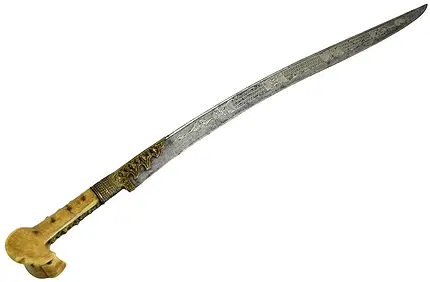
Ottoman Yatagan
The yatagan is the signature short sword of the Ottoman world: a single-edged blade curving forward like the kopis and kukri family, a hilt… Continued…
-
Pike
The pike is the longest infantry weapon ever carried in formation: an ash shaft of 16 to 22 feet tipped with a small steel head, used by… Continued…
-
Polish Nadziak
The nadziak was the war hammer of the Polish-Lithuanian cavalry from the sixteenth to the eighteenth century. Its head combined a long… Continued…
-
Polish Szabla
The szabla is the curved saber of the Polish-Lithuanian Commonwealth, carried by the Polish nobility and cavalry from the sixteenth to the… Continued…
-
Swivel Gun
The swivel gun was a small cannon mounted on a forked iron yoke that pivoted in a socket on a ship's rail, fighting top or boat bow, so… Continued…
-
Trebuchet
The counterweight trebuchet was the heaviest artillery of the Middle Ages: a great pivoting beam whose short arm carried a box of earth or… Continued…
-
Venetian Galleass
The galleass was a large, heavily gunned warship of the sixteenth-century Mediterranean, built by Venice from its great merchant galleys.… Continued…
-
Wheellock Pistol
The wheellock was the first self-igniting firearm: a spring-driven steel wheel spun against pyrite to shower sparks into the pan, no… Continued…
-
Winged Hussar Lance
The kopia was the lance of the Polish-Lithuanian winged hussars, the heavy cavalry that dominated Eastern European battlefields for more… Continued…