Historical Context
Age of Chivalry
Medieval European culture elevated the mounted knight as the dominant military force. Full plate armor, longswords, lances, and heraldic shields defined this era, with weapon-making craftsmanship reaching both artistic and functional peaks in centers like Toledo and Solingen.
c. 1000 – 1500
Overview
The Age of Chivalry spans the high medieval period — from the consolidation of feudalism and the emergence of the mounted knight as Europe's dominant military force, to the demise of that dominance in the face of the longbow, crossbow, and pike. It is the era of the Crusades, heraldry, jousting, and the progressive development of armor from chainmail to full plate — a 500-year arms race between offensive and defensive technology.
The Knight and His Arms
The medieval knight was an armored cavalry warrior — the most expensive, training-intensive, and individually lethal soldier of his era. A full war equipment represented roughly the value of a small farm.
The Sword
The knightly sword evolved significantly across the period:
- Early medieval (Carolingian type, 900–1100) — Pattern-welded or monosteel; broad, relatively flat; wide fuller; pommel; designed for cutting against lightly armored opponents
- High medieval (1100–1300) — Narrower point; longer grip allowing two-hand use; cross-shaped guard; as chainmail improved, swords needed to thrust into gaps
- Late medieval (1300–1500) — With plate armor, the war sword (bastard/hand-and-a-half sword) and longsword developed; longer, stiffer blades; acute points for thrusting into armor gaps; half-swording (gripping the blade with a gauntleted hand for controlled thrusting) and murder stroke (using the hilt as a hammer against armored opponents) became standard fighting techniques
Notable types: estoc (rigid armor-piercing sword), falchion (single-edged cutting sword), great sword (two-handed).
The Lance
The lance was the knight's primary offensive weapon:
- Used couched under the arm from the late 11th century onward — a revolutionary technique that transferred the horse's full momentum into the lance point
- An armored cavalry charge with couched lances was nearly unstoppable against infantry not in prepared positions
- Tournaments (jousting) reproduced this single combat; a couched lance hit could unhorse a fully armored opponent
Secondary Arms
- War hammer and mace — With plate armor, cutting weapons were less effective; blunt weapons transmitted impact through armor; the war hammer's spike could punch through plate
- Poleaxe — The preferred weapon of armored men fighting on foot; combined axe, hammer, and spike; designed specifically to defeat plate armor
- Dagger (misericorde) — "Mercy" dagger; slim-bladed; pushed through visor or joints to kill a downed armored opponent; the last resort in close combat
Armor Development
The central narrative of the Age of Chivalry is the arms race between weapon and armor:
Chainmail (c. 1000–1300)
- Hauberk — Full chainmail body garment; extended to mid-thigh with split skirts for riding; long sleeves; integrated coif (head covering) in many versions
- Chausses — Chainmail leg coverings
- Limitations — Chainmail stopped cuts but transmitted blunt trauma; crossbow bolts and bodkin-point arrows could penetrate at battle range; no protection against bludgeoning
Transitional Armor (1200–1350)
- Coat of plates — Iron plates riveted inside a fabric garment; provided rigid protection over chainmail
- Early plate additions — Knee caps (poleyns), elbow cops (couters), and arm plates (vambraces) added over chainmail
Full Plate Armor (1350–1500)
- Gothic armor (German) — Characterized by fluted surfaces that deflected weapons; elaborate articulation; full coverage from head to foot
- Milanese armor (Italian) — Rounded, smooth surfaces; extremely complete coverage; the finest production armor in Europe
- An armored knight in full plate was remarkably well-protected — A well-fitted harness could survive arrows, sword cuts, and even some firearms; defeating a knight required targeting the gaps at armpits, groin, and visor, or using specialized weapons (poleaxe, rondel dagger)
- Weight — A full plate harness weighed 15–25 kg; roughly equal to a modern soldier's combat load; distributed across the body, it was more manageable than popularly imagined
The End of Chivalry's Military Dominance
Three weapons ended the knight's supremacy:
The Longbow (1300s)
At Crécy (1346), Poitiers (1356), and Agincourt (1415), English and Welsh longbowmen destroyed French cavalry charges. A skilled longbowman fired 10–12 arrows per minute; a massed volley from hundreds of archers saturated an area with enough arrow density to hit horses (which could not be fully armored) and penetrate chainmail at the flanks.
The Crossbow (1000–1400s)
The crossbow democratized ranged anti-armor capability — requiring little training, it could penetrate chainmail at combat range. The Church attempted to ban it (Second Lateran Council, 1139) as an unchivalrous weapon; this reflected its threat to the knightly class.
The Pike and Halberd (1300s–1400s)
Swiss and Flemish infantry using pike formations and halberds defeated armored cavalry at Morgarten (1315), Laupen (1339), and Grandson (1476). A disciplined phalanx of pikemen presented an impenetrable wall of points that cavalry could not overrun; halberds pulled knights from horses.
This article is a stub. Contributions covering specific battles, weapons, and chivalric orders are welcome.
Battles & Operations
-
Battle of Crécy (26 August 1346)
The Battle of Crécy, fought on 26 August 1346 in Ponthieu in northern France, was the first great English victory of the Hundred Years War.… Continued…
-
Battle of Agincourt (25 October 1415)
The Battle of Agincourt was fought on 25 October 1415, St Crispin's Day, in northern France during the Hundred Years War. King Henry V's… Continued…
Weapons
-
Arbalest
The arbalest was the heavy crossbow of the late Middle Ages, with a bow of steel or thick composite so powerful it had to be drawn with a… Continued…
-
Arming Sword
The arming sword was the one-handed, double-edged sword of the medieval knight, carried from the eleventh to the fifteenth century with a… Continued…
-
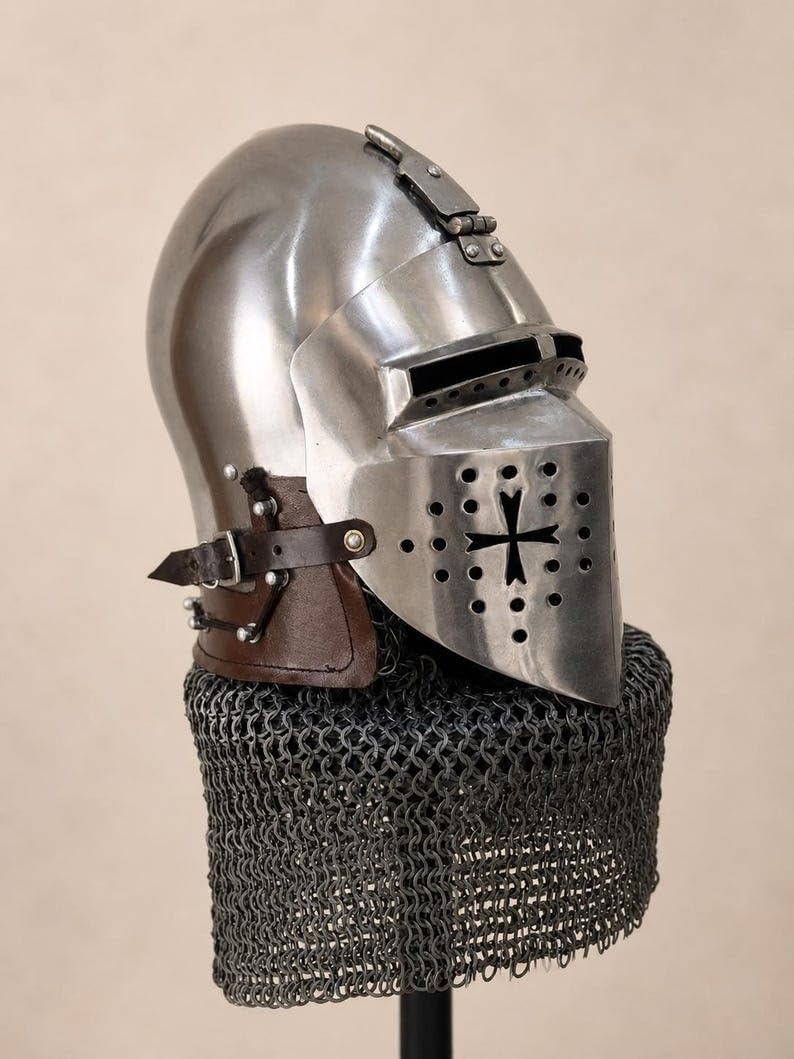
Bascinet
The bascinet was the most widely worn helmet of fourteenth-century Europe: an iron skull cap drawn up into a point, with a curtain of mail… Continued…
-
Crossbow
The crossbow put a bow on a stock, held its own draw, and released on a trigger — trading the archer's lifetime of training for a weapon… Continued…
-
English Longbow
The English longbow was the great ranged weapon of the later Middle Ages: a self bow of yew, as tall as its archer or taller, drawing well… Continued…
-
Estoc
The estoc was a sword made to defeat plate armor: a long, stiff blade with no real cutting edge, triangular, square or diamond in section… Continued…
-
Falchion
The falchion was a single-edged medieval sword with a broad blade, heavier toward the point, that combined the chopping power of an axe… Continued…
-
Glaive
The glaive is a European pole arm made of a single-edged blade, shaped like a large knife or cleaver, mounted on a shaft of about six to… Continued…
-
Gothic Plate Armor
Gothic armor is the name collectors give to the full plate harnesses made in the German lands of the Holy Roman Empire from roughly 1460 to… Continued…
-
Great Helm
The great helm was the fully enclosed, flat-topped or sugarloaf helmet of the high medieval knight, worn from around 1220 until the mid… Continued…
-
Kettle Hat
The kettle hat was an open-faced iron or steel helmet with a wide brim, known in French as the chapel de fer, the iron hat. It appeared in… Continued…
-
Knight's Lance
The knight's lance was the defining weapon of medieval European heavy cavalry: a long wooden shaft with an iron head, held tight under the… Continued…
-
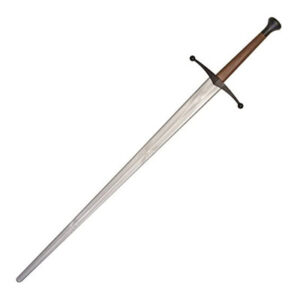
Longsword
The longsword is the two-handed knightly sword of the late Middle Ages and Renaissance: a straight, double-edged blade of roughly 33 to 43… Continued…
-
Mail Hauberk
The mail hauberk was the principal body armor of European warriors for most of the Middle Ages: a long shirt of thousands of interlinked… Continued…
-
Medieval Mace
The mace is concentrated impact: a weighted head of iron or bronze on a stout haft, built to transmit force THROUGH armor rather than cut… Continued…
-
Morning Star
The morning star is a spiked club: a wooden or iron shaft topped with a heavy ball or cylinder studded with steel spikes, used across… Continued…
-
Norman Kite Shield
The kite shield is the long, round-topped, tapering shield carried by the Norman knights of the Bayeux Tapestry and by armored horsemen… Continued…
-
Poleaxe
The poleaxe was the knight's weapon for fighting on foot in full plate armor during the fifteenth century. About five to six feet long, it… Continued…
-
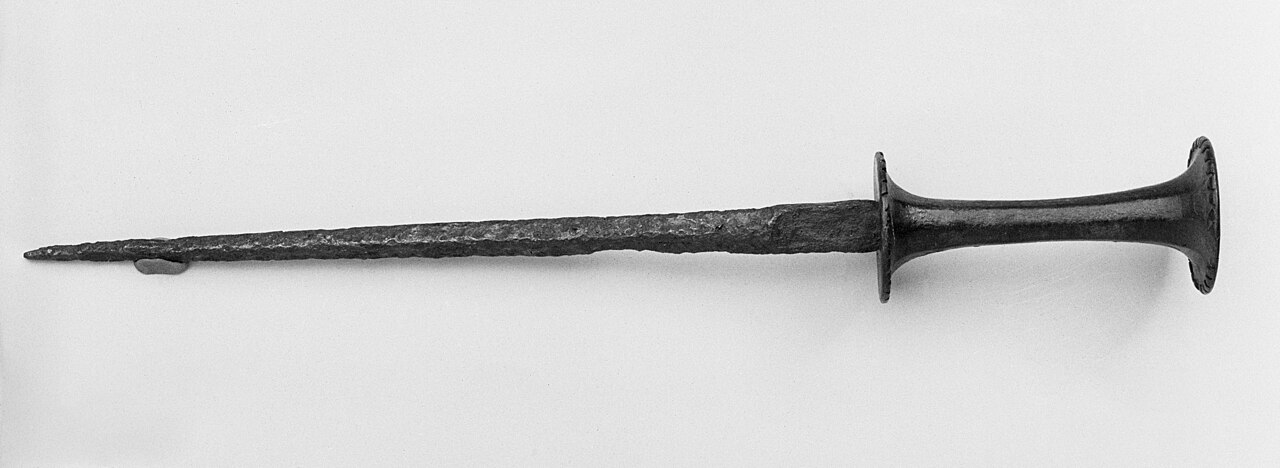
Rondel Dagger
The rondel dagger was the stiff, needle-pointed dagger of the late medieval knight, named for the disc-shaped guard and pommel that framed… Continued…
-
Trebuchet
The counterweight trebuchet was the heaviest artillery of the Middle Ages: a great pivoting beam whose short arm carried a box of earth or… Continued…
-
War Hammer
The war hammer is the late medieval answer to plate armor: a steel head with a blunt, often toothed hammer face on one side and a stout… Continued…