Battle of Crécy
The Battle of Crécy, fought on 26 August 1346 in Ponthieu in northern France, was the first great English victory of the Hundred Years War. Edward III, marching through northern France with a small army, took a defensive position on a ridge with dismounted men-at-arms and thousands of longbowmen. The French army of Philip VI attacked late in the day: its Genoese crossbowmen were outshot, and repeated charges by the French knights were broken by archery and the dismounted English line. French losses were heavy, and Edward went on to besiege Calais.
Also known as Crécy, Crecy, Cressy, Battle of Crécy-en-Ponthieu
Background
Edward III claimed the throne of France through his mother, and in July 1346 he landed in Normandy with an army of perhaps 12,000 to 15,000 men. He sacked Caen and marched toward the Seine and Paris, burning the country as he went, then turned north with the much larger army of Philip VI following him. On 24 August the English forced the crossing of the Somme at the ford of Blanchetaque, and two days later Edward chose to stand and fight on a ridge between the villages of Crécy-en-Ponthieu and Wadicourt, with a wood on one flank and the river Maye on the other.
The Battle
Edward dismounted his men-at-arms and formed them in three divisions, the vanguard under his sixteen-year-old son Edward, the Black Prince, with archers on the flanks and a wagon park behind. The French army, perhaps twice as large, arrived piecemeal and late in the afternoon of 26 August, tired from the march. Philip sent forward his Genoese mercenary crossbowmen, several thousand strong. Their large pavise shields had been left with the baggage, and the chroniclers say a rain shower had soaked their strings. The English archers, shooting three or four arrows for every crossbow bolt, drove them back in disorder. The French men-at-arms, impatient behind them, rode down the retreating Genoese and charged up the slope. They were met by a storm of arrows that killed and maddened the horses, and those who reached the English line were fought on foot by the dismounted men-at-arms. At least fifteen charges went in, the last after dark. The blind King John of Bohemia had himself led into the fighting, tied to his knights, and was killed; Philip was wounded and led from the field. English chroniclers claimed that small cannon were also fired, which would make Crécy one of the first European field battles to see them, although the evidence is debated.
Weapons
Crécy made the English Longbow famous: a war bow of yew shooting a heavy arrow, handled by archers who could loose ten or twelve arrows a minute, outranging and outshooting the Crossbow in the open field. It worked together with the dismounted men-at-arms, in Mail Hauberk, plate reinforcements and the Bascinet, who held the line the archers could not have held alone. The French knights charged with the Knight's Lance as they had always done.
Aftermath
The heralds counted more than 1,500 French knights and men-at-arms dead, including the King of Bohemia, the Duke of Lorraine, the Count of Flanders and the King's brother, the Count of Alençon; the losses among ordinary soldiers are unknown. English losses were light. Edward marched on and besieged Calais, which fell in August 1347 and remained English for two centuries. The same combination of archers and dismounted men-at-arms won at Poitiers in 1356 and again at the Battle of Agincourt in 1415.
Weapons used
-
English Longbow
Some 5,000 to 7,000 English and Welsh archers outshot the Genoese crossbowmen and broke charge after charge of French cavalry. Continued…
-
Crossbow
Philip VI's Genoese mercenary crossbowmen opened the French attack and were driven back by the English archery. Continued…
-
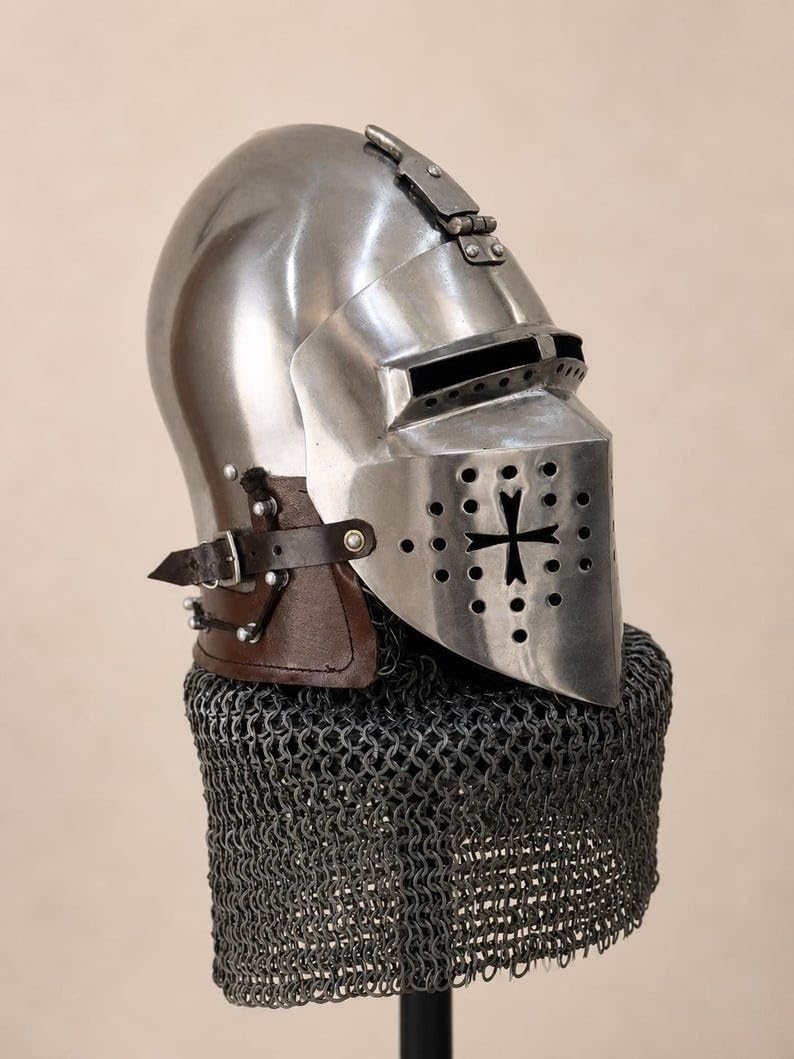
Bascinet
The close-fitting bascinet was the standard helmet of the men-at-arms on both sides by 1346. Continued…
-
Knight's Lance
The French knights charged with the couched lance, up the slope against the dismounted English line. Continued…
-
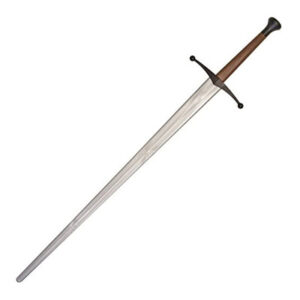
Longsword
Carried by knights and men-at-arms who fought on foot in the English line. Continued…
Sources
Sumption, Jonathan. The Hundred Years War, Volume I: Trial by Battle. Faber and Faber, 1990.
Ayton, Andrew, and Philip Preston. The Battle of Crécy, 1346. Boydell Press, 2005.
DeVries, Kelly. Infantry Warfare in the Early Fourteenth Century. Boydell Press, 1996.
Froissart, Jean. Chronicles, trans. Geoffrey Brereton. Penguin Classics, 1968.
Suggest an edit · account required · reviewed before publishing · how it works