Bascinet
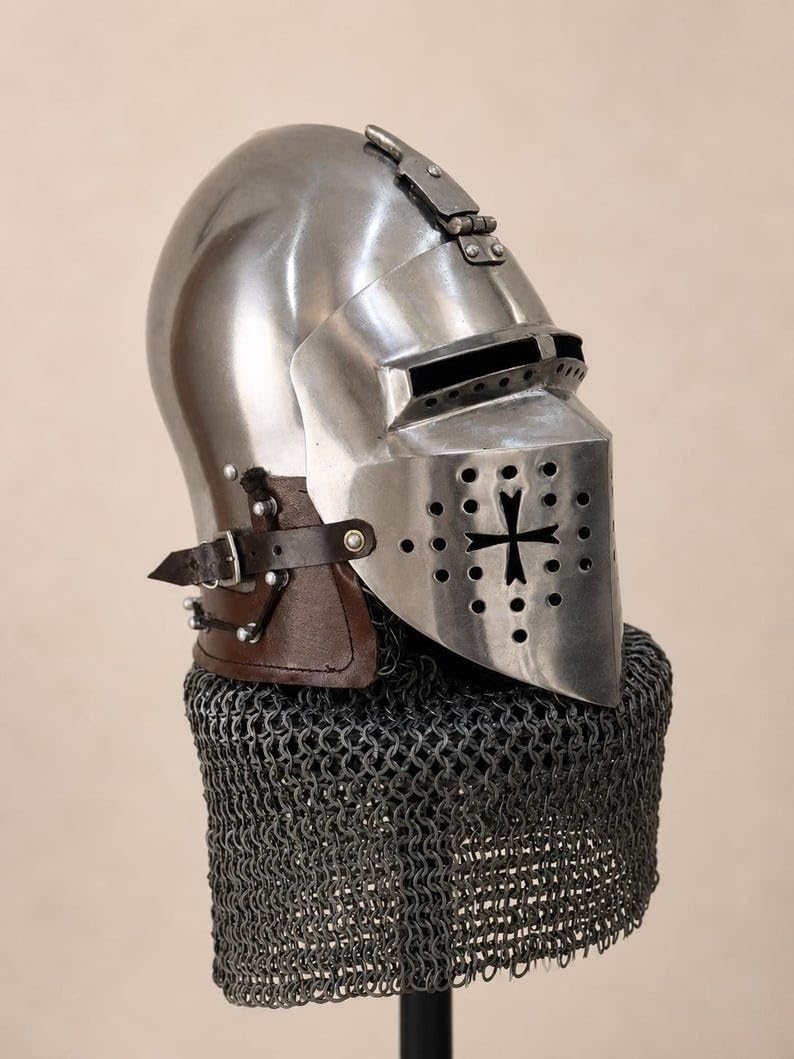
The bascinet was the most widely worn helmet of fourteenth-century Europe: an iron skull cap drawn up into a point, with a curtain of mail, the aventail, protecting the neck and shoulders. First worn beneath the great helm, it became a helmet in its own right and gained a hinged visor, drawn out into the sharp snout that gave the 'pig-faced' bascinet or hounskull its name. It was the helmet of the men-at-arms of the Hundred Years War, and its final form, the great bascinet, closed the head entirely in plate.
Also known as Basinet, bassinet, hounskull, pig-faced bascinet, klappvisier, great bascinet
Origins
In the later thirteenth century knights began to wear a small, close-fitting iron cap beneath the heavy, flat-topped Great Helm, and sometimes on its own. This was the bascinet. Through the early fourteenth century it grew taller and more pointed and extended down over the ears and the back of the neck, and many men-at-arms stopped wearing the great helm over it at all except in the tournament. By the middle of the century it was the standard helmet of European men-at-arms, from England and France to Italy and the German lands.
Design & Construction
The fourteenth-century bascinet is a single piece of iron raised into a tall, pointed skull that deflects blows downward and away. Around its lower edge a row of staples, called vervelles, carried a leather band from which hung the aventail, a curtain of mail protecting the throat, neck and shoulders. The face was protected by a visor. Early visors were hinged at the brow (the German klappvisier); later ones pivoted at the sides so they could be lifted. The characteristic late-fourteenth-century visor is drawn forward into a long, pointed snout pierced with breaths and sights, which deflected blows and gave room to breathe; the English called it the hounskull, and modern writers the "pig-faced" bascinet. In the early fifteenth century the mail aventail gave way to a plate gorget, producing the great bascinet that enclosed the head and neck entirely in steel.
Combat Use
The bascinet was the helmet of the long campaigns of the Hundred Years War. English and French men-at-arms wore it at the Battle of Crécy in 1346 and at Poitiers ten years later, and many of those who fought on foot at the Battle of Agincourt in 1415 wore visored or great bascinets. Its pointed shape and snouted visor gave excellent protection against cuts and arrows from the front, though the visor limited vision and breathing, and many men raised it or removed it altogether when not in close combat. The bascinet was worn with the Mail Hauberk and, increasingly, with plate armor for the body and limbs. Effigies and funeral brasses of the period show knights in bascinet and aventail almost without exception, which is why the helmet so often dates the monuments of fourteenth-century England.
Legacy
In the fifteenth century the bascinet was replaced by new forms — the armet in Italy and the sallet in Germany and England — worn with the full plate harness, such as Gothic Plate Armor. The pig-faced bascinet remains one of the most recognizable helmets of the Middle Ages and the signature of the fourteenth-century knight in art and film. Surviving examples, some still with their aventails, are held by collections such as the Royal Armouries, the Metropolitan Museum and the Wallace Collection.
Sources
Blair, Claude. European Armour, circa 1066 to circa 1700. Batsford, 1958.
Oakeshott, Ewart. A Knight and His Armour. Lutterworth Press, 1961.
Edge, David, and John Miles Paddock. Arms and Armour of the Medieval Knight. Bison Books, 1988.
Suggest an edit · account required · reviewed before publishing · how it works