Battle of Vítkov Hill
The Battle of Vítkov Hill was fought on 14 July 1420 on a ridge just east of Prague. A small Hussite garrison under Jan Žižka held a hastily fortified position against an attack by crusading knights of the army of King Sigismund, until a sortie from the city drove the attackers back down the slopes. The victory kept open Prague's supply route and helped break Sigismund's first crusade against the Hussites. The hill is now called Žižkov after the victor.
Also known as Battle of Vitkov Hill, Battle of Vítkov, Bitva na Vítkově, Battle of Žižkov, Battle of Zizkov Hill, Vítkov 1420, Siege of Prague 1420
Background
The Hussite movement grew out of the teaching of the Prague reformer Jan Hus, who was burned as a heretic at the Council of Constance in 1415. His followers demanded church reform and, above all, that ordinary believers receive both bread and wine at communion; their symbol was the chalice. In July 1419 radical Hussites threw councillors from the windows of the New Town Hall in Prague, and the death of King Wenceslaus IV a few weeks later left the crown to his brother Sigismund, King of Hungary and King of the Romans. Most Hussites refused to accept him. In March 1420 Pope Martin V proclaimed a crusade against the Bohemian heretics, and Sigismund gathered an army from across the Holy Roman Empire and beyond.
By late June the crusaders had reached Prague and camped around the city. Royalist garrisons held Prague Castle and the fortress of Vyšehrad, but the Old and New Towns were in Hussite hands, reinforced by radicals from Tábor under the one-eyed veteran soldier Jan Žižka. The size of Sigismund's army is uncertain; medieval figures of well over 100,000 are certainly exaggerated, and modern historians suggest a force of some tens of thousands. The crusaders' plan was to cut Prague off from the east, where the road from the countryside ran past a long, narrow ridge called Vítkov.
The Battle
Žižka saw the importance of the ridge and had it fortified with two wooden blockhouses, a ditch and walls of earth and stone. The garrison was small. Chronicle accounts put it at only a few dozen men and some women, and although the figures cannot be checked, there is no doubt it was heavily outnumbered. On 14 July a large body of crusader cavalry, mostly knights from Meissen and other German territories, crossed the river and attacked the ridge from the east, where the slope was easiest. They dismounted to storm the defenses. The defenders fought back with flails, spears, stones and missiles, and Žižka himself was in danger of being killed or captured before his men rescued him.
Reinforcements then arrived from Prague, led, according to the chronicles, by a priest carrying the sacrament. They struck the attackers in the flank while the garrison held its ground. The crusaders, crowded on the narrow ridge, panicked and fled. Many fell or were driven down the steep slopes. Several hundred crusaders are thought to have died, while Hussite losses were light. The main crusading army, camped across the river, did little to help.
Weapons
The Hussite defenders were mostly townsmen and peasants. Their best-known weapon was the Military Flail, adapted from the threshing flail. They also used spears, polearms, the Crossbow and side arms such as the Langes Messer. The Hussites were early users of firearms, including the Hand Cannon, and the large Hussite Pavise was already part of their equipment, but at Vítkov the position depended mainly on its earthworks. The crusaders were armored knights and men-at-arms in plate and mail, with the Bascinet as their common helmet. They were trained to fight with the Knight's Lance on horseback, but on the steep, narrow hilltop their cavalry could not charge.
Aftermath
The defeat badly damaged the morale of the crusade. Sigismund had himself crowned King of Bohemia in St Vitus Cathedral in Prague Castle on 28 July, but his army, divided and short of supplies, soon broke up. In November 1420 the Hussites defeated a royal relieving force at Vyšehrad. The victory at Vítkov made Žižka the leading Hussite commander, and over the next years he developed the wagon-fort tactics that defeated crusade after crusade during the Hussite Wars. The hill took the name Žižkov, and in the twentieth century a national memorial was built on it with a huge bronze equestrian statue of Žižka by the sculptor Bohumil Kafka.
Weapons used
-
Military Flail
Hussite townsmen and peasants fought with flails converted from farm tools, the weapon most associated with the movement. Continued…
-
Crossbow
Crossbows were the main missile weapon of both the Hussite defenders and the crusading army. Continued…
-
Knight's Lance
The Meissen and German knights who attacked the hill came as heavy cavalry but had to dismount on the steep ground. Continued…
-
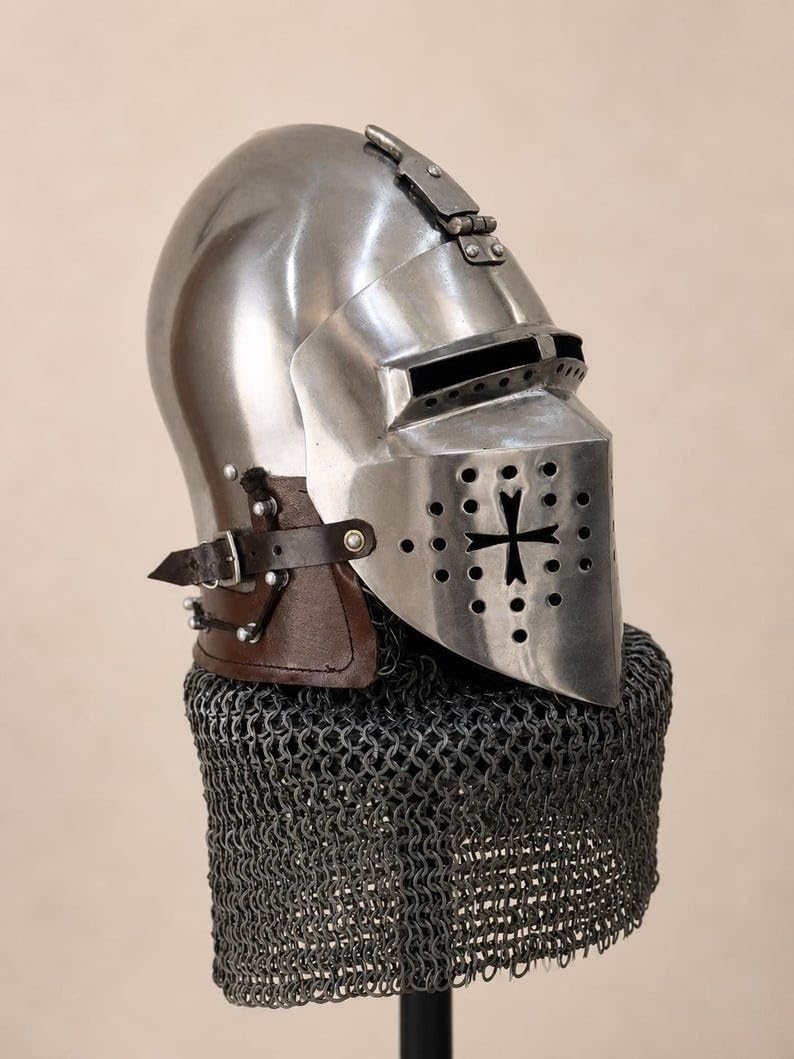
Bascinet
The bascinet was the most common helmet of the knights and men-at-arms of the crusading army in 1420. Continued…
-
Hussite Pavise
Pavises were already part of Hussite equipment in 1420, although at Vítkov the defenders relied mainly on earthworks and blockhouses. Continued…
-
Hand Cannon
The Hussites were early users of handguns, though their role in this particular action is not clearly recorded. Continued…
-
Langes Messer
Single-edged long knives of the Messer type were common side arms among Bohemian infantry of the period. Continued…
Sources
Heymann, Frederick G. John Žižka and the Hussite Revolution. Princeton University Press, 1955.
Fudge, Thomas A. The Crusade against Heretics in Bohemia, 1418-1437. Ashgate, 2002.
Šmahel, František. Die Hussitische Revolution. Hahnsche Buchhandlung, 2002.
Turnbull, Stephen. The Hussite Wars 1419-36. Osprey, 2004.
Suggest an edit · account required · reviewed before publishing · how it works