Origin
Holy Roman Empire
The Holy Roman Empire was a fragmented political entity whose member states produced varied weapons traditions. German swordsmanship schools (Fechtbücher) were highly influential, and German and Austrian armorsmiths produced some of the finest plate armor in Europe.
Overview
The Holy Roman Empire (962–1806) was a loose confederation of German, Italian, Czech, and other Central European states under an elected Emperor. Its weapon traditions reflect this diversity — German swordsmiths and armorsmiths in Augsburg, Nuremberg, Solingen, and Milan (when part of the empire) produced some of the finest arms in the world.
Armorsmiths
Augsburg and Nuremberg were the twin centers of German plate armor production. Master armorsmiths — Kolman Helmschmid, Jörg Seusenhofer — produced armor for emperors and kings across Europe. The Gothic plate armor style, with its distinctive fluted surfaces and vertical ridges, is associated with German smiths of the 15th century.
Milanese armorsmiths produced the competing Milanese style — rounder, smoother, arguably more practical.
Landsknechts
The Landsknechts were German mercenary infantry who dominated European battlefields from roughly 1490 to 1620. Armed with pikes, arquebuses, and (for elite Doppelsöldner) the enormous Zweihänder, they fought across Italy, France, and the Holy Roman Empire. Their distinctive slashed-clothing fashion influenced civilian dress across Europe.
Fencing Traditions
The German school of swordsmanship (Kunst des Fechtens) is among the most thoroughly documented medieval martial art. Master Johannes Liechtenauer's teachings (c. 1350) were recorded by multiple students and preserve a comprehensive system for the longsword, messer, dagger, spear, and mounted combat. Later masters Hans Talhoffer and Joachim Meyer built on this tradition.
Artillery
The Holy Roman Empire's gunpowder era saw significant artillery development. The siege of Constantinople (1453) — while Ottoman — used cannon cast in part by Christian engineers working in HRE territories. Imperial forces used artillery extensively in the Italian Wars and Thirty Years War.
This article is a stub.
Battles & Operations
-
Battle of Vítkov Hill (14 July 1420)
The Battle of Vítkov Hill was fought on 14 July 1420 on a ridge just east of Prague. A small Hussite garrison under Jan Žižka held a… Continued…
-
Battle of Breitenfeld (17 September 1631 (7 September Old Style))
The Battle of Breitenfeld, fought north of Leipzig on 17 September 1631, was the first great victory of Gustavus Adolphus of Sweden in the… Continued…
-
Battle of Vienna (12 September 1683)
The Battle of Vienna, fought on 12 September 1683, ended the second Ottoman siege of the Habsburg capital. The Grand Vizier Kara Mustafa… Continued…
Weapons
-
Arbalest
The arbalest was the heavy crossbow of the late Middle Ages, with a bow of steel or thick composite so powerful it had to be drawn with a… Continued…
-
Arming Sword
The arming sword was the one-handed, double-edged sword of the medieval knight, carried from the eleventh to the fifteenth century with a… Continued…
-
Arquebus
The arquebus was the first practical infantry firearm, a matchlock long gun light enough to be fired from the shoulder or chest without a… Continued…
-
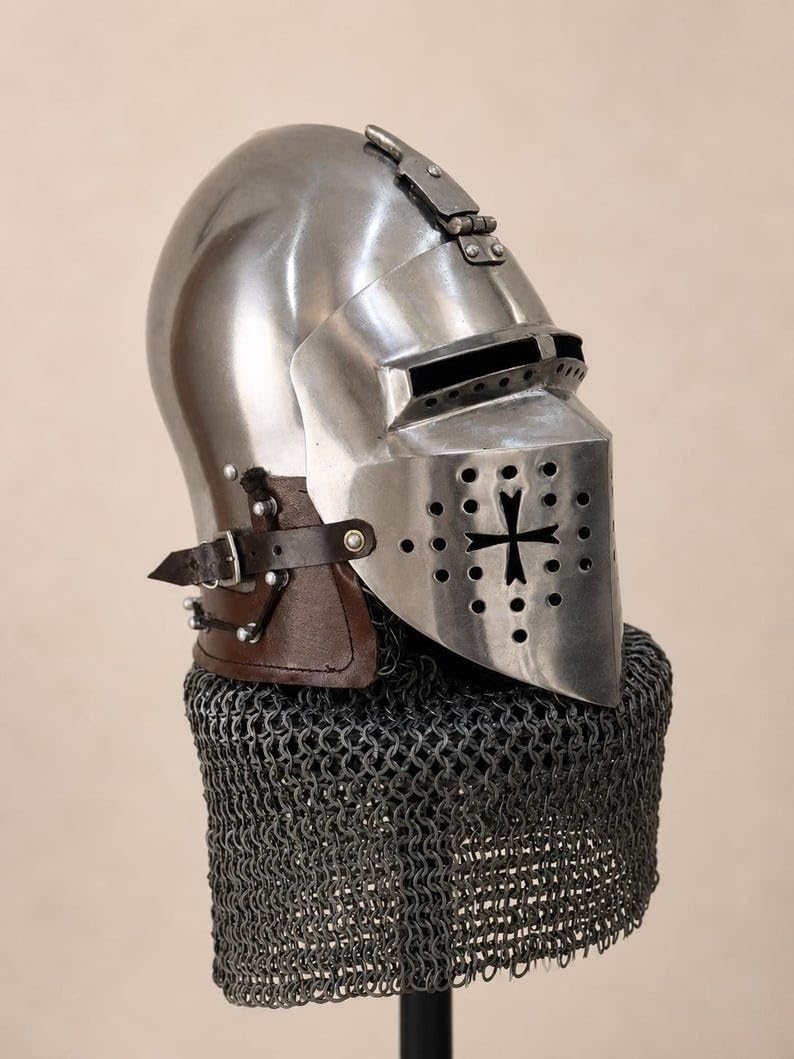
Bascinet
The bascinet was the most widely worn helmet of fourteenth-century Europe: an iron skull cap drawn up into a point, with a curtain of mail… Continued…
-
Cuirassier Armor
Cuirassier armor was the three-quarter plate armor worn by heavy cavalry in Europe from the late sixteenth century to the middle of the… Continued…
-
Estoc
The estoc was a sword made to defeat plate armor: a long, stiff blade with no real cutting edge, triangular, square or diamond in section… Continued…
-
Glaive
The glaive is a European pole arm made of a single-edged blade, shaped like a large knife or cleaver, mounted on a shaft of about six to… Continued…
-
Gothic Plate Armor
Gothic armor is the name collectors give to the full plate harnesses made in the German lands of the Holy Roman Empire from roughly 1460 to… Continued…
-
Great Helm
The great helm was the fully enclosed, flat-topped or sugarloaf helmet of the high medieval knight, worn from around 1220 until the mid… Continued…
-
Halberd
The halberd combined axe blade, thrusting spike, and back hook on a two-meter haft — a complete toolkit for infantry facing armored… Continued…
-
Hussite Pavise
The Hussite pavise was a large rectangular shield used by the Hussite armies of Bohemia in the fifteenth century. Tall enough to cover a… Continued…
-
Jäger Rifle
The Jäger rifle was the short, heavy-barreled flintlock hunting rifle of the German lands, carried in war by the light troops called Jäger… Continued…
-
Kettle Hat
The kettle hat was an open-faced iron or steel helmet with a wide brim, known in French as the chapel de fer, the iron hat. It appeared in… Continued…
-
Landsknecht Zweihänder
The zweihänder was the great two-handed sword of the German Landsknecht mercenaries: up to 1.8 meters of steel with side rings, parrying… Continued…
-
Langes Messer
The Langes Messer, German for long knife, was a single-edged sword used in the German lands and Central Europe from the fourteenth to the… Continued…
-
Lobster-Pot Helmet
The lobster-pot helmet was the standard helmet of European light-armored cavalry in the seventeenth century. Known in German as the… Continued…
-
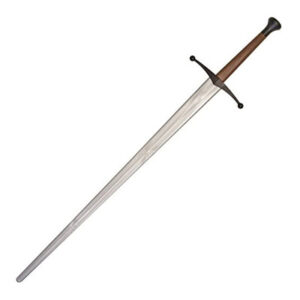
Longsword
The longsword is the two-handed knightly sword of the late Middle Ages and Renaissance: a straight, double-edged blade of roughly 33 to 43… Continued…
-
Military Flail
The military flail was a two-handed weapon made from the farmer's threshing flail: a long wooden haft joined by a hinge or short chain to a… Continued…
-
Morning Star
The morning star is a spiked club: a wooden or iron shaft topped with a heavy ball or cylinder studded with steel spikes, used across… Continued…
-
Pappenheimer Rapier
The Pappenheimer is a type of rapier or heavy cut-and-thrust sword of about 1620-1650, recognized by the two large dished shells, usually… Continued…
-
Pike
The pike is the longest infantry weapon ever carried in formation: an ash shaft of 16 to 22 feet tipped with a small steel head, used by… Continued…
-
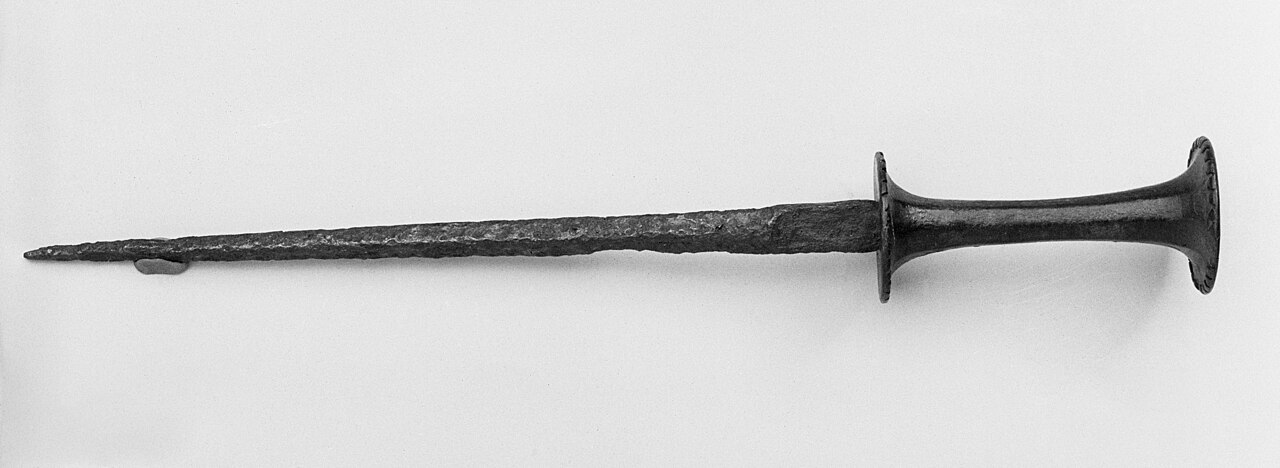
Rondel Dagger
The rondel dagger was the stiff, needle-pointed dagger of the late medieval knight, named for the disc-shaped guard and pommel that framed… Continued…
-
War Hammer
The war hammer is the late medieval answer to plate armor: a steel head with a blunt, often toothed hammer face on one side and a stout… Continued…