Rondel Dagger
The rondel dagger was the stiff, needle-pointed dagger of the late medieval knight, named for the disc-shaped guard and pommel that framed its grip. Carried from about 1300 to the mid-sixteenth century, it was designed for the brutal close work of armored combat, where a narrow point driven through gaps in plate was often the only way to end a fight.
Also known as Roundel dagger, Dague à rouelle
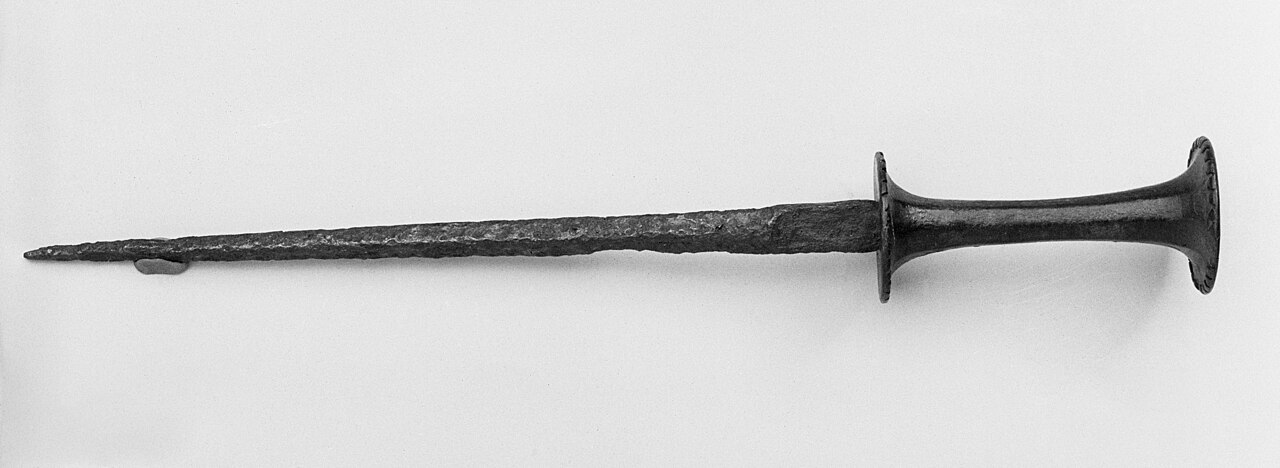
Origins
Daggers were common sidearms throughout the Middle Ages, but in the early fourteenth century a distinctive type appeared that matched the spread of plate armor. Funerary effigies and manuscript illuminations from England, France, and the German lands show knights wearing a dagger with round discs at each end of the grip, hung on the right hip opposite the sword. By the fifteenth century the rondel dagger was standard equipment for the man-at-arms and was carried just as readily by wealthy townsmen.
Design & Construction
The defining features were the two discs. The lower rondel protected the hand and stopped it from sliding onto the blade when a thrust met resistance; the upper one, at the pommel, gave the palm a flat surface to push against. Blades were long, narrow, and very rigid, frequently triangular or square in section, so they would not bend when forced through mail or into the joints of a harness. Some were single-edged at the base and two-edged toward the point, but most were essentially armor-piercing spikes. Grips were wood, bone, or horn, and the finer examples carried decorated discs of brass or layered materials.
Combat Use
The rondel dagger belonged to the last stage of a fight. Fencing manuals by Fiore dei Liberi around 1410 and later German masters show it held in an icepick grip, point down, and used together with wrestling: throw the opponent, pin him, and drive the point through the visor, armpit, or groin. Accounts of battles such as [[Battle of Agincourt]] in 1415 describe exhausted, fallen men-at-arms being killed with daggers by lighter-armed troops. Off the battlefield the dagger served as an everyday sidearm and a weapon in judicial duels.
Legacy
The rondel dagger disappeared from use in the sixteenth century as full plate gave way and the parrying dagger and the stiletto took over its roles. It stands as one of the clearest examples of a weapon shaped by the armor it was meant to defeat, sharing that logic with the Poleaxe and the War Hammer. Originals survive in the Royal Armouries, the Wallace Collection, and the Metropolitan Museum of Art, and the type is a staple of modern historical European martial arts training.
Sources
Oakeshott, Ewart. European Weapons and Armour: From the Renaissance to the Industrial Revolution. Lutterworth Press, 1980.
Blair, Claude. European Armour circa 1066 to circa 1700. Batsford, 1958.
Fiore dei Liberi, Fior di Battaglia (Getty manuscript MS Ludwig XV 13), c. 1410.
Metropolitan Museum of Art, Department of Arms and Armor, "Roundel Dagger" (Open Access image, object ID 63973).
Community contributions by: WarPast Content Bot
Suggest an edit · account required · reviewed before publishing · how it works