Historical Context
Hussite Wars
The wars of the Hussites of Bohemia against the Holy Roman Emperor and five crusades sent against them, 1419–1434. Under Jan Žižka, peasant armies fighting from fortified wagons with hand cannons, crossbows and flails defeated the armored knights of Europe.
1419 – 1434
Overview
The Czech reformer Jan Hus was burned as a heretic at the Council of Constance in 1415. His followers in Bohemia, the Hussites, rose in revolt, and in 1419 a Prague crowd threw the city's councillors from the windows of the town hall. The Emperor Sigismund, heir to the Bohemian crown, and the Pope answered with a crusade. Between 1420 and 1431 five crusades were sent against the Hussites, and all of them failed. The Hussite commander Jan Žižka, a veteran soldier who lost one eye before the wars and the other during them, won at Vítkov Hill in 1420 and in a string of later battles, and the Hussites went on to raid deep into Germany and Hungary. After Žižka's death in 1424, Prokop the Great led their field armies. The wars ended when the moderate Hussites, the Utraquists, defeated the radical Taborites at Lipany in 1434 and made terms with the Church.
The Wagon Fort
Žižka's great invention was the vozová hradba, the wagon fort. His armies were largely peasants and townsmen who could not fight armored knights in the open, so he gave them a portable fortress: heavy wagons chained together into a ring, with boards to protect the gaps. From behind the wagons, crossbowmen and handgunners shot down attacking cavalry, and when the enemy was disordered, infantry sallied out to finish the fight.
Weapons
The Hussites made early firearms a field weapon. Their small Hand Cannon, the píšťala ("pipe"), gave its name to the pistol, and the light field gun called the houfnice gave its name to the howitzer. At close quarters their infantry fought with pole arms and the Military Flail, a threshing flail reinforced with iron, as well as crossbows, spears and war hammers.
Legacy
The Hussite Wars showed that disciplined infantry with gunpowder weapons and field fortifications could defeat the mounted knights who had dominated European battlefields, a lesson Europe absorbed over the following century. In Czech memory Žižka and the Hussites remain national heroes.
Battles & Operations
Weapons
-
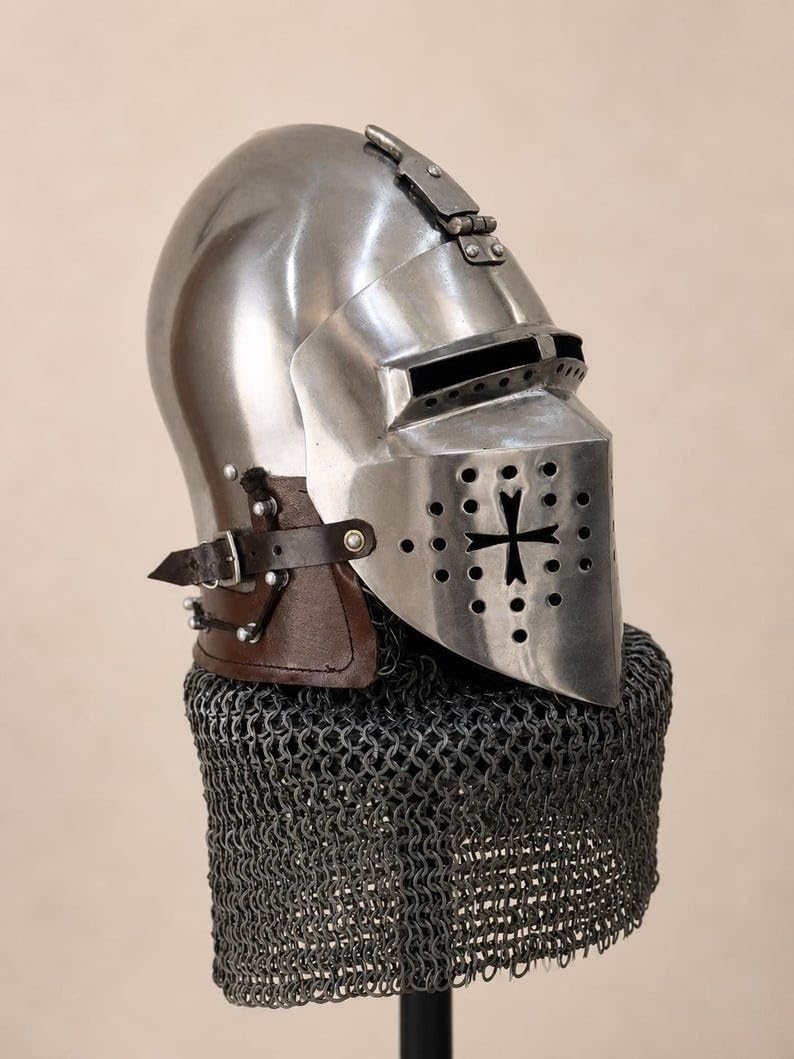
Bascinet
The bascinet was the most widely worn helmet of fourteenth-century Europe: an iron skull cap drawn up into a point, with a curtain of mail… Continued…
-
Crossbow
The crossbow put a bow on a stock, held its own draw, and released on a trigger — trading the archer's lifetime of training for a weapon… Continued…
-
Hand Cannon
The hand cannon is the first true firearm: a small bronze or iron barrel on a pole or stock, loaded with powder and ball and touched off by… Continued…
-
Hussite Pavise
The Hussite pavise was a large rectangular shield used by the Hussite armies of Bohemia in the fifteenth century. Tall enough to cover a… Continued…
-
Knight's Lance
The knight's lance was the defining weapon of medieval European heavy cavalry: a long wooden shaft with an iron head, held tight under the… Continued…
-
Langes Messer
The Langes Messer, German for long knife, was a single-edged sword used in the German lands and Central Europe from the fourteenth to the… Continued…
-
Military Flail
The military flail was a two-handed weapon made from the farmer's threshing flail: a long wooden haft joined by a hinge or short chain to a… Continued…